Most professional services firms believe their client relationships are in good shape — until the evidence says otherwise. A referral source goes quiet. A former client surfaces at a competitor. A partner conversation that generated real momentum simply stops.
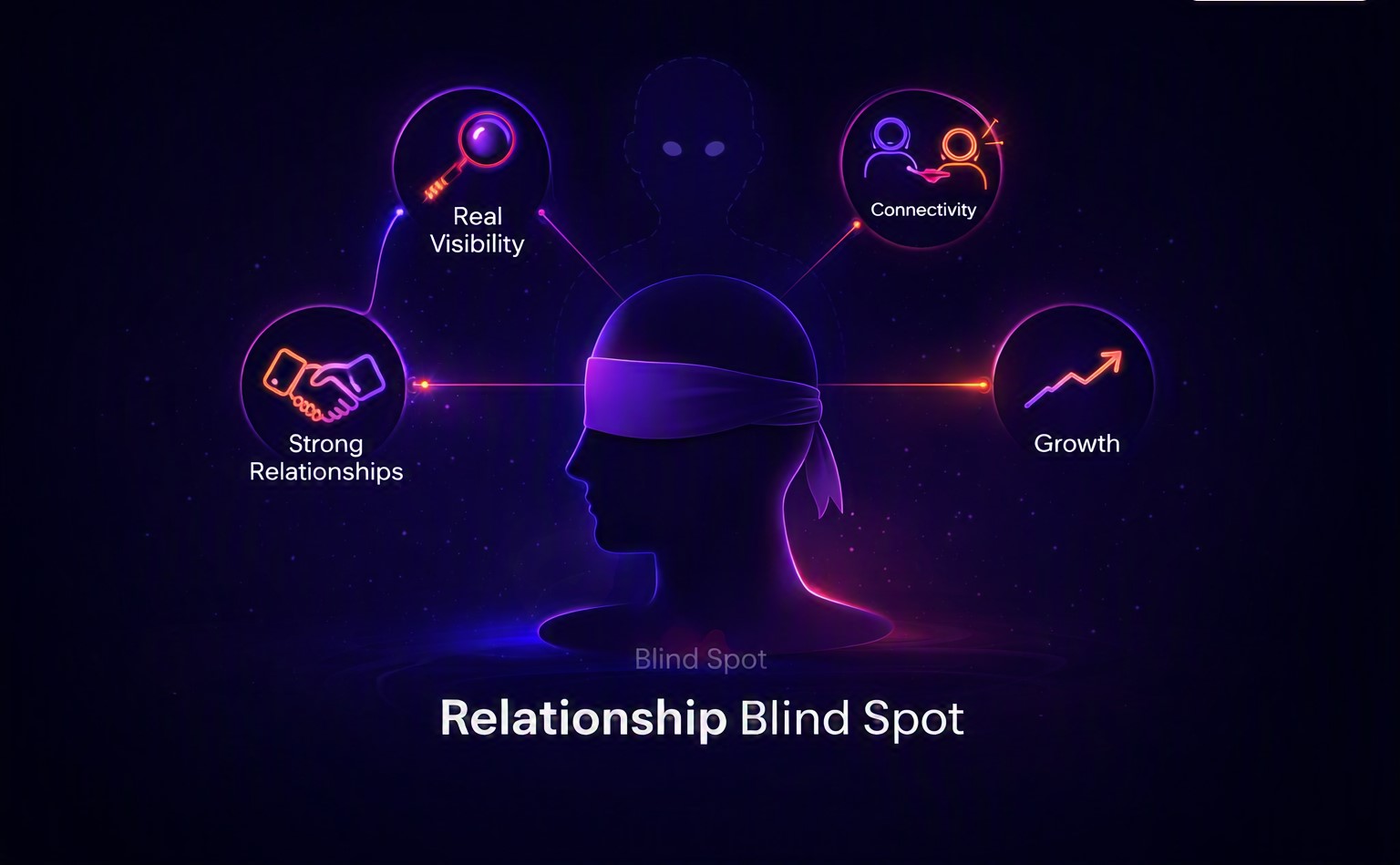
The Relationship Blind Spot is the gap between the relationships your firm depends on for growth and the relationships your firm can actually see, track, and actively progress. If your firm grows through relationships, this is the single most expensive problem you’re not measuring.
What Is the Relationship Blind Spot?
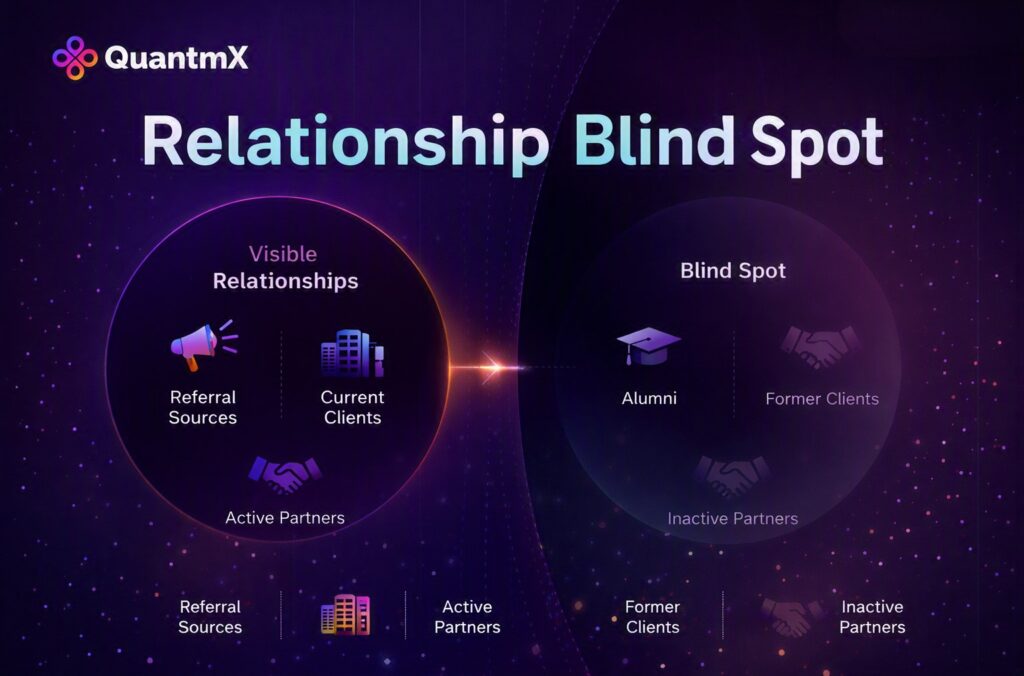
The Relationship Blind Spot is the portion of your firm’s growth-critical relationship network that exists outside any structured system — or inside a system but not being actively progressed. It typically includes:
- Former clients who became decision-makers at new firms
- Referral sources whose introductions have slowed
- Partners whose joint engagements stalled after the second call
- Alumni who moved on but remain valuable connections
These relationships are real and the intent to maintain them is genuine. But without Relationship Intelligence — the capability to detect signals, surface what matters, and drive the right next action — they drift silently and stop generating revenue.
For over half of consultants, 60% of their business comes via referral. When those relationships are invisible to the firm, the revenue consequences compound quietly.
Why the Relationship Blind Spot Is Getting Worse
The professional services market is under structural pressure:
- Industry-wide EBITDA in 2025 sits at 9.9%, against a five-year average of 13.8% — a 28% collapse
- The percentage of new clients firms attracted fell to 29.3% in 2024, from 31.3% in 2023
- Client retention and account expansion are becoming the primary growth lever, not a backup plan
Growth through existing relationships — referrals, alumni, repeat engagements, partner introductions — is exactly where the Relationship Blind Spot breaks down.
The 5 Signs
Sign 1: Your Most Important Relationships Live in Someone’s Inbox
The partner who manages your top accounts keeps contact history in email. A senior consultant who left last year took their top client relationship with them — because it was never captured anywhere the firm could see.
- When a team member leaves, the relationships leave with them
- When a senior partner is unavailable, the account goes dark
- When a client calls to continue a conversation, nobody else has context
This is a Business Relationship Management failure, not an information problem: more than 40% of professional services firms missed recent revenue targets, with lack of visibility cited as a leading cause.
Sign 2: You Cannot Tell Which Referral Relationships Are Active
Referral relationships decay silently — no breakup, no complaint, just a gradual drop in introductions nobody notices until the revenue impact is undeniable.
- The firm knows referrals matter: more than half of businesses (54%) found their professional services firm through a referral or recommendation
- Knowing that isn’t the same as tracking which referral relationships are active, fading, or need a touchpoint right now
If you can’t answer “which referral sources are active right now, and when did we last contact them?” — you have a Relationship Blind Spot.
Sign 3: Former Clients Are Not Being Actively Managed
A client completes a project, the engagement was strong, but contact frequency drops to zero the moment it closes. Six months later, that client takes a senior role at a target account — and nobody at the firm knew.
- Former clients already trust the firm and know the quality of the work
- They’re dramatically easier to re-engage than a cold prospect — but only if maintained
- Referred customers carry an average of 16% higher lifetime value than clients acquired through other channels
Former clients who feel forgotten don’t come back. Former clients who get consistent, relevant touchpoints become repeat clients and referral sources.
Sign 4: Partner and Alumni Relationships Stall After the First Few Conversations
Two calls happen, both sides express real interest, then the conversation is never picked back up — not because interest faded, but because nobody owned what happens after call two.
- 63% of consultants cite networking and referrals as their most powerful marketing channel
- Networking without follow-through is just conversation
- The gap between a promising conversation and a productive relationship is almost always a system gap, not a relationship gap
Sign 5: Your Growth Depends on Who Is in the Room
The firm grows when a particular senior partner is active in business development. When that partner is heads-down on delivery — or on leave — the pipeline slows or stops.
- One person knows which relationships to activate for which opportunities
- One person remembers which former client is ready to re-engage
- High-performance professional services organizations are 19% more visible across their organizations than the rest of the market — and that visibility is structural, not individual
This is the most dangerous version of the Blind Spot because it feels like a strength — until that person leaves, and the relationship network they carried goes with them.
How to Know If Your Firm Has a Relationship Blind Spot
Ask your leadership team:
- Can you name your top ten referral sources and when each was last contacted?
- Do you have a system that flags former clients not engaged in 90+ days?
- When a team member leaves, does the firm retain relationship context — or does it leave with them?
- Can you identify which partner or alumni conversations have stalled, and who owns the next step?
- If your most relationship-active partner were unavailable for six months, how would the pipeline be affected?
If any of these can’t be answered with data, the fix is systems, not effort.
What Closing the Relationship Blind Spot Looks Like- The Key Takeaway
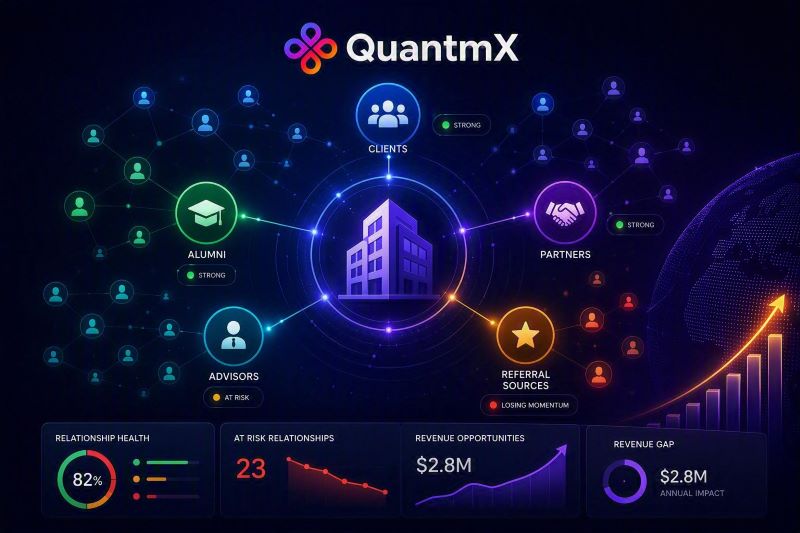
QuantmX is the first Relationship Growth Platform built specifically for professional services firms. It brings every growth-critical relationship — clients, alumni, partners, referral sources, advisors — into one system and keeps each one actively progressing through its Relationship Intelligence Engine:
- Complete visibility across the full relationship network, not just the pipeline
- Automatic detection of relationships losing momentum before revenue is affected
- Clear ownership and suggested next steps for every growth-critical relationship
- Shared institutional knowledge that stays in the firm when people leave
- A Revenue Gap calculation showing what the Blind Spot is costing your firm annually
Calculate your Revenue Gap → or apply for early access to see what your firm’s Blind Spot is costing you.
Frequently Asked Questions
What is a Relationship Blind Spot in professional services?
A Relationship Blind Spot is the portion of a firm’s growth-critical relationship network that exists outside any structured system, or inside a system but not actively progressed. It typically includes:
- Former clients who moved to new decision-making roles
- Referral sources whose introductions have quietly slowed
- Alumni and partners whose relationships never got formal ownership
It’s the financial cost of that invisibility, and it compounds the longer it goes unmeasured.
How do I know if my firm has a Relationship Blind Spot?
The clearest signs show up as gaps in visibility rather than gaps in effort:
- Key relationships living in individual inboxes, not a shared system
- No visibility over which referral sources are active
- Former clients not being proactively engaged
- Partner conversations that stall after the first two meetings
- Growth that depends on one or two senior people rather than firm-wide infrastructure
If your firm can check more than one or two of these, the Blind Spot is likely already costing revenue.
What causes relationship management problems in consulting firms?
Relationship management problems in consulting firms are almost always a systems problem, not a people problem. When relationship data lives in:
- Individual inboxes
- Personal spreadsheets
- The memory of senior partners
…consistency, follow-through, and visibility become impossible at scale, no matter how skilled the individual relationship-builders are.
What are the symptoms of a Relationship Blind Spot?
Common symptoms cluster around silent decay rather than obvious failure:
- Referral sources going quiet without explanation
- Former clients re-engaging with competitors instead
- Partner conversations losing momentum after the second call
- Institutional relationship knowledge leaving with departing partners
- Revenue growth dependent on individual effort rather than firm-wide infrastructure
What is Relationship Intelligence, and how does it help?
Relationship Intelligence is the capability to detect signals across a firm’s full relationship network, interpret what those signals mean for growth, and surface the right next action automatically. In practice, it turns a passive system of record into an active system of progression by:
- Flagging relationships losing momentum before revenue is affected
- Assigning clear ownership to every growth-critical relationship
- Surfacing the next best action instead of relying on memory
What is Business Relationship Management for professional services firms?
Business Relationship Management is the discipline of actively managing the full network of relationships that drive business outcomes — not just the customer pipeline. For a professional services firm, that network includes:
- Clients (active and dormant)
- Alumni
- Partners
- Referral sources
- Advisors and investors
It’s the operational foundation of relationship-led growth, rather than a nice-to-have layered on top of sales.
How does the Relationship Blind Spot show up in law firms?
Law firm growth depends on relationships a legal CRM typically never captures. The Blind Spot shows up as:
- Referring attorneys at other firms whose introduction volume has quietly dropped
- Former partners who moved in-house and became client-side decision-makers
- Alumni who landed general counsel roles at potential client companies
- Bar association and professional network contacts with no assigned owner
How does the Relationship Blind Spot affect accounting and advisory firms?
Accounting firms face a compounding version of the problem because of seasonal client cycles and high partner turnover. Typical blind spots include:
- Clients active during tax season with no contact since
- Referral sources who have quietly stopped sending audit or advisory work
- Dormant clients from prior engagement cycles with no re-engagement owner
- Partner-level relationships that exist only in one inbox
How does the Relationship Blind Spot affect marketing and creative agencies?
Agency growth runs on relationships outside the active retainer list — and most of those have no formal owner. The Blind Spot typically includes:
- Former clients who move to new companies and become buyers again
- Freelancer and subcontractor networks tied to specific accounts
- Referral partnerships with complementary agencies
- Past pitch contacts who went cold but were never formally closed out
How does the Relationship Blind Spot affect wealth management and financial advisory firms?
In wealth management, the relationships most likely to drive new assets under management are also the ones most likely to live only in one advisor’s head:
- Referral sources such as CPAs, estate attorneys, and other centers of influence
- Dormant prospects and former clients who left during a life transition
- Introductions that never converted but remain warm
- Advisor-level relationships with no firm-wide visibility
How does the Relationship Blind Spot affect engineering and architecture firms?
Because engineering and architecture work is episodic, the relationship often goes cold between projects even when trust is fully intact. Common blind spots include:
- General contractors and developers from past projects
- Past clients likely to commission follow-on work
- Referral partners in adjacent disciplines
- Project-based contacts with no post-delivery touchpoint plan
Is the Relationship Blind Spot the same as poor CRM data hygiene?
No — they’re related but distinct problems. CRM data hygiene is about accuracy: are the fields filled in correctly, are duplicates merged, is contact information current. The Relationship Blind Spot is broader:
- It includes relationships that were never entered into any system at all
- It covers relationships that are logged but never actively progressed
- Clean CRM data can still leave a firm blind if nobody owns the next action
Fixing data hygiene alone won’t close the gap if relationships still lack ownership and progression.
How long does it take to close a Relationship Blind Spot with QuantmX?
Most firms see the shape of their Blind Spot immediately, since the Revenue Gap calculation runs on the firm’s own numbers in under 90 seconds. From there, closing it is a gradual, ongoing process rather than a one-time fix:
- Initial visibility into the full relationship network typically emerges in the first few weeks
- Ownership assignment and health-signal tracking build over the following month
- Measurable revenue recovery compounds over subsequent quarters as dormant relationships re-engage