
For professional services firms, relationships are not just a soft business asset—they are often the engine behind referrals, repeat engagements, introductions, partnerships, and long-term revenue.
Yet most firms still manage relationships by memory, spreadsheets, CRM notes, and individual partner networks.
That creates a fundamental problem: you may know who your clients are, but do you know which relationships are healthy, which are weakening, and which deserve attention right now?
This is where relationship health scoring becomes valuable.
A relationship health score turns relationship activity and signals into a practical measure of relationship strength. Instead of asking, “When did we last speak to this client?”, firms can ask a more useful question: “Is this relationship moving forward—or quietly losing momentum?”
For firms that depend heavily on relationships, this distinction can directly influence retention, referrals, and growth.
And increasingly, relationship intelligence platforms such as QuantmX are helping firms move beyond simply recording relationships toward actively managing and progressing them.
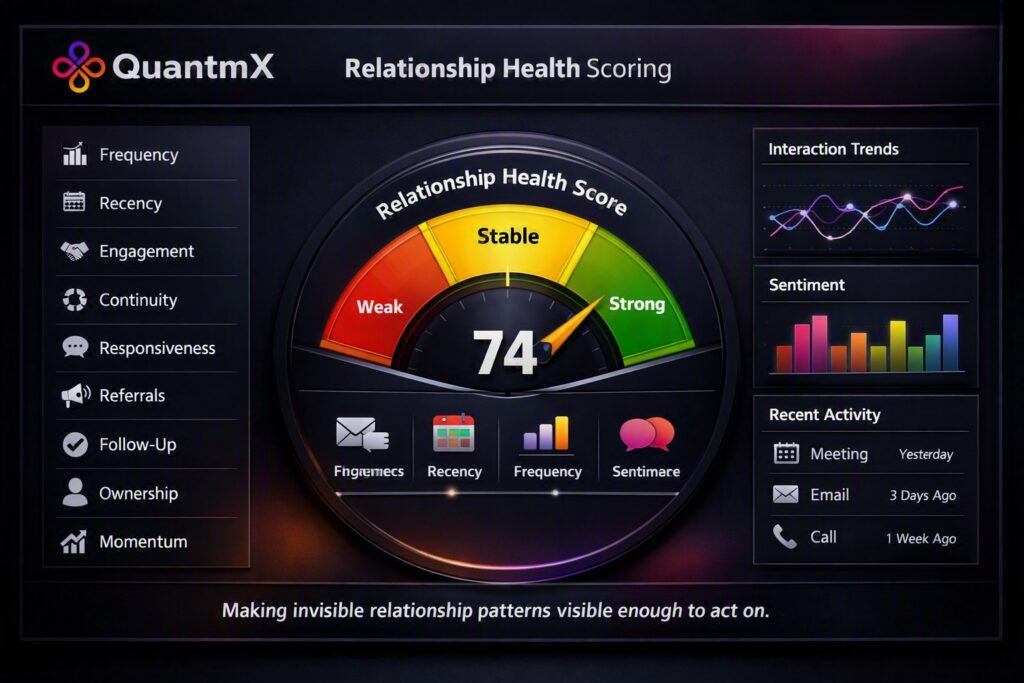
What Is a Relationship Health Score?
A relationship health score is a measurement that indicates the current strength, momentum, and risk level of a business relationship.
In simple terms:
A relationship health score tells you whether a relationship is strong, stable, weakening, or at risk—and where your team should focus next.
A useful score can consider signals such as:
- Frequency of interactions
- Recency of communication
- Meeting and engagement patterns
- Relationship continuity
- Changes in client or contact roles
- Responsiveness
- Referral activity
- Follow-up consistency
- Ownership of the relationship
- Momentum toward the next interaction or opportunity
The goal is not to reduce a complex human relationship to a single number.
The goal is to make invisible relationship patterns visible enough to act on.
That distinction matters.
A traditional CRM may tell you that a client exists and show you the history of previous interactions. Relationship health scoring asks what that history means today.
Why Relationship Health Scoring Matters for Professional Services
Professional services firms operate differently from transactional businesses.
A consulting firm, law firm, accounting practice, advisory firm, agency, or specialist consultancy may generate significant revenue from a relatively small network of relationships.
- One former client may become a buyer again.
- One partner may introduce multiple opportunities.
- One senior executive may move companies and take an existing relationship into a new organization.
- One referral source may influence a significant portion of annual business.
This means relationship deterioration can be expensive—even when there is no immediate indication in the sales pipeline.
Consider a simple example.
A former client has not engaged with your firm for 14 months. Your CRM may simply classify them as an inactive contact.
But suppose that person has recently:
- moved into a senior decision-making position,
- joined a company that fits your ideal client profile, and
- remained connected to several people at your firm.
The relationship may actually have increased in potential value despite appearing inactive in a conventional CRM.
This is the type of insight that relationship intelligence and relationship analytics are designed to surface.
How Does Relationship Health Scoring Work?
Relationship health scoring generally works by combining multiple relationship signals into a structured assessment.
A simplified framework looks like this:
Relationship Health = Recency + Frequency + Engagement + Continuity + Momentum + Strategic Value
The exact weighting should depend on the firm’s business model.
For example, a professional services firm could evaluate:
1. Recency
When was the last meaningful interaction?
A relationship that has gone untouched for 18 months may require attention even if it was historically strong.
2. Frequency
How consistently are interactions taking place?
A relationship with regular, meaningful contact is generally healthier than one that only receives occasional generic outreach.
3. Engagement
Are both sides participating?
A series of unanswered emails is not equivalent to an active conversation.
4. Continuity
Does the relationship have more than one point of connection?
If only one partner knows the client, the relationship may be vulnerable even when it appears strong.
5. Momentum
Is there a clear next step?
A healthy relationship should not simply have a history. It should have forward movement.
6. Strategic Value
What could this relationship contribute to the firm?
This could include:
- Future revenue
- Repeat business
- Referrals
- Partnerships
- Market access
- Introductions
- Industry influence
The most useful relationship health models combine relationship strength with business relevance.
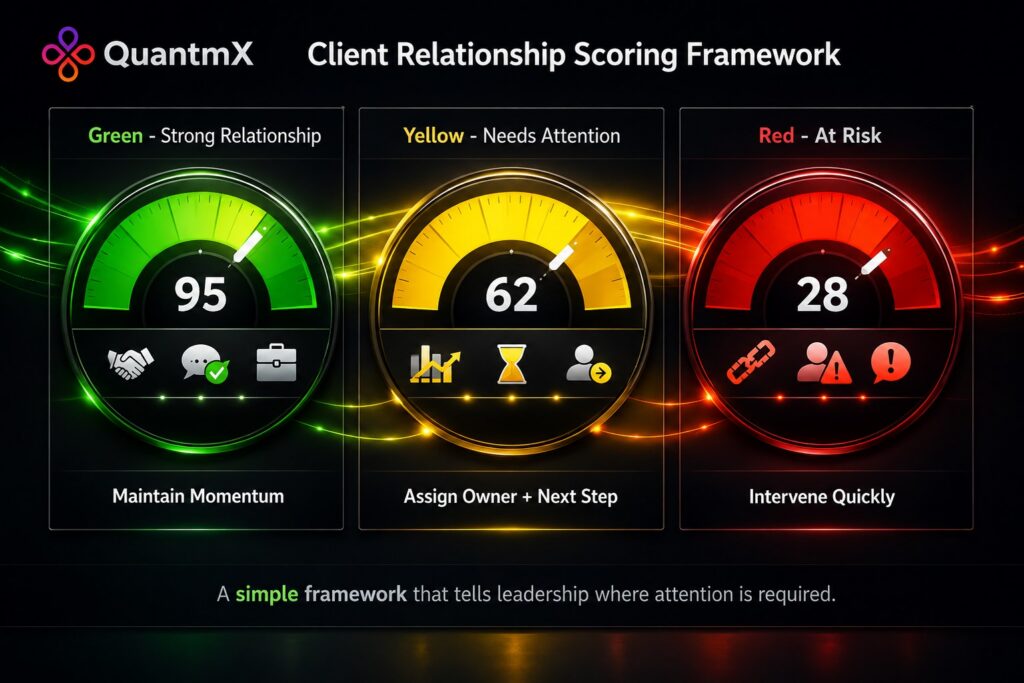
How to Score Client Relationships: A Practical Framework
If you are wondering how to score client relationships, avoid creating an unnecessarily complicated scoring model.
Start with four practical categories.
Green: Strong Relationship
A green relationship typically has:
- Recent meaningful interaction
- Regular engagement
- Multiple points of contact
- Clear ownership
- Strong responsiveness
- A logical next step
Recommended action: Maintain momentum and identify expansion, referral, or strategic opportunities.
Yellow: Relationship Needs Attention
A yellow relationship may show:
- Declining interaction frequency
- Longer response times
- No clear next action
- Limited relationship coverage
- Reduced engagement
Recommended action: Assign an owner and create a specific next step.
Red: Relationship at Risk
A red relationship may show:
- Long periods without meaningful interaction
- Broken follow-ups
- No identifiable relationship owner
- Declining engagement
- Key contact changes
- Heavy dependence on one individual
Recommended action: Intervene quickly before the relationship becomes commercially difficult to recover.
This simple framework gives leadership teams something more useful than a dashboard full of activity metrics.
It tells them where attention is required.
Relationship Strength Measurement vs. Activity Tracking
This is an important distinction.
A common mistake is assuming that more activity automatically means a healthier relationship.
It does not.
For example:
Client A
- 20 emails
- 4 meetings
- Multiple stakeholders involved
- Clear next project
Client B
- 40 automated emails
- No meetings
- No responses
- No relationship owner
Client B has more recorded activity.
But Client A may have significantly greater relationship strength.
That is why effective relationship strength measurement should focus on meaningful engagement rather than raw activity volume.
The question should not be:
“How many interactions happened?”
It should be:
“What do those interactions tell us about relationship momentum?”
Relationship Intelligence Makes Health Scoring More Useful
Relationship intelligence takes relationship health scoring one step further.
Instead of requiring teams to manually review every contact, relationship intelligence can bring together signals from the firm’s relationship ecosystem and highlight what deserves attention.
For example, a relationship intelligence system can help identify:
- Clients whose engagement is declining
- Referral sources that have gone quiet
- Alumni who have moved into important roles
- Partners without recent follow-up
- Relationships concentrated around one senior partner
- Opportunities where the next action is unclear
- Relationships that appear valuable but are receiving little attention
QuantmX describes its Relationship Intelligence Engine as a layer that captures interactions, assigns ownership, surfaces relationship risk, and suggests next steps.
That is a meaningful shift from traditional relationship management.
Instead of simply answering:
“What happened?”
the system is designed to help the team understand:
“What matters next?”
Why a Client Health Score Alone Isn’t Enough
A client health score is useful, but professional services firms should avoid looking only at active clients.
Your growth ecosystem is much larger than your current client list.
It can include:
- Current clients
- Former clients
- Alumni
- Referral sources
- Strategic partners
- Advisors
- Investors
- Prospects
- Industry connectors
- Senior executives in your network
This is one of the limitations of a conventional customer-centric approach.
A former client who has not purchased from you recently may still be one of your highest-value relationships.
Likewise, a referral partner may never become a customer but could generate substantial revenue for the firm.
Therefore, relationship health scoring becomes significantly more powerful when applied across the entire relationship ecosystem, not just the customer database.
QuantmX’s Relationship Growth Platform is designed around this broader model, bringing customers, partners, alumni, advisors, investors, referral sources, and other growth-critical relationships into one system.
Relationship Analytics: Turning Scores Into Decisions
A score by itself does not create value.
The real value comes from the decision it enables.
This is where relationship analytics becomes important.
A leadership team should be able to identify:
- Which high-value relationships are weakening?
- Which relationships have no clear owner?
- Which referral sources have stopped generating introductions?
- Which former clients have become strategically relevant again?
- Which relationships depend entirely on one partner?
- Where are follow-ups being missed?
- Which relationships deserve immediate attention?
This allows firms to prioritize relationship activity based on potential impact instead of treating every contact equally.
Imagine having 2,000 contacts in your database.
Your team cannot realistically give all 2,000 relationships the same level of attention.
But it can identify the 50 or 100 relationships where a change in momentum could matter most.
That is the practical value of relationship analytics.
The Problem With Managing Relationships Through Memory
Many professional services firms have an invisible dependency:
the senior partner’s memory.
A partner remembers:
- Who needs a call
- Who recently changed jobs
- Who might introduce a client
- Who has not been contacted
- Which former client is worth reconnecting with
- Which relationship needs nurturing
This can work when a firm is small.
It becomes increasingly fragile as the firm grows.
The risks include:
- Relationship knowledge remains siloed
- Opportunities disappear when people become busy
- New team members lack context
- Client relationships become dependent on individuals
- Follow-ups happen inconsistently
- Senior partners become relationship bottlenecks
A relationship platform should reduce this dependency by turning individual relationship knowledge into shared organizational intelligence.
QuantmX positions this as moving from relationship recording to relationship growth, with ownership and next-step accountability built into the platform.
What Should Relationship Health Scoring Software for Professional Services Include?
If you are evaluating relationship health scoring software for professional services, do not select a platform simply because it provides a score.
Look for a system that can:
- Capture relationship interactions automatically
- Connect relationship data across the firm
- Identify declining relationship momentum
- Provide relationship health signals
- Assign clear ownership
- Recommend or surface next steps
- Track relationships beyond current customers
- Identify valuable dormant relationships
- Reduce dependence on individual memory
- Connect relationship health with growth opportunities
Most importantly, ask one question:
Does the software simply tell us what happened, or does it help us determine what should happen next?
That distinction can separate a reporting tool from a genuine relationship growth system.
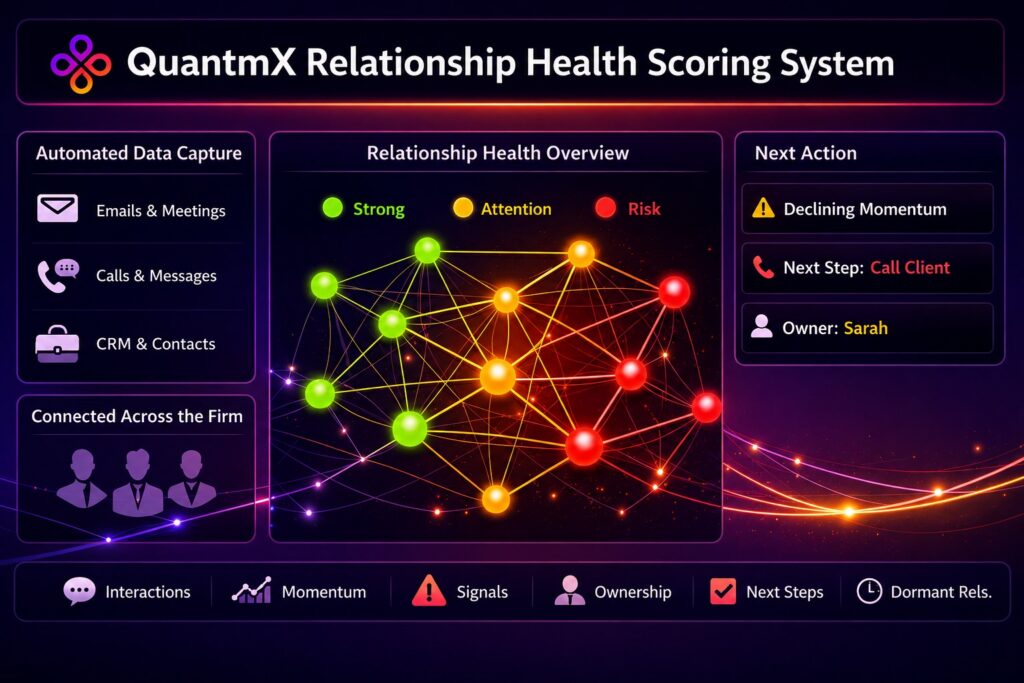
Relationship Health Scoring Is About Action, Not Dashboards
The ultimate purpose of scoring is not to create another management dashboard.
It is to change behavior.
A good relationship health system should help your team move from:
“We should probably reconnect with them.”
to:
“This relationship is losing momentum, Sarah owns it, and the next action is a conversation this week.”
That is a much more operational approach to relationship management.
And for relationship-driven firms, operational consistency matters.
Because relationships decay when they are unmanaged.
The longer a relationship remains without meaningful progression, the harder it can become to restart momentum.
How QuantmX Approaches Relationship Health
This is where firms should think beyond traditional CRM.
QuantmX positions itself as a Relationship Growth Platform, designed around the idea that professional services firms need to manage and progress the full network that contributes to growth—not simply track active customers.
Its platform brings together:
- Relationship intelligence
- Interaction capture
- Health and decay signals
- Relationship ownership
- Next-step accountability
- Relationship progression
- Visibility across the broader relationship ecosystem
The underlying principle is straightforward:
All relationships matter. But not all relationships require the same attention at the same time.
The job of the system is to help firms identify where attention can create the greatest commercial impact.
For professional services leaders, that can mean fewer relationships slipping through the cracks, better visibility into the firm’s network, and a more systematic approach to relationship-led growth.
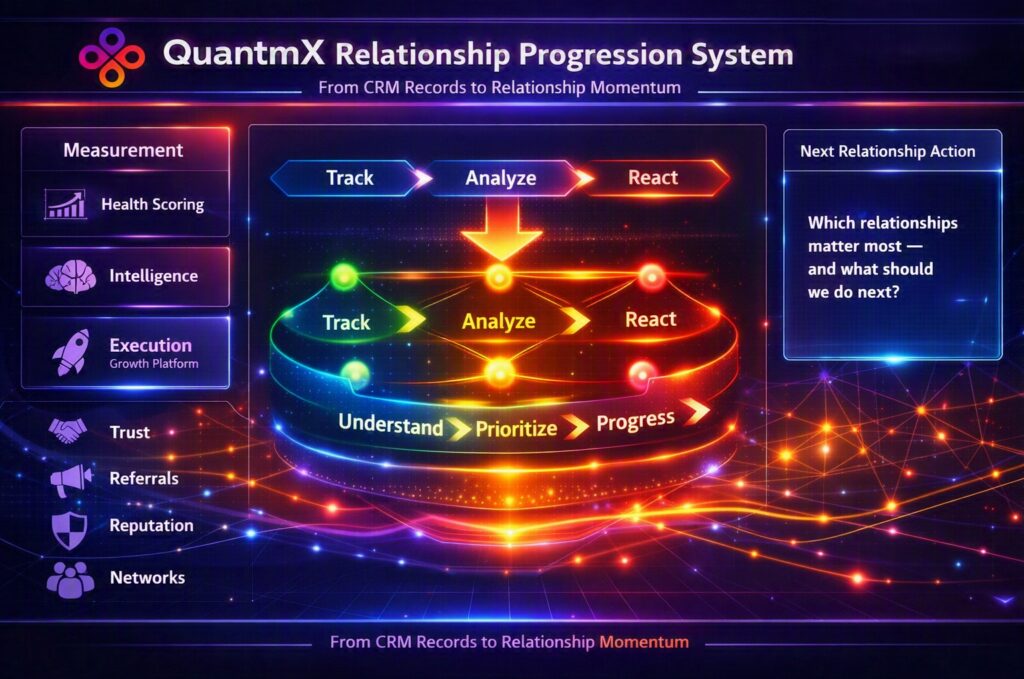
The Future of Relationship Management Is Relationship Progression- key takeaway
The traditional CRM model is primarily built around recording customer information and managing transactions.
But professional services firms often grow through something broader:
trust, introductions, referrals, repeat engagements, expertise, reputation, and networks.
That requires a different operating model.
Relationship health scoring provides the measurement layer.
Relationship intelligence provides the insight layer.
And a relationship growth platform provides the execution layer.
Together, they allow firms to move from:
Track → Analyze → React
to:
Understand → Prioritize → Progress
That is the shift businesses should be preparing for.
The next question for your firm isn’t simply, “Who do we know?”
It is:
“Which relationships matter most—and what should we do next?”
Frequently Asked Questions
1. What is a relationship health score?
A relationship health score is a measurement of the strength, engagement, momentum, and risk associated with a business relationship. It helps teams identify relationships that are healthy, weakening, or at risk so they can prioritize the right action.
2. How do you calculate a relationship health score?
A relationship health score can combine factors such as interaction recency, engagement frequency, responsiveness, relationship continuity, ownership, momentum, and strategic value. The weighting should reflect the firm’s business model and relationship priorities.
3. How can relationship health scoring help consulting firms?
Consulting firms often rely on repeat engagements, partner relationships, referrals, and long-term client trust. A relationship health score helps firms identify which relationships are strong, which are losing momentum, and where a partner or account leader needs to intervene.
How QX helps: QX gives consulting firms visibility into relationship health, ownership, interaction patterns, and next actions, helping teams turn relationship intelligence into a structured growth process instead of relying solely on individual partner memory.
4. How can law firms measure the health of client relationships?
Law firms can measure relationship health by looking beyond current matters and evaluating factors such as client engagement, communication patterns, relationship coverage, partner ownership, and the potential for future work or referrals.
How QX helps: QX helps law firms identify relationships that may be under-engaged, understand who owns important connections, and prioritize relationships that require attention. This can help firms protect valuable client relationships while identifying opportunities for deeper engagement.
5. How can accounting firms use relationship health scoring to increase client retention?
Accounting firms often have recurring relationships with clients, but client engagement can weaken between major reporting, tax, or advisory cycles. Relationship health scoring can highlight relationships where engagement is declining before the relationship becomes commercially vulnerable.
How QX helps: QX can help accounting firms monitor relationship momentum, identify accounts that need attention, and establish clear next steps. Instead of waiting for the next annual engagement, firms can proactively strengthen relationships throughout the year.
6. How can investment banks use relationship intelligence to identify business opportunities?
Investment banks depend heavily on senior-level relationships, corporate networks, investors, intermediaries, and referral sources. A relationship that appears dormant may become highly valuable when an executive changes roles, a company enters a new phase, or a transaction opportunity emerges.
How QX helps: QX helps firms gain broader visibility into their relationship networks and identify important connections that may otherwise remain hidden across individual professionals, emails, and disconnected systems. This allows teams to prioritize relationships with the greatest potential commercial impact.
7. How can financial advisory firms score relationships with high-net-worth clients?
Financial advisory firms need to maintain trust over long periods while understanding changes in client engagement, family relationships, professional networks, and referral potential. A relationship health score can help advisors identify when a previously strong relationship is losing momentum.
How QX helps: QX can provide a structured view of relationship health and ownership, helping advisory teams identify which relationships require attention and where meaningful follow-up could strengthen client engagement or create new introductions.
8. How can recruitment firms use relationship analytics to strengthen their candidate and client networks?
Recruitment firms operate through relationships with hiring managers, candidates, former candidates, referral sources, and companies. The value of these relationships can change quickly as people move organizations or take on new roles.
How QX helps: QX can help recruitment firms understand relationship activity across their network, identify dormant or under-managed connections, and surface relationships that may be worth reactivating. This creates a more systematic approach to business development and referral generation.
9. How can marketing and creative agencies measure client relationship health?
For agencies, client relationships can weaken even when projects are still being delivered. Reduced communication, fewer strategic conversations, limited stakeholder relationships, or a lack of future-project discussions can indicate declining relationship momentum.
How QX helps: QX helps agencies look beyond project delivery and assess the broader relationship. Teams can identify important relationships that need attention, establish ownership, and create next actions to maintain client momentum and uncover future opportunities.
10. How can architecture and engineering firms use relationship health scoring?
Architecture and engineering firms often develop relationships that span multiple projects and years. However, relationships may become concentrated around one project manager, partner, or client contact, creating a risk if that person leaves or changes roles.
How QX helps: QX can help firms understand relationship depth, identify important connections, and highlight relationships that may be overly dependent on a single individual. This allows firms to strengthen relationship coverage and build more resilient client networks.
11. How can private equity firms use relationship intelligence?
Private equity firms manage extensive networks involving executives, operating partners, portfolio companies, lenders, advisors, intermediaries, investors, and potential acquisition targets. The commercial value of these relationships can be difficult to track across a large organization.
How QX helps: QX can provide a centralized view of relationship intelligence and help teams identify important connections, relationship owners, and opportunities for engagement. This can make the firm’s network more accessible across investment and business development teams.
12. How can insurance brokers use relationship health scoring to improve retention and referrals?
Insurance brokers often depend on long-term relationships and referrals. A client may remain with a broker for years, but reduced engagement can still indicate a potential retention risk or missed opportunity for broader services.
How QX helps: QX can help brokers identify relationships that are losing momentum, understand relationship ownership, and prioritize clients or referral sources that deserve proactive engagement. This supports a more deliberate approach to retention and relationship-led growth.
- How can real estate advisory firms use relationship analytics for business development?
Real estate advisory firms rely heavily on relationships with property owners, investors, developers, lenders, tenants, intermediaries, and other market participants. Many opportunities originate from conversations rather than traditional inbound leads.
How QX helps: QX helps firms turn their relationship network into a more visible growth asset. By identifying relationship strength, ownership, engagement, and next steps, teams can focus business development efforts on connections most likely to generate opportunities.
14. How can professional services firms use QX to manage relationships across industries?
Whether a firm operates in consulting, legal, accounting, recruitment, financial advisory, engineering, marketing, private equity, insurance, or real estate, the underlying challenge is similar: valuable relationships can become invisible, fragmented, or unmanaged as the organization grows.
How QX helps: QX is designed around relationship intelligence and relationship progression. It helps firms move beyond simply storing contacts by providing visibility into relationship health, ownership, engagement, and the actions needed to keep important relationships progressing.
Instead of asking teams to remember every relationship that matters, QX helps turn relationship knowledge into a more systematic growth process.