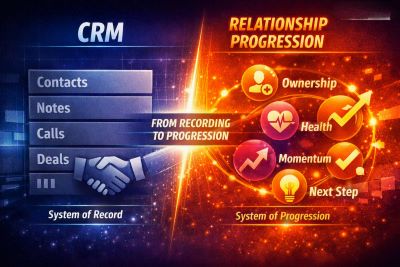
Most professional services firms believe they are managing their relationships well because their CRM is full of notes, contacts, and call logs. But a full CRM is not the same as active relationship progression — and that gap is where growth quietly leaks out of a firm. Recording tells a team what happened. Progressing a relationship tells them what should happen next, and makes sure it does.
Quick answer: Active relationship progression is the practice of assigning ownership, surfacing next steps, and continuously moving a business relationship forward — rather than just logging what already happened. It covers every relationship that drives growth, not just accounts in a sales pipeline:
- Clients
- Partners
- Alumni
- Advisors
- Referral sources
- Investors
A firm can log every call, every email, and every meeting for years and still lose partners, alumni, and referral sources to silence — because nothing in the system was ever built to move a relationship forward. It was only built to remember it.
What Is Active Relationship Progression?
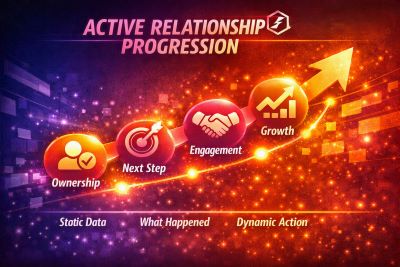
Active relationship progression is the continuous process of assigning ownership, surfacing next steps, and moving a business relationship toward its next meaningful engagement, rather than simply logging what has already occurred.
Traditional CRM systems were built around a different job entirely: relationship recording.
- A rep logs a call.
- A note gets added to a contact record.
- A deal stage gets updated.
- That data sits there, accurate but inert, until someone remembers to look at it.
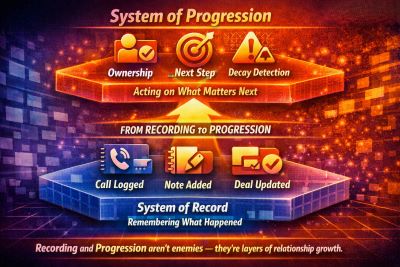
This newer approach flips that model. Instead of a static record waiting to be reviewed, the relationship itself carries momentum — a clear owner, a next action, and a system that flags when that momentum stalls. Put simply: one model asks a team to remember. The other builds remembering into the system itself, then goes a step further and tells the team what to do with what it remembers.
Recording vs. Progression: The Core Difference
- Recording captures what happened. Progression determines what happens next.
- Recording relies on someone remembering to check the record. Progression surfaces the next step automatically.
- Recording treats every contact the same once the note is logged. Progression tracks momentum over time and flags decay before it becomes loss.
- Recording typically lives inside the customer pipeline. Progression covers the full relationship ecosystem — partners, alumni, referral sources, and advisors included.
- Recording depends on one person’s memory or diligence. Progression assigns clear ownership so nothing depends on a single senior partner’s schedule or attention.
This is the same distinction behind the shift from a CRM to a Relationship Growth Platform: a system of record versus a system that actively shapes what comes next.
Why Recording Isn’t Enough
A CRM full of accurate history can still leave a firm blind to what matters most: momentum. This is what QuantmX calls Progression Blindness — a firm can see every past interaction and still have no idea which relationships are stalling right now. Recording answers “what happened.” It never answers “what matters next,” which is the question that actually protects revenue.
The data backs this up:
- Sales reps spend 17% of their average workweek manually entering data, according to Salesforce’s State of Sales Report, 7th Edition — nearly a full workday every week spent recording relationships instead of moving them forward, with none of that logged data doing anything on its own once it’s entered.
- 81.5% of professional services providers have received a referral from someone who was never their client, according to Hinge Research Institute’s study of 523 professional services firms — meaning most of a firm’s referral network sits outside the people it actively “manages” day to day.
- 63% of B2B brands don’t track referrals generated through their own customer relationships at all, according to CustomerGauge’s State of B2B Account Experience report — leaving the majority of referral-driven revenue effectively invisible until it either shows up or doesn’t.
A firm can have a CRM full of referral-source contact records and still have no visibility into which of those sources have gone quiet, because a contact record does not tell anyone that a relationship is losing momentum. The record is accurate. It is also useless for catching decay before it costs a deal.
This is exactly the gap this shift is built to close. It is not about capturing more data — it is about making sure the data that already exists actually drives an action, every time, for every relationship.
Signs Your Firm Is Stuck in Recording Mode
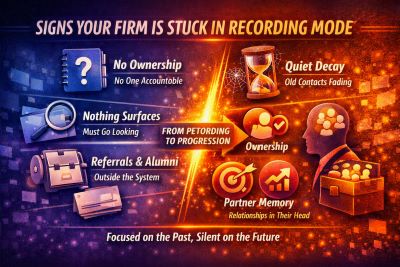
- Relationships have history but no owner. Anyone can pull up the notes, but no single person is accountable for what happens next.
- Nothing surfaces until someone goes looking. Decay is only discovered when a partner happens to check a record that has gone quiet.
- Alumni and referral sources live outside the main system. They get a line in a spreadsheet or a folder of business cards, not the same tracking customer accounts get.
- “What happened” questions get fast answers; “what’s next” questions don’t. The record is detailed on the past and silent on the future.
- Senior partners are the real system. When someone with tenure leaves, the relationships they carried in their head leave with them.
If more than one of these sounds familiar, the CRM is doing its job as a record — it just isn’t doing the job of moving relationships forward.
What This Looks Like in Practice
- Every relationship has a named owner — not a team, not “whoever gets to it,” but a specific person accountable for what happens next.
- The next step is visible without asking. Owners don’t dig through notes to figure out what to do; the system surfaces it for them.
- Momentum is tracked, not just history. A relationship gone quiet for weeks gets flagged before it becomes a lost opportunity, not discovered after the fact.
- Coverage extends past the pipeline. Alumni, referral sources, advisors, and partners get the same forward motion that customer accounts get.
- Interactions are captured automatically. Calls, emails, and meetings feed the relationship’s momentum without relying on someone to log them by hand.
None of these are recording tasks. They are progression tasks — the difference between a firm that reacts to lost relationships after the fact and a firm that catches them early enough to act.
The Cost of Passive Relationship Recording
Progression Blindness has a real dollar cost, and it compounds quietly because nothing about a quiet CRM record looks urgent on its face.
- A referral source that stops sending introductions still has a perfectly intact contact history.
- A partner deal that stalls after the second call still has accurate notes sitting in the system.
- Nothing in the record itself signals decay — which is exactly why so much revenue slips through what QuantmX calls the Relationship Blind Spot.
Every hour spent recording a relationship instead of progressing it is an hour that a stalling partner, a quiet alumnus, or a fading referral source goes unnoticed by anyone in the firm. This is also where Total Relationship Value (TRV) comes in. Most firms can measure the revenue sitting in their pipeline. Very few can measure the revenue tied up in relationships that were recorded but never actively moved forward — the Revenue Gap that this approach is specifically designed to close, one relationship at a time.
How QuantmX Enables Active Relationship Progression
QuantmX was built around active relationship progression as the core operating model, not as an add-on feature bolted onto a traditional CRM. The Relationship Intelligence Engine at the center of the platform does the work that recording alone never could:
- Captures interactions automatically across email, calendar, and meetings, so relationship history is unified rather than scattered across inboxes, spreadsheets, and memory.
- Assigns ownership and next steps to every growth-critical relationship, so accountability never depends on who happens to remember.
- Surfaces decay before it becomes loss, flagging partners, alumni, and referral sources who are losing momentum while there is still time to act.
- Extends coverage beyond the pipeline, treating the full relationship ecosystem as one system instead of leaving alumni and referral sources to live in someone’s inbox.
The result is a shift from asking “what happened?” to knowing “what matters next” — the entire premise behind this model, and the reason a Relationship Growth Platform exists as a category distinct from the CRM.
Recording and Progression Aren’t Enemies — They’re Different Layers
None of this makes recording worthless. A clean interaction history is still the raw material a firm needs — it just isn’t the finish line. The mistake most firms make is treating a well-kept CRM as proof that relationships are being managed, when it only proves that relationships are being remembered.
- Remembering and moving forward are two different jobs.
- A firm that only invests in the first will always be surprised by the partner who went quiet, the alumnus who resurfaced somewhere else, or the referral source that stopped calling.
- The firms that get this right don’t abandon their records — they build a layer on top of them: ownership, next steps, and decay detection.
That layer is what makes the history a firm is already capturing actually do something, instead of sitting in a contact record waiting to be rediscovered months too late.
The Bottom Line
Recording a relationship and actively progressing it are not the same discipline, even though most systems treat them as one and the same. Active relationship progression is what turns a CRM’s worth of accurate history into forward motion: clear ownership, visible next steps, and decay caught before it costs revenue. Firms that close this gap stop asking what happened and start acting on what matters next.
Want to see what relationship progression looks like in practice? Explore QuantmX → https://www.quantmx.ai/
Frequently Asked Questions
What is active relationship progression? It is the practice of assigning ownership, surfacing next steps, and continuously moving a business relationship forward, rather than only recording what has already happened.
How is this different from relationship recording? Recording logs past interactions in a static record. This model uses that same data to determine and surface what should happen next, with a clear owner responsible for acting on it.
Why isn’t a CRM enough on its own? A CRM was built to record customer transactions, not to actively move every relationship a firm depends on forward. It stores history well but does not, by itself, flag decay or assign next steps across partners, alumni, and referral sources.
What is Progression Blindness? Progression Blindness is the state of having complete relationship history recorded, while still being unable to see which relationships are actively losing momentum right now.
Can active relationship progression be measured? Yes. Firms can track it through metrics like relationship ownership coverage, response time to decay signals, and the size of their Relationship Revenue Gap — the portion of Total Relationship Value currently going unprogressed.
How does this apply to law firms specifically? Law firms depend heavily on referral relationships with other attorneys, and on alumni who leave for in-house roles and later become client sources. Recording captures the last case or referral; progression flags a referring attorney who has gone quiet or an alumnus contact who hasn’t been engaged since they moved firms.
How does this apply to accounting and CPA firms? Accounting firms carry seasonal relationship risk — a referral source or client contact can go quiet for months between tax seasons without anyone noticing until renewal time. Progression tracks that gap actively instead of leaving it to whoever happens to remember at filing season.
How does this apply to management consulting firms? Consulting relationships often stall between engagements, when there’s no active project to keep the relationship visible in a rep’s day-to-day. Progression keeps former clients and referral partners assigned to an owner and flagged for outreach even when there’s no open engagement driving contact.
How does this apply to marketing and advertising agencies? Agencies frequently lose visibility into past clients and referral partners once a contract ends, since the CRM record goes cold the same day the account does. Progression keeps ex-clients and partner agencies active in the pipeline for potential rehires and referrals.
How does this apply to engineering and architecture firms? These firms rely on long project cycles and repeat developer or contractor relationships that can go dormant for a year or more between bids. Progression flags dormant developer and contractor relationships before the next project cycle starts, instead of relying on someone to remember who to call.
How does this apply to wealth management and financial advisory firms? Advisory firms depend on centers-of-influence relationships — attorneys, accountants, and other advisors who refer clients — that are easy to record but easy to let go quiet. Progression assigns ownership to each center-of-influence relationship and flags when contact frequency drops.
How does this apply to executive search and recruiting firms? Search firms manage large networks of candidates and hiring-manager relationships that can go stale between searches. Progression keeps placed candidates, silver-medalist candidates, and past clients actively tracked for the next mandate, rather than starting from scratch each time.