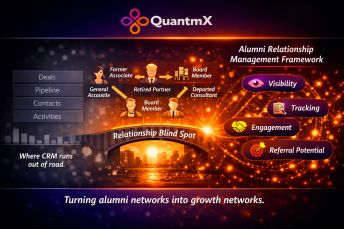
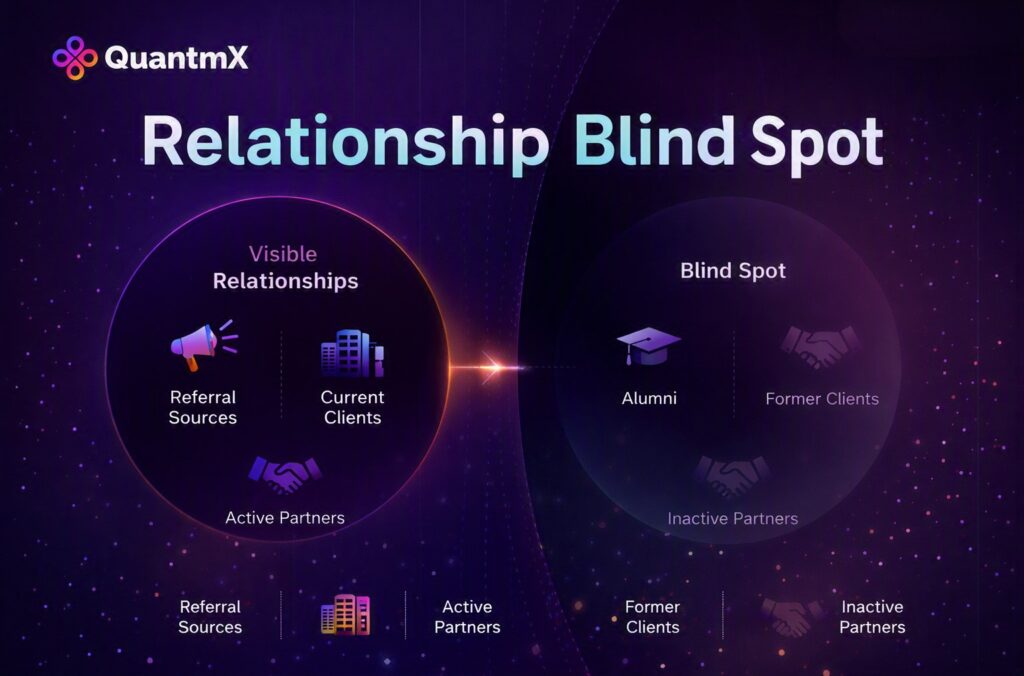
Most professional services firms can tell you who their clients are this quarter. Very few can tell you where their alumni are right now, what they are doing, or whether any of them are sitting inside a company that could become the firm’s next engagement. That gap has a name. It is a Relationship Blind Spot, and alumni are one of the largest, least-tracked pieces of it.
A former senior associate becomes general counsel at a mid-market company. A retired partner joins the board of three organizations that all need outside services. A departed consultant lands at a firm that is actively looking for exactly the kind of work their old employer does. None of this shows up in a pipeline report, because none of it was ever entered into a system built to track it. The relationship did not end when the person left the building. It just stopped being visible.
This is what alumni relationship management is built to solve, and it is also exactly where the CRM runs out of road — which is why alumni network management has to live somewhere other than a deactivated contact record.
Why the CRM Was Never Built for This
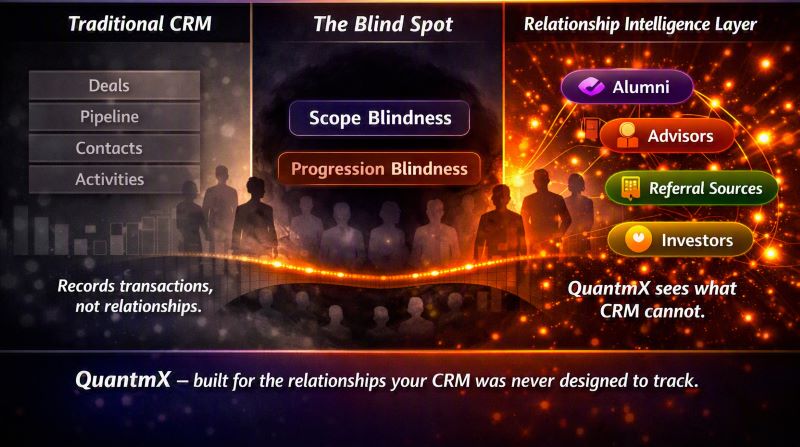
A CRM exists to record transactions with people who are currently customers, currently in a deal stage, or currently assigned to a sales rep. The moment someone leaves the firm as an employee, or a client relationship goes quiet, that person typically drops out of active records entirely.
They are archived, deactivated, or simply forgotten, because the system has no concept of a relationship that persists after the transaction ends.
That is Scope Blindness: a CRM’s field of view stops at “current customer” or “current employee,” even though the firm’s real network of value extends far beyond either category. Alumni sit squarely outside that scope.
So do referral sources, advisors, and investors, but alumni are a special case because they carry something the others don’t: institutional knowledge, credibility with the firm’s brand, and a standing invitation to be re-engaged the moment their circumstances change.
Even firms that do keep an alumni spreadsheet run into the second problem: Progression Blindness. A spreadsheet can record that an alumnus exists. It cannot tell anyone what should happen next — who owns the relationship, when the last meaningful contact occurred, or whether momentum is building or decaying. Recording is not the same as progressing. A list of names sitting untouched for eighteen months is not systematic tracking. It is a static archive with a former colleague’s name on it.
What Alumni Relationship Management Actually Means
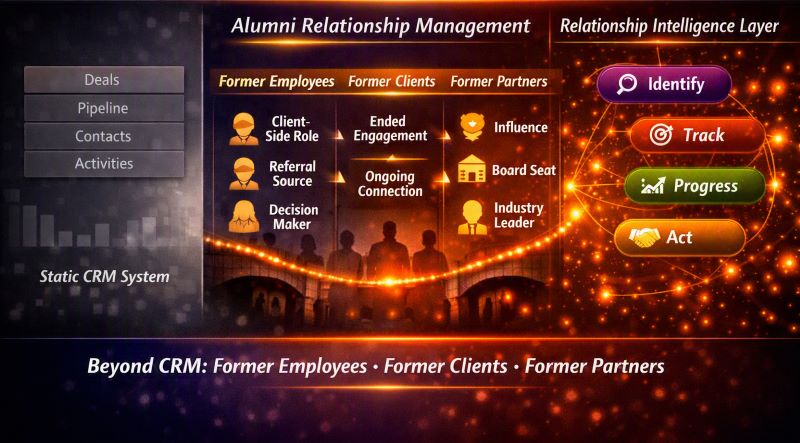
Alumni relationship management is the systematic practice of identifying, tracking, and actively progressing relationships with former employees, former clients, and former partners so the firm can act on new roles, new referrals, and new business opportunities as they happen — not months after the fact.
- Done properly, it covers three distinct groups that firms tend to lump together or, more often, ignore entirely:
- Former employees who have moved into client-side, referral-source, or decision-making roles at other organizations
- Former clients whose engagements ended but whose relationship with the firm did not
- Former partners or principals who retain influence, board seats, or industry standing long after they stop billing hours
- Treating these three groups as a single undifferentiated “alumni list” is one of the most common mistakes firms make, because each group re-enters the pipeline through a different door and needs a different kind of former client tracking.
What the Data Says About Alumni Relationship management and Revenue
Firms that treat alumni as a nice-to-have culture initiative rather than a revenue channel are working against the data. A few figures worth putting in front of leadership:
LinkedIn data shows that 15% of hires at top companies come from alumni, making it one of the highest-ROI talent sourcing channels — and the same warm-relationship dynamic that makes alumni a strong hiring channel makes them a strong business development channel. (Source: Hyring, HR & Rehiring Guide)
Independent research on referrals found that 81.5% of firms have received a referral from a non-client source, and separate research from the same institute found that the most common reason referrals stall is that the referring party was never asked about the firms they have worked with — a finding that applies directly to alumni who would happily make an introduction if anyone thought to reach out. (Source: Hinge Research Institute, Referral Marketing for Professional Services Firms)
Alumni network research found that 78% of alumni network members would advocate for their former employer, which means the willingness to help is rarely the obstacle — the obstacle is that most firms have no system prompting anyone to ask. (Source: EnterpriseAlumni, How Alumni Drive Revenue)
Put together, these numbers describe a Revenue Gap that is almost entirely self-inflicted: the willingness is already there among alumni, and the failure sits on the firm’s side of the relationship, in the absence of a system that tracks and prompts action.
A Systematic Framework for Managing Alumni Relationships
Firms that get this right generally follow a version of the same sequence, whether or not they have named it:
- Capture every departure as a relationship event, not an HR event. The day someone leaves should trigger a record, not close one. That record should include where they are going, what they will be doing, and who inside the firm should own the relationship going forward.
- Segment by category and by value. A retiring partner with three board seats is not the same tracking problem as a two-year associate moving to an in-house role. Total Relationship Value should account for referral potential, hiring potential, and reputational value, not just the possibility of a repeat engagement.
- Assign explicit ownership. Every alumnus should have a named person responsible for the relationship, the same way a live client account has an owner. Without ownership, alumni tracking degrades into a shared spreadsheet nobody feels accountable for.
- Monitor for signals, not just contact history. A role change, a promotion, a new company, or a public announcement are all signals that the relationship has re-entered an active window. Firms that wait for the alumnus to reach out first miss most of these windows.
- Re-engage on a cadence, not a whim. A light-touch check-in schedule — quarterly for high-value alumni, less frequent for others — keeps the relationship warm without becoming intrusive.
Build a repeatable alumni engagement strategy around cadence and ownership, then feed alumni activity back into pipeline and referral reporting. If an alumnus becomes a referral source or a client again, that outcome should be visible in the same reporting the firm uses for its regular pipeline, so the value of this work is provable rather than anecdotal.
How QuantmX Systematizes These Relationships
This is precisely the gap the Relationship Growth Platform was built to close, and it is where alumni relationship management stops being a side project and becomes part of the core system. Where a traditional system stops tracking someone the day they leave, the Relationship Intelligence Engine keeps every alumnus inside the same active system as current clients and partners — with an assigned owner, a visible history, and a surfaced next step.
Every departure is captured as a relationship, complete with role, destination, and ownership, instead of being archived out of view
Signals such as a new job title, a promotion, or a public move are surfaced automatically, so the firm can act inside the window instead of after it has closed
Relationship health scoring flags alumni who are going quiet, the same way it flags a client relationship losing momentum, so an alumnus does not silently drift into Progression Blindness
Every re-engaged alumnus — as a referral source, a rehire, or a returning client — feeds back into Total Relationship Value, so the Revenue Gap this work closes becomes a measurable number, not a story someone tells in a partner meeting
The result is not a better spreadsheet. It is active progression: alumni move from “former employee, untracked” to “known relationship, owned, and moving toward a next step,” which is the entire difference between recording a relationship and growing one. See what unmanaged relationships — including alumni — are costing your firm with the Revenue Gap calculator, and read more about the broader problem in What Is the Relationship Blind Spot?
Managing Alumni Relationships by Industry
The mechanics of this work stay consistent across professional services, but the highest-value alumni signals differ by vertical.
1. Law Firms
Departing associates and partners routinely move in-house, becoming general counsel or legal ops leaders with direct authority over outside counsel budgets. A former associate who becomes in-house counsel at a mid-size company is one of the highest-value alumni signals a law firm can track, because that person is now a buyer, not just a contact.
2. Consulting Firms
Consultants who move client-side often land in roles where they commission the exact type of engagement they used to deliver. Tracking which alumni moved into operations, strategy, or transformation roles turns a former colleague into a warm introduction to a net-new buying committee.
3. Accounting Firms
Alumni who move into CFO, controller, or finance-leadership roles at client or prospect organizations are a well-documented source of repeat engagements and referrals, particularly for audit, advisory, and tax work, because they already trust the firm’s technical judgment from the inside.
The Bottom Line
Alumni relationship management isn’t a goodwill gesture or an HR checkbox — it’s a revenue channel most firms are leaving untouched. The willingness is already there among former employees, clients, and partners. The only thing missing is a system built to track them, flag the moment they re-enter an active window, and prompt someone to act.
Ready to see what your firm’s untracked alumni, referral sources, and dormant relationships are actually costing you? Run the numbers with the Revenue Gap calculator, or visit QuantmX to see how the Relationship Intelligence Engine keeps every alumnus — and every relationship that matters — inside one active system.
Frequently Asked Questions
What is alumni relationship management?
Alumni relationship management is the systematic tracking and active progression of relationships with former employees, former clients, and former partners, so a firm can act on new roles, referrals, and business opportunities as they occur rather than discovering them months later.
How is this different from an alumni network or alumni program?
An alumni network or program is typically an event and communications initiative focused on goodwill and community. This is a revenue-and-intelligence discipline: it assigns ownership, tracks signals, and measures outcomes the same way a firm manages any other relationship that drives growth.
Why doesn’t a CRM handle this well?
Most CRMs are scoped to current customers or current employees. The moment someone leaves either category, they typically drop out of active records, which is why alumni sit in a Relationship Blind Spot rather than a working pipeline.
What is the business case for investing in this work?
Alumni are a proven source of referrals, rehires, and repeat business, and research shows most alumni are willing to help — the gap is that most firms never systematically ask, track, or follow up.
Who should own alumni relationships inside a firm?
Ownership should be assigned the same way a live account is assigned — to a named person accountable for monitoring the relationship, watching for signals, and initiating re-engagement on a set cadence.
How often should a firm re-engage with alumni?
High-value alumni typically warrant a quarterly touchpoint at minimum, with lighter-touch outreach for lower-priority alumni, adjusted whenever a signal (a promotion, a new company, a public move) indicates the relationship has re-entered an active window.
How does this work for law firms specifically?
Law firms should prioritize tracking associates and partners who move in-house, since a former associate who becomes general counsel or legal ops leadership becomes a direct buyer of outside counsel services.
What alumni signals matter most for law firm business development?
Promotions into general counsel, deputy general counsel, or legal operations roles at companies without an existing relationship to the firm are the highest-value signals to track and act on quickly.
How does this differ for consulting firms?
Consulting firms should track alumni moving into strategy, operations, or transformation roles client-side, since those individuals frequently commission the same category of engagement they used to deliver internally.
What makes a consulting alumnus a high-value relationship to track?
An alumnus who moves into a role with budget authority over consulting engagements — particularly at a company the firm doesn’t already serve — represents a warm path into a new buying committee.
How should accounting firms approach this?
Accounting firms should focus on alumni who move into CFO, controller, or finance-leadership roles, since these individuals are well-positioned to bring audit, advisory, or tax work back to a firm whose technical judgment they already trust.
Why are finance-leadership alumni especially valuable for accounting firms?
They combine budget authority with firsthand knowledge of the firm’s work quality, which shortens the sales cycle for repeat engagements compared with an unfamiliar prospect.