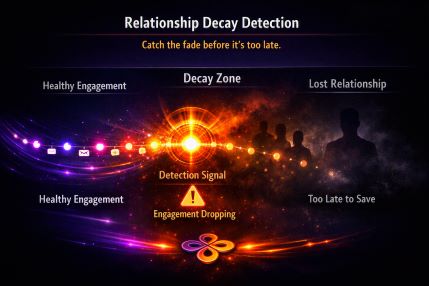
Most professional services firms don’t lose a client in a single moment. They lose them in slow motion — a call that used to happen every three weeks stretches to six, an email goes unanswered for a little longer than usual, a champion inside the client organization stops showing up to meetings. None of this trips an alarm in a traditional CRM, because a CRM only records what happened. It has no mechanism for noticing what stopped happening. Relationship decay detection is the practice of catching that gap — identifying the pattern of fading engagement while there is still time to act, instead of finding out only when the client informs you they are leaving.
This is the core problem with treating client relationships as static records. A contact record does not decay. A relationship does. And by the time a lost account shows up as a number on a revenue report, the relationship itself decayed months earlier.
What Is Relationship Decay Detection?
Relationship decay is the gradual loss of engagement, responsiveness, and momentum in a business relationship. It builds up well before any formal signal makes the loss visible in the numbers, such as:
- A cancellation
- A non-renewal
- A lost referral
It is not a single event. It is a trend, built from small changes:
- slower replies
- shorter meetings
- fewer questions
- less initiative from the client’s side
Relationship decay detection means identifying that trend early enough to intervene, rather than discovering it retroactively once revenue has already been lost.
This distinction matters because most firms are set up to measure outcomes, not trends. A missed renewal shows up clearly. The eight weeks of quiet that preceded it usually does not — unless someone is deliberately watching for it. That deliberate watching is what relationship decay detection actually is.
Why Relationship Decay Detection Matters
The financial case for catching relationship decay early is not abstract. Research from Bain & Company, popularized in the Harvard Business Review, found that increasing customer retention rates by just 5% can increase profits by 25% to 95%, depending on the industry.
That range exists because retained relationships compound — they cost less to serve, refer more work, and generate revenue the firm never had to go acquire. The same research notes that early-year client relationships are often barely profitable once acquisition costs are factored in; the real return arrives in later years, when the relationship has been sustained.
For professional services firms specifically, the stakes compound further. Hinge Research Institute’s referral research found that 69% of clients are willing to make referrals to their service providers — but far fewer actually do, and the most common reason, cited by 72% of respondents, is simply that they were never asked. A decaying relationship does not just risk the client’s own revenue. It quietly shuts down the referral pipeline that client would otherwise have kept open.
This is where the Relationship Blind Spot shows up most often — not in relationships that were never tracked at all, but in relationships that were logged, recorded, and then left untouched while the connection itself faded. A CRM field showing “last contacted: 45 days ago” is not relationship decay detection. It is relationship recording. The two are not the same thing, and the gap between them is exactly where revenue disappears.
Warning Signs Relationship Decay Detection Should Catch
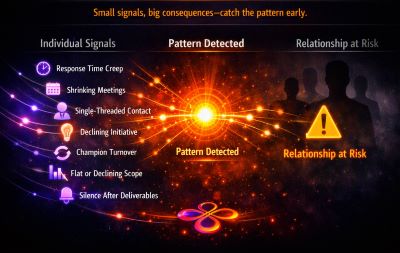
Relationship decay rarely announces itself. It shows up as a pattern across several smaller signals, most of which are easy to miss individually and hard to miss once they are aggregated. The most consistent early indicators include:
- Response time creep — replies that once came within a day now take a week, with no explanation offered
- Shrinking meeting cadence — a recurring check-in that quietly stops recurring, or gets rescheduled without a new date set
- Single-threaded contact — all communication running through one person at the client, with no visibility into anyone else at the organization
- Declining initiative — the client used to raise questions or ideas; now they only respond when prompted
- Champion turnover — the internal advocate who originally drove the relationship changes roles, leaves the company, or goes quiet
- Flat or declining scope — no new requests, no expansion conversations, no signs the relationship is growing
- Silence after deliverables — work gets delivered and acknowledged with a one-line reply instead of a substantive follow-up
Any single signal on its own can be explained away — someone is traveling, a quarter is busy, a reorg is underway. Relationship decay detection depends on tracking these signals together, over time, so that a pattern is visible before a single dramatic event forces the issue.
How to Build a Relationship Decay Detection System
Detecting relationship decay systematically requires three things most firms do not have by default: a single place where every interaction across a relationship is captured, a way to score relationship health rather than just record activity, and a clear owner responsible for acting on what the score shows.
Capture the full interaction history. Relationship decay is invisible if the data behind it is scattered across individual inboxes, calendars, and the memory of whichever partner owns the relationship. Every call, meeting, and email needs to live in one unified record, not three different systems that never talk to each other.
Score relationship health, not just activity. A relationship health score turns scattered signals — response time, meeting frequency, contact breadth, sentiment — into a single number that can be tracked over time and compared across the client base. We cover how that scoring process actually works, signal by signal, in How Relationship Health Scoring Works: A Practical Guide — it is the mechanism that makes relationship decay detection possible at scale, rather than relying on one partner’s gut feeling that “something feels off.”
Assign ownership to the signal, not just the account. A declining health score that nobody is accountable for acting on is just data. Every relationship showing early decay signals needs a named owner and a clear next step — not a dashboard that gets checked once a quarter.
This is the function of a Relationship Intelligence Engine: it does not just store what happened, it actively surfaces which relationships are losing momentum and assigns what should happen next, so relationship decay detection does not depend on any single person remembering to look.
Relationship Decay Detection Across Professional Services
The specifics of relationship decay look different depending on the type of firm, but the underlying pattern — engagement fading before revenue shows the loss — holds across the industry.
- Law firms: A general counsel who used to loop the firm in on every matter starts routing only the largest cases elsewhere, without ever formally ending the relationship
- Accounting and advisory firms: A client who once asked proactive tax-planning questions each quarter shifts to purely reactive, filing-only engagement
- Management consulting firms: A sponsor who championed the engagement internally moves to a new role, and no new internal advocate is identified before the next project comes up for renewal
- Wealth and financial advisory firms: A client who used to initiate portfolio reviews now only responds when the advisor reaches out first, and reviews get shorter each time
- Architecture, engineering, and construction firms: A repeat client who used to bring the firm in at the concept stage starts issuing RFPs instead, treating the relationship as one more vendor bid
- Staffing and recruiting firms: A hiring manager who once called directly for urgent roles starts routing everything through a formal procurement process instead
In each case, the loss shows up as a shift in behavior long before it shows up as a lost account. Relationship decay detection is the discipline of noticing the shift while there is still a relationship left to repair — regardless of which corner of professional services the firm operates in.
From Relationship Decay Detection to Action
Detecting relationship decay only creates value if it changes what happens next. A health score that flags a cooling relationship should trigger a specific action — a check-in call, a re-engagement plan, a conversation with a new stakeholder — not just a colored indicator on a dashboard that nobody opens. The firms that get the most value from relationship decay detection treat a declining signal the way they would treat a stalled deal: as something that needs a named owner and a next step, immediately, not at the next quarterly review.
Relationship decay is not a failure of effort. It is a failure of visibility. The partners and teams involved are usually doing good work — the problem is that nobody is watching the pattern across the full relationship until it is too late to reverse. Closing that gap is what turns relationship management from a reactive, memory-dependent habit into a system the whole firm can rely on.
See what relationships in your own client base may already be showing early decay signals — calculate your firm’s Revenue Gap in 90 seconds and find out what it’s costing you, or get early access to QuantmX to see relationship decay detection built into a Relationship Growth Platform.
Frequently Asked Questions About Relationship Decay Detection
What is relationship decay?
Relationship decay is the gradual loss of engagement, responsiveness, and momentum in a business relationship before that loss becomes visible in formal outcomes like a cancellation or a lost referral. It builds up through small changes — slower replies, fewer questions, less initiative — rather than a single event.
What are the early warning signs of relationship decay?
The most consistent signals include slower response times, a shrinking meeting cadence, communication narrowing to a single contact, declining client-initiated questions or ideas, turnover of the internal champion, flat or shrinking scope, and thin, low-substance replies after deliverables are sent.
How is relationship decay different from customer churn?
Churn is the outcome — the client leaves, cancels, or stops referring work. Relationship decay is the process that precedes it. Relationship decay detection focuses on the leading indicators, while churn reporting only captures the lagging result after the relationship is already lost.
Can relationship decay be detected before a client leaves?
Yes, when interaction data is captured consistently and scored over time. The signals of decay are almost always present weeks or months before a formal loss — the challenge is usually visibility, not the absence of warning signs.
What causes relationship decay in a business relationship?
Common causes include a change in the client’s internal champion, a shift in priorities on the client’s side, inconsistent follow-through from the service provider, or simply a lack of proactive engagement once the relationship becomes familiar and routine.
What is a relationship health score?
A relationship health score is a composite measure — built from signals like response time, meeting frequency, contact breadth, and engagement trend — that turns scattered relationship activity into a single trackable number, making relationship decay detection possible across an entire client base rather than relationship by relationship.
How does relationship decay show up in law firms?
It typically shows up as matter routing shifting away from the firm without any formal termination — a general counsel quietly sends the next few matters elsewhere while the existing relationship stays technically open on paper.
How does relationship decay affect referral sources for professional services firms?
A referral source experiencing relationship decay does not usually announce it. Introductions simply slow, then stop, often well before anyone at the firm notices the pattern — which is part of why forgotten referral relationships are such a common, quiet source of lost revenue.
Can relationship decay detection prevent partner and alumni relationships from going cold?
It can, when those relationships are tracked with the same discipline as active client accounts. Partner and alumni relationships decay the same way client relationships do — through fading contact and lost context — and the same health-scoring approach applies to both.
How often should professional services firms review relationship health?
Relationship health should be monitored continuously rather than reviewed on a fixed quarterly cycle, since the whole value of relationship decay detection is catching a shift while it is still small. Formal reviews still matter, but they should surface trends that were already being tracked, not discover them for the first time.
Who should own relationship decay detection at a professional services firm?
Every relationship showing decay signals needs a named owner accountable for the next action, not a shared dashboard nobody is responsible for. In most firms, that owner is the partner or team member closest to the relationship, supported by a system that surfaces the signal before they would otherwise notice it.
How does relationship decay detection reduce a firm’s Revenue Gap?
A firm’s Revenue Gap is the portion of Total Relationship Value being lost because relationships are outside the system or not being actively progressed. Relationship decay detection closes part of that gap directly — every relationship caught and re-engaged before it goes cold is revenue that would otherwise have quietly disappeared.