
Law firm dormant client revenue loss is one of the largest, least-discussed line items in legal industry economics — a cost that never appears on a P&L statement because it never gets tracked in the first place. Every firm has a roster of former clients who haven’t been contacted in years, who would still take a call, and who represent real revenue sitting untouched. Most firms have no idea how large that number actually is.
That’s the uncomfortable part. This gap isn’t a marketing problem or a business development failure — it’s a visibility problem. The clients are still there. The relationships aren’t dead, just untracked. And untracked relationships don’t generate revenue on their own.
What Is Law Firm Dormant Client Revenue Loss?
Law firm dormant client revenue loss is the ongoing revenue a firm fails to capture because past clients — people and companies the firm already served successfully — have gone untouched long enough that the relationship has effectively gone cold. These aren’t lost clients in the sense of clients who left dissatisfied. They’re clients whose matter simply closed, and no one at the firm ever followed up again.
The distinction matters. A dissatisfied former client is a service problem. A dormant client is a systems problem — the absence of a process for staying in touch after the engagement ends. That systems gap is what turns a satisfied former client into a silent, six-figure blind spot.
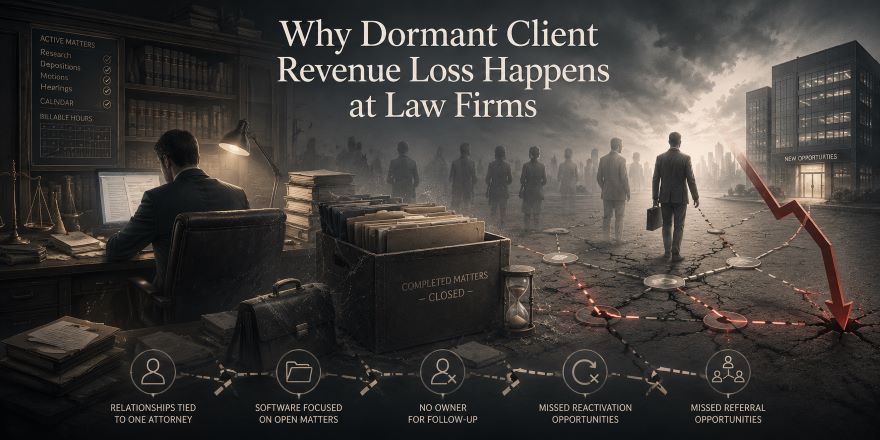
Why Dormant Client Revenue Loss Happens at Law Firms
This isn’t a discipline problem. It’s a structural one, built into how most firms operate day to day.
- Client relationships are owned informally by whichever attorney handled the matter, and when that attorney is busy, promoted, or departs, the relationship goes with them
- Practice management software tracks open matters, billing, and conflicts — not what happens to a client relationship once the matter closes
- There’s no assigned owner for staying in touch with former clients, so the responsibility defaults to nobody
- Partners assume business development means finding new clients, when reactivating former ones is usually faster and cheaper
- A former client who changes companies, gets promoted, or refers a colleague rarely gets noticed unless someone happens to see it
What the Data Says About Dormant Client Revenue Loss
The scale of this problem becomes clear once you look at how much law firms actually depend on the clients they already have. LeanLaw’s analysis of Bain & Company research found that the professional services sector — which includes law firms — averages an 84% client retention rate, while the best-performing law firms retain 92%. That seven-point gap compounds into millions in lost profit over five years. The same analysis found that fewer than 40% of law firm partners even know their own firm’s retention rate, which means most firms are experiencing dormant client revenue loss without a way to measure it.
Referrals compound the exposure. According to Search Lab’s research, 67% of new legal clients still come through referrals, though that share is declining by three to five percentage points every year — meaning the referral sources a firm already has are becoming more valuable, not less, at exactly the moment most firms are losing track of them.
And according to Practice Proof’s data, cited in the same report, 91% of law firms rely on repeat clients as a meaningful source of revenue — yet very few of those firms have a system in place to know which former clients have gone quiet, or how much revenue that silence represents.
Alumni add another layer entirely. The Legal Marketing Association reports that nearly 70% of AmLaw 100 firms now run formal alumni programs, recognizing that a former associate or partner who moves in-house often becomes one of the firm’s highest-value referral sources — if the relationship survives their departure. How to Manage Alumni Relationships Systematically looks at exactly how to build that into a repeatable process.
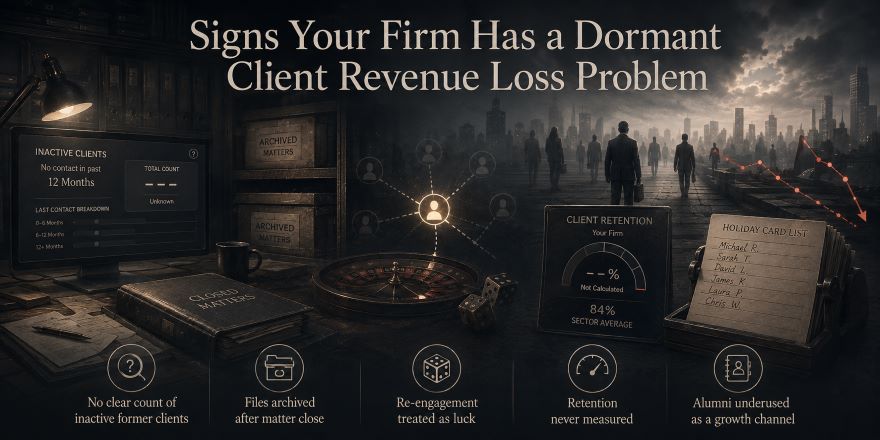
Signs Your Firm Has a Dormant Client Revenue Loss Problem
Most firms don’t realize how much revenue this problem is quietly costing them until the pattern is laid out plainly. It’s part of the broader Relationship Blind Spot most professional services firms carry, just concentrated in one category.
- No one at the firm can name, with confidence, how many former clients haven’t been contacted in the past twelve months
- Client files are archived the moment a matter closes, with no process for re-engagement afterward
- Partners describe new engagements from former clients as “good timing” rather than the result of any deliberate outreach
- The firm’s retention rate has never been calculated, let alone benchmarked against the 84% sector average
- Alumni — former associates and partners — are tracked, if at all, on a holiday card list rather than as a business development channel
How to Calculate Your Firm’s Dormant Client Revenue Loss
- Pull a list of every client with no active matter and no contact in the past 12 to 24 months.
- Estimate the average matter value for that practice group, and multiply it by a realistic reactivation rate — even 10 to 15% is a meaningful, achievable target.
- Compare that figure against your current retention rate, if you have one, or benchmark against the sector’s 84% average if you don’t.
- Add in a rough estimate of alumni-driven referral value, since alumni relationships often produce work no dormant-client analysis alone would capture.
The number that comes out of this exercise is usually larger than firm leadership expects. For a step-by-step walkthrough of the underlying math, see How to Calculate Your Relationship Revenue Gap?.
Dormant Client Reactivation: Turning Loss Into Revenue
Dormant client reactivation doesn’t require an aggressive sales push. It requires a system that surfaces the right relationship at the right time, so an attorney can make a natural, low-pressure reconnection instead of a cold outreach.
- Segment dormant clients by matter type and value, so reactivation efforts start with the highest-potential relationships first
- Assign a named owner to each dormant relationship — usually the attorney who handled the original matter — so outreach doesn’t depend on someone remembering to do it (see How Relationship Ownership Accountability Works in Practice)
- Track signals like a company acquisition, a leadership change, or a new regulatory requirement that might reopen the need for legal work
- Treat alumni as a distinct reactivation category, since a former associate now in-house can become a referral source, not just a former colleague
Firms that build this into a repeatable process typically find that dormant client reactivation costs a fraction of what new client acquisition costs, since the relationship, trust, and prior work product already exist.
Legal Industry CRM: Why It Isn’t Enough
Most legal industry CRM systems were built to manage active matters, intake, and conflicts checks — not to track what happens to a client relationship after the matter closes. That’s a structural gap, not a configuration problem. A practice management platform can tell you everything about an open file and almost nothing about a former client who’s gone quiet.
This is exactly where the loss originates. The moment a matter closes, the relationship falls outside the system the firm actually uses day to day, and from that point forward, whether it gets revisited depends entirely on human memory.
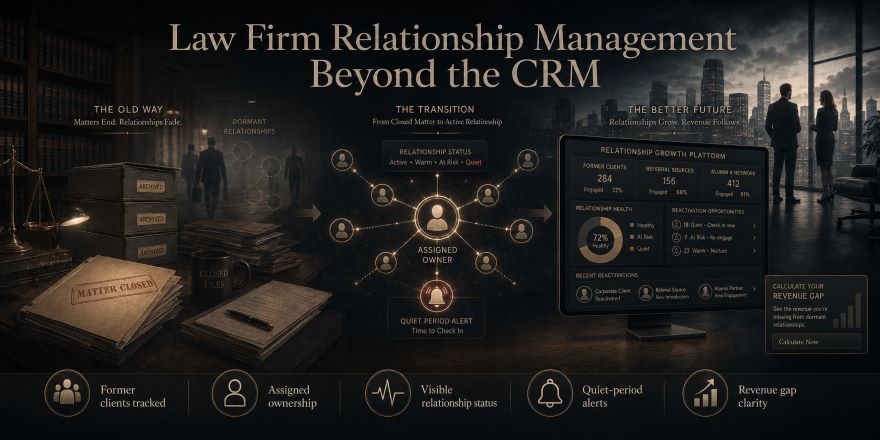
Law Firm Relationship Management Beyond the CRM- Key Takeaway
Effective law firm relationship management treats the end of a matter as the beginning of a new relationship phase, not the end of one. That means tracking former clients and alumni with the same discipline applied to active matters — assigned ownership, visible status, and a system that flags when a relationship has gone quiet long enough to warrant a check-in.
A Relationship Growth Platform applies that discipline automatically, treating dormant clients, referral sources, and alumni as active, trackable relationships rather than closed files. That’s the difference between a firm that discovers its”law firm dormant client revenue loss by accident and one that closes it on purpose.
The fastest way to see what your own law firm’s dormant client revenue loss is actually costing you is to calculate your Revenue Gap using your firm’s own numbers.
Frequently Asked Questions
What is law firm dormant client revenue loss?
Law firm dormant client revenue loss is the revenue a firm fails to capture from former clients it already served successfully, simply because no one followed up after the matter closed. The relationship isn’t damaged — it’s untracked.
How common is dormant client revenue loss among law firms?
Very common. Fewer than 40% of law firm partners know their own firm’s client retention rate, which means most firms have no way to measure how much dormant client revenue loss they’re actually carrying.
What’s the difference between a lost client and a dormant client?
A lost client left dissatisfied or switched firms. A dormant client simply hasn’t been contacted since their matter closed — the relationship is intact, just inactive, and often just as reachable as it was on day one.
How much of a law firm’s new business comes from referrals?
According to Search Lab, 67% of new legal clients come through referrals, though that share is declining by three to five percentage points annually — making existing referral relationships more valuable to protect, not less.
What percentage of law firms rely on repeat clients for revenue?
According to Practice Proof, 91% of law firms consider repeat clients a meaningful source of revenue, which is exactly the population most exposed to dormant client revenue loss without an active reactivation process.
Why do alumni matter for law firm dormant client revenue loss?
Former associates and partners often move in-house, where they become decision-makers on outside counsel. The Legal Marketing Association reports that nearly 70% of AmLaw 100 firms now run formal alumni programs specifically to capture this value.
Can a legal industry CRM solve dormant client revenue loss on its own?
No. A legal industry CRM is typically built around active matters, intake, and conflicts checks. It generally has no structured process for what happens to a client relationship once the matter closes, which is exactly where dormant client revenue loss originates.
How do you calculate a firm’s dormant client revenue loss?
Start by listing clients with no contact in the past 12 to 24 months, estimate an average matter value, and apply a realistic reactivation rate. Comparing the result against the sector’s 84% average retention rate shows how much is currently being left on the table.
What is dormant client reactivation?
Dormant client reactivation is the deliberate process of reconnecting with former clients through a low-pressure, relevant touchpoint — rather than a cold sales pitch — using signals like a leadership change or new regulatory need to time the outreach naturally.
Who should own dormant client relationships at a law firm?
Usually the attorney who handled the original matter, since they already have the relationship and the context. The key is assigning ownership explicitly, rather than leaving it to whoever happens to remember.
What is a realistic reactivation rate for dormant law firm clients?
Even a 10 to 15% reactivation rate on a firm’s dormant client list typically represents meaningful revenue, since the acquisition cost for these relationships is close to zero compared with winning an entirely new client.
Does dormant client revenue loss affect small firms differently than large firms?
The mechanism is the same at any size, but small firms often feel it more acutely, since a handful of dormant relationships can represent a larger share of total revenue potential than at a large firm with hundreds of matters.
How does law firm relationship management differ from case management?
Case management tracks the life of an open matter — deadlines, documents, billing. Law firm relationship management tracks the life of a relationship, including the years before and after any single matter, which is where dormant client revenue loss typically hides.