Most professional services firms already have some form of automated relationship management running in the background — a reminder that fires after a missed call, a task that gets created when a deal stage changes, a follow-up email triggered by a form fill. What most firms don’t have is a clear line between what should run on autopilot and what still needs a human hand on it.
That line matters more than it looks. Automate the wrong action and a partner introduction gets a generic drip email instead of a phone call. Automate too little, and the firm goes back to relying on memory, spreadsheets, and whoever happens to be paying attention that week — the exact condition that creates a Relationship Blind Spot in the first place.
This guide breaks down what automated relationship management should systematize, what it should never fully own, and how professional services firms are drawing that line in practice.
What Is Automated Relationship Management, and Why Does It Matter Now?
Automated relationship management is the practice of using software to detect relationship signals, assign ownership, and trigger next steps across a firm’s full network of clients, partners, alumni, referral sources, and advisors — without requiring someone to remember to do it manually.
It matters now for a straightforward reason: relationship-led growth is not optional the way it once was. According to Hinge Marketing’s 2026 High Growth Study, leads from referrals and direct human outreach account for nearly two-thirds of all new business at professional services firms, even as the median growth rate across the industry has slid to 9.9%. When two-thirds of revenue depends on relationships, the firms that systematize how those relationships get tracked and progressed have a structural advantage over the firms that don’t.
At the same time, the case for relationship automation professional services firms can actually trust is not “automate everything.” It’s knowing precisely where automation adds leverage and where it quietly erodes trust.
The Difference Between Automated Relationship Management and Simple CRM Automation
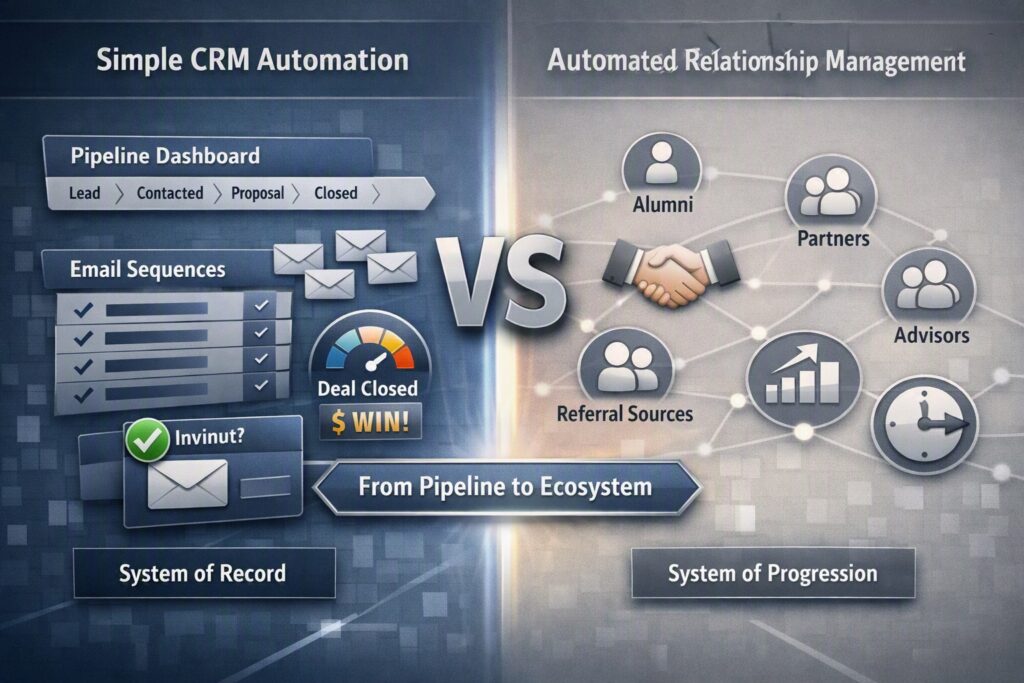
Traditional CRM automation was built around the pipeline: automated stage changes, automated lead scoring, automated email sequences to prospects. It assumes the relationship in question is a deal.
Automated relationship management, by contrast, is built for the full relationship ecosystem — alumni, partners, referral sources, advisors, investors — not just the contacts sitting in an active pipeline. The distinction matters because:
- A pipeline-based system stops paying attention once a deal closes or stalls.
- A relationship-based system keeps watching a contact for years, long after they’ve left the pipeline entirely.
- A pipeline-based system records what happened. A relationship-based system is built to progress what happens next – the same Progression Blindness problem that a passive CRM never solves on its own.
What Automated Relationship Management Should Systematize
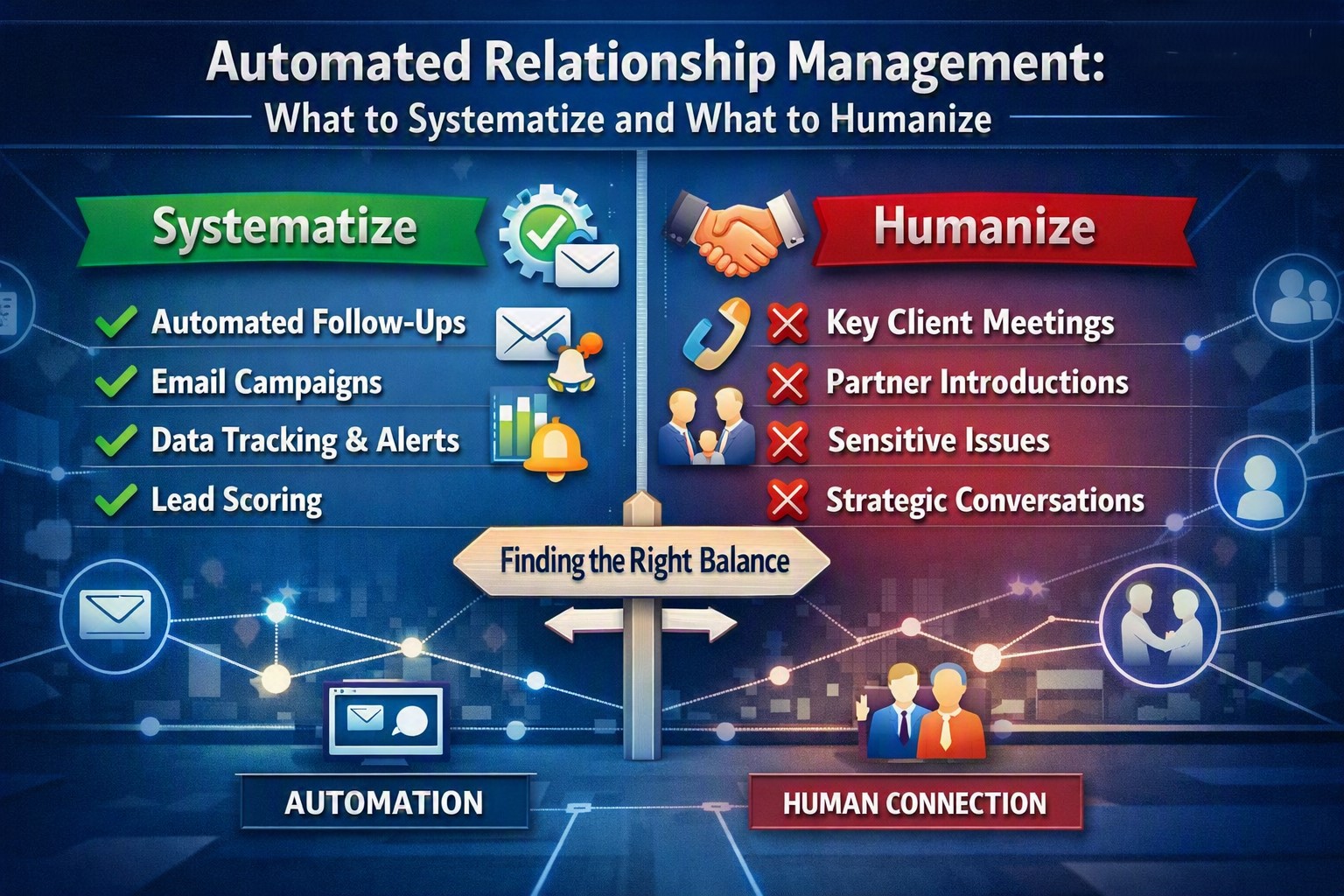
Some relationship actions are well suited to automation because they are repetitive, time-sensitive, or easy to miss. These are the actions where systematized tracking consistently earns its keep:
- Signal detection. Flagging a contact who has gone quiet for a set number of days, a champion who changed jobs on LinkedIn, or a referral source whose introductions have dried up.
- Ownership assignment. Automatically routing a relationship to a named owner the moment a signal fires, so accountability doesn’t depend on someone noticing first.
- Interaction capture. Logging calls, emails, and meetings across a firm’s relationship network so the history is unified instead of scattered across inboxes.
- Reminder and task creation. Generating the next-step task – “schedule a check-in,” “send the proposal,” “reconnect with this alumnus” – the moment a relationship needs attention.
- Health scoring updates. Recalculating a relationship’s health score as new signals come in, rather than waiting for a quarterly review.
- Reporting roll-ups. Aggregating relationship activity into dashboards for partners and leadership without manual data pulls.
Each of these is a case where a system executing the action, at machine speed, produces a better outcome than a person doing it manually — not just a faster one. The data backs this up: research from Prospeo found that sales reps spend roughly 25% of their week on manual CRM data entry, and B2B contact records decay fast enough that 70.8% of contacts change something material — job title, phone number, or address — within twelve months. Systematizing capture and signal detection is how firms keep pace with that decay rate without adding headcount.
What Automated Relationship Management Should Never Fully Automate
The same firms that benefit most from automation are usually the ones most careful about where they stop. Some relationship actions lose their value entirely when a system executes them without a person:
- The actual outreach to a senior partner, key client, or major referral source. A generic automated email to a dormant relationship of real value can do more damage than no outreach at all.
- Judgment calls on relationship strategy. Deciding how to re-engage a cooling relationship – a call, a coffee, an introduction to someone else – is a human decision informed by automated signals, not a decision the system should make alone.
- Sensitive conversations. Renewal risk, pricing pushback, and partner departures need a person, not a workflow.
- Final ownership accountability. Automation can assign a task. It should never let a person believe the relationship is “handled” just because a workflow ran. Ownership accountability still needs a name attached, as outlined in How Relationship Ownership Accountability Works in Practice.
This is the practical boundary most firms are missing: automated relationship management should remove the busywork of tracking relationships, not remove the relationship itself.
How Automated Relationship Management Fits Into the Relationship Intelligence Engine
Inside a Relationship Intelligence Engine, automation is one layer among several — detect, analyze, prioritize, execute. Automated relationship management sits mostly at the detect and execute ends of that pipeline:
- Detect: the system notices decay, risk, and opportunity signals automatically – the same mechanism behind Relationship Decay Detection.
- Analyze and prioritize: this is where health scoring and Total Relationship Value context get applied, often with a person reviewing the output.
- Execute: low-judgment actions – reminders, ownership routing, follow-up tasks – get carried out automatically, while high-judgment actions get surfaced to the right owner instead of executed blind.
Firms that get this sequencing right end up with a system that behaves less like a rules engine and more like a colleague who never forgets to follow up.
The Cost of Not Adopting Automated Relationship Management
Firms that skip this kind of relationship automation entirely tend to pay for it in a few predictable ways:
- Referral sources go quiet without anyone noticing until the pipeline visibly dries up.
- Alumni relationships expire by default rather than by decision, simply because nobody was assigned to check in.
- Senior partners become single points of failure, holding relationship context that never gets captured anywhere else.
- Revenue Gap widens as more of a firm’s Total Relationship Value sits outside any system that’s actively watching it.
None of these failures are dramatic on any single day. They compound quietly — which is exactly why they’re so easy to underestimate until the Revenue Gap shows up in a Total Relationship Value review.
How to Roll Out Automated Relationship Management in Your Firm
Firms adopting this approach for the first time generally see better results when they sequence the rollout rather than automating everything at once:
- Start with capture, not action. Unify interaction history across email, calendar, and meetings before automating any outbound step.
- Automate signal detection before automating response. Let the system tell you what’s happening before you let it decide what to do about it.
- Assign ownership automatically, but keep escalation human. Every signal should reach a named person, not just a dashboard.
- Review automated actions on a fixed cadence. A monthly audit of what’s firing automatically prevents “automation drift,” where workflows built for one situation quietly misfire in another.
- Reserve full automation for low-stakes, high-volume actions. Reminders and internal task creation are safe to fully automate. Client- and partner-facing communication rarely is.
The Bottom Line on Automated Relationship Management
Automated relationship management works best as an assistant, not a replacement. Used well, it catches decay and risk signals before a relationship goes cold, keeps ownership assigned so nothing depends on memory, frees up partners and business development teams for the judgment calls only they should make, and keeps a firm’s full relationship ecosystem – not just its pipeline – inside a system that’s actually watching it. The firms getting this right aren’t the ones automating the most. They’re the ones automating the right layer, and leaving the relationship itself to the people who built it.
See how much of your Total Relationship Value is sitting outside your current systems.
Calculate your Revenue Gap in 90 secondsFrequently Asked Questions About Automated Relationship Management
What is automated relationship management in professional services?
It’s the use of software to detect relationship signals, assign ownership, and trigger next steps across a firm’s clients, partners, alumni, and referral sources — reducing reliance on memory or manual tracking.
Is automated relationship management the same as CRM automation?
Not exactly. CRM automation is typically scoped to the sales pipeline. This approach extends the same logic to relationships outside the pipeline — alumni, partners, advisors, and referral sources.
Which relationship actions are safest to automate for law firms and consulting firms?
Signal detection, interaction logging, task creation, and health score updates are generally safe to automate. Direct outreach to high-value clients or partners should stay human-led.
Can automated relationship management replace a business development team? No. It removes the manual tracking burden from the team so they can spend more time on judgment calls, outreach, and strategy — not less time on relationships overall.
How does this help with referral source management
It flags when a referral source’s introductions have slowed or stopped, so a firm can re-engage before the relationship goes fully cold rather than after.
What happens if a firm over-automates client relationships?
Client-facing communication can start to feel generic or impersonal, which is the fastest way to damage a relationship a firm is trying to protect. Automation should support the human interaction, not substitute for it.
Does it help with alumni relationship management specifically?
Yes — it’s one of the more common use cases, since alumni relationships are the easiest to lose track of without a system actively watching for role changes or re-engagement opportunities.
How does automated relationship management reduce a firm’s Revenue Gap? By keeping relationships outside the traditional pipeline — partners, alumni, referral sources — inside a system that’s actively monitored, rather than letting them sit untracked and quietly stop generating revenue.
What data does this kind of system typically pull from?
Email, calendar, meeting records, and CRM activity are the most common sources, unified into a single relationship history per contact.
Is automated relationship management worth it for smaller professional services firms?
Smaller firms often benefit the most, since they have fewer people available to manually track every relationship and a higher cost when one slips through unnoticed.
How is this different from marketing automation?
Marketing automation is built for broadcast — the same message to many contacts. This approach is built for one-to-one relationship tracking and signal detection at the individual contact level.
What’s the first step to implementing automated relationship management at a firm?
Unify interaction data across email, calendar, and meetings first. Signal detection and next-step assignment only work well once the underlying relationship history is complete and current.