
Most professional services firms measure revenue from clients in the pipeline. Very few measure the revenue sitting outside it — in alumni who moved on, partners who went quiet, referral sources who stopped sending work, and advisors who were never properly tracked.
That unmeasured revenue is your Relationship Revenue Gap. And for most firms, it is larger than anyone expects.
This blog explains what the Relationship Revenue Gap is, how to calculate it using a clear formula, and how a structured approach to business relationship management turns that gap into a measurable growth lever.
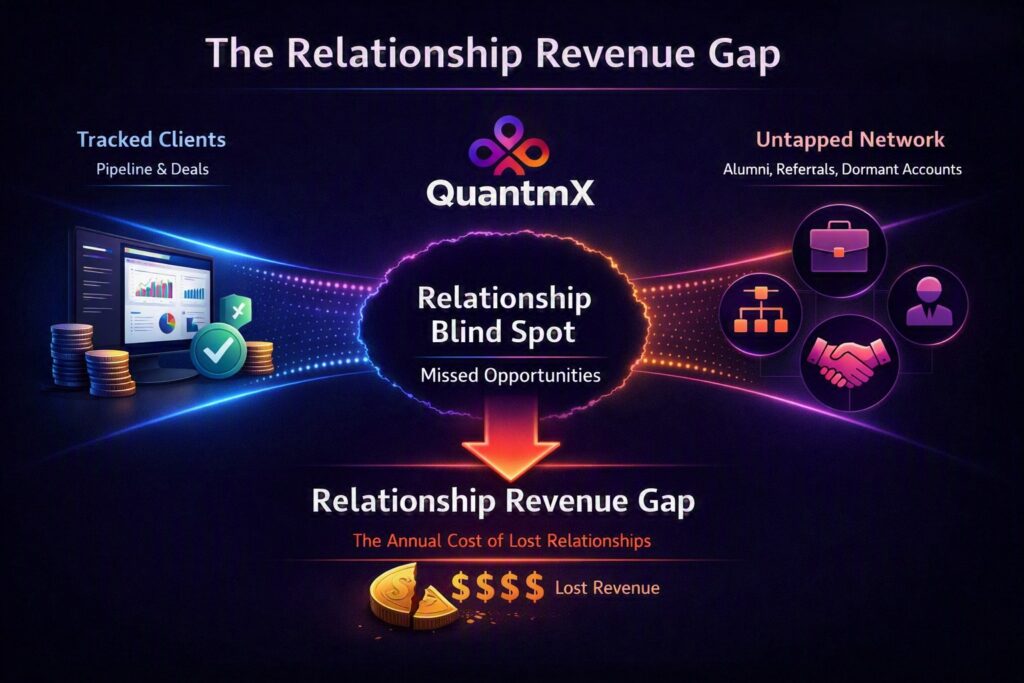
What Is the Relationship Revenue Gap?
The Relationship Revenue Gap is the annual revenue a professional services firm is losing because growth-critical relationships — outside the active client pipeline — are not being systematically managed or progressed.
It is not a metric most firms track. But it is a metric every firm is living with.
Most relationship management systems, including traditional CRMs, are built to track customers. They record transactions, log pipeline stages, and measure closed deals. What they do not do is capture the full ecosystem of relationships that actually drive professional services growth: alumni who have moved into senior buyer roles, referral sources who quietly went cold, strategic partners whose introductions dried up, and dormant clients who would come back — if someone had called.
This is what QuantmX defines as the Relationship Blind Spot: the gap between the relationships a firm is actively tracking and the full network of relationships driving — or capable of driving — growth.
The Relationship Revenue Gap is the financial cost of that blind spot, calculated annually.
Why This Matters More Than Most Firms Realize
The numbers on referral and relationship-led revenue in professional services are stark.
- For professional services firms, 85% of new business comes from referrals. Yet most firms have no system for tracking referral source health, managing partner relationships, or knowing when an introduction pipeline has gone cold. (Meetanshi)
- Referrals convert at 58% compared to just 3% for cold outreach — making them 19 times more effective for consultants. And referred clients have a lifetime value of $187,450 compared to $67,390 for non-referred clients — a 178% improvement in long-term value.
- On the retention side, the revenue math is equally compelling. A business with $2M revenue and 20% annual churn must generate $400,000 in new revenue every year just to stay flat — before accounting for growth. Acquiring new clients costs 5 to 25 times more than retaining existing ones.
- According to Bain & Company, increasing customer retention by just 5% increases profits by 25% to 95%.
- Put this together: if most new business comes from relationships outside the pipeline, and those relationships are not tracked or progressed, the revenue being left on the table is not marginal. It is structural.
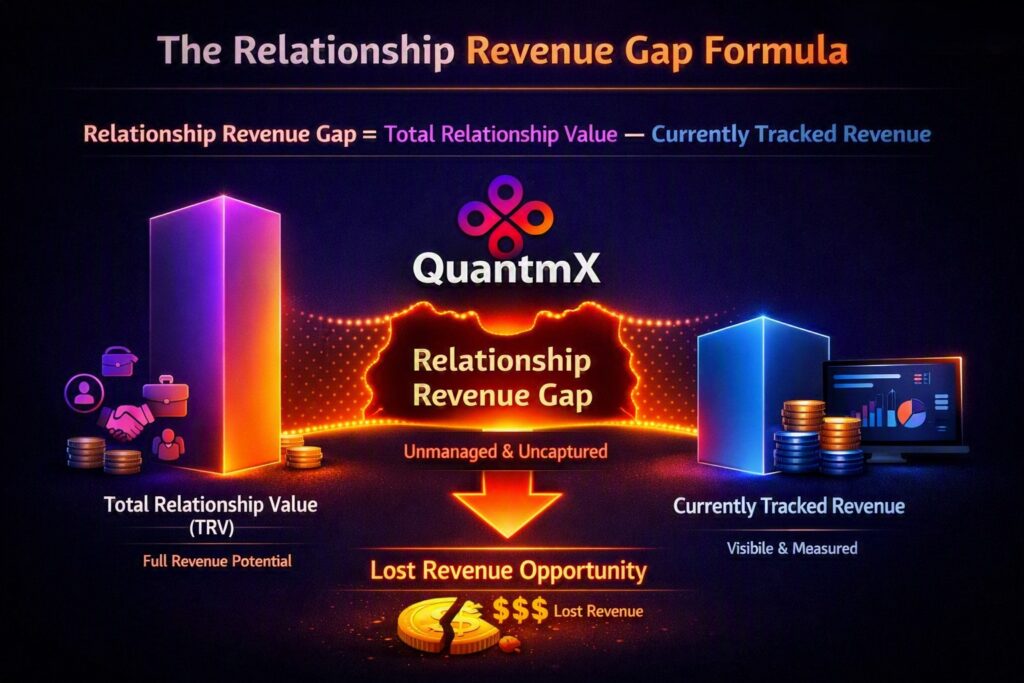
The Relationship Revenue Gap Formula
The Relationship Revenue Gap is calculated by identifying every category of growth-critical relationship a firm runs on, estimating the revenue potential of each, and then measuring how much of that potential is currently unmanaged or inactive.
Here is the formula:
- Relationship Revenue Gap = Total Relationship Value (TRV) − Currently Tracked Revenue
- Breaking this down:
- Total Relationship Value (TRV) is the sum of revenue potential across all relationship categories — not just active clients, but alumni, partners, referral sources, dormant clients, advisors, and investors.
- Currently Tracked Revenue is the revenue your firm can see and measure today: active pipeline, current client base, booked recurring work.
The gap between the two is your annual Relationship Revenue Gap — the revenue that exists within your relationship network but is not being captured because it is outside the system.
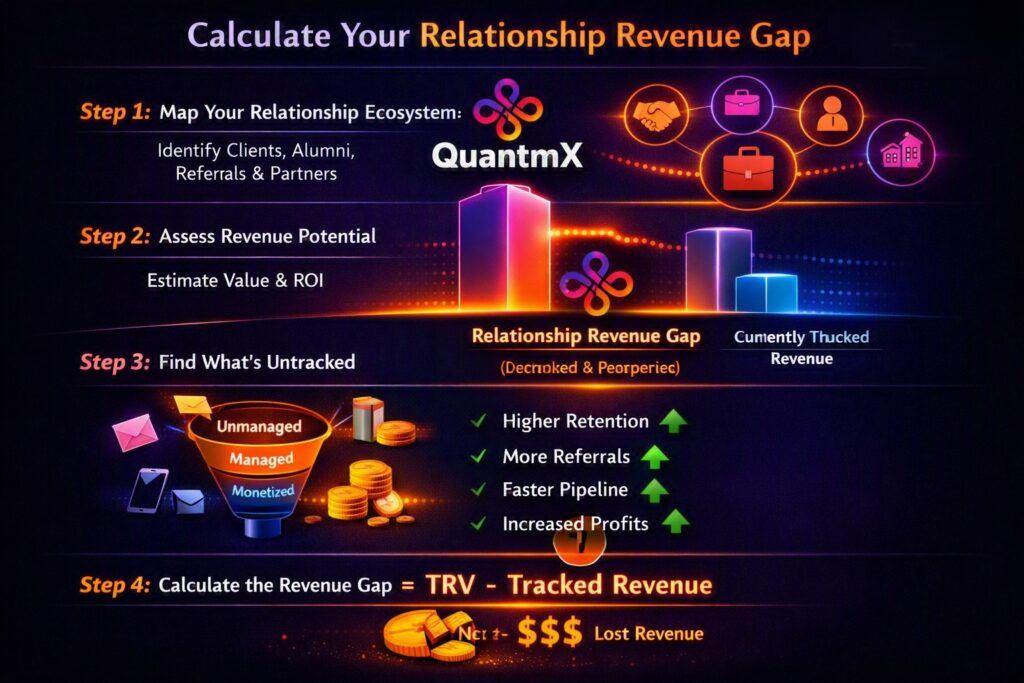
Step-by-Step: How to Calculate Your Relationship Revenue Gap
Step 1 — Map Your Full Relationship Ecosystem
List every category of relationship that drives or could drive revenue for your firm. For most professional services firms, this includes:
- Active clients
- Dormant clients (no engagement in the last 6–18 months)
- Alumni (former clients who have moved into new roles)
- Referral sources (introducers, advisors, complementary firms)
- Strategic partners
- Investors and advisors with network influence
Most firms can account clearly for the first category. The others are scattered across inboxes, spreadsheets, and senior partners’ memories.
Step 2 — Assign a Revenue Potential to Each Category
- For each relationship category, estimate:
- Average annual revenue per active relationship in that category
- Number of relationships currently in that category (active and dormant)
- Estimated conversion or re-engagement rate
For example: if a firm has 20 dormant clients with an average annual contract value of $40,000, and a realistic re-engagement rate of 25%, the potential revenue from that single category is $200,000 per year — invisible to any standard pipeline report.
Step 3 — Identify What Is Outside the System
- Which of these relationships have no assigned owner?
- Which have not had a meaningful touchpoint in more than 60 days?
- Which exist only in someone’s phone or email?
- This is where most firms discover the size of their gap.
The percentage of new clients that professional services firms attracted in 2024 fell to 29.3% from 31.3% in 2023 — a trend that makes the untapped value in existing relationship networks even more significant. Client retention and account expansion are becoming more critical as key revenue drivers. (Deltek)
Step 4 — Calculate the Gap
- Once you have estimated TRV across all categories and compared it to your currently tracked revenue, the difference is your Relationship Revenue Gap.
- Most firms that run this calculation for the first time find the number significantly higher than expected — often representing 30–40% of current annual revenue.
- The QuantmX Revenue Gap Calculator lets you run this calculation using your firm’s own numbers in under 90 seconds.
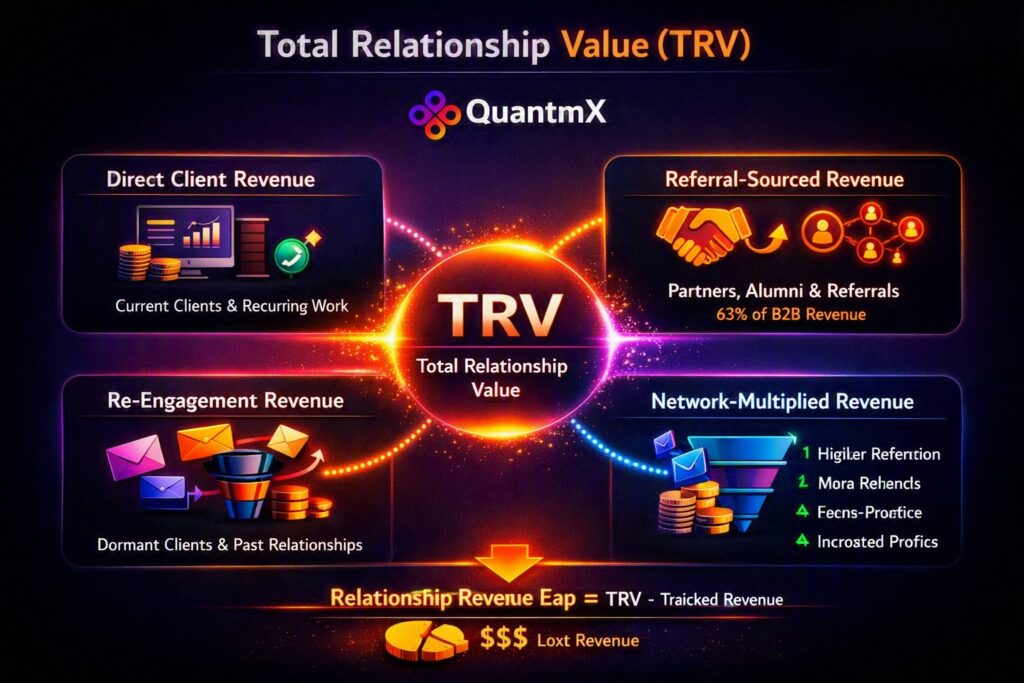
What Is Total Relationship Value (TRV)?
Total Relationship Value is the framework at the center of relationship revenue gap analysis. It extends beyond customer lifetime value (CLV) — which measures the revenue from a single client relationship over time — to capture the full network of relationships that generate revenue for a professional services firm.
TRV has four components:
- Direct client revenue — active and recurring work from current clients.
- Referral-sourced revenue — revenue generated through introductions from partners, alumni, and referral sources. Given that 63% of B2B revenue comes from existing clients and referrals combined, this is typically the largest unmeasured component of TRV.
- Re-engagement revenue — revenue from dormant clients and former relationships who return. The probability of closing an upsell to a current client is 60–70% versus just 5–20% for a cold prospect — and dormant clients who had a strong prior relationship sit closer to the former than the latter.
- Network-multiplied revenue — revenue generated through second-degree connections: introductions that referral sources themselves facilitated, or alumni who brought in new relationships at their new organizations.
Most firms measure only the first component with any consistency. The gap between what is measured and what exists across all four components is the Relationship Revenue Gap.
Why Relationship ROI Is Different From Standard Marketing ROI
- Standard marketing ROI measures the return on a campaign, channel, or acquisition spend.
- Relationship ROI measures the return on the quality, coverage, and progression of a firm’s relationship network.
- The distinction matters because the drivers are different.
- Relationship ROI is not improved by spending more on ads. It is improved by:
- assigning ownership to every growth-critical relationship,
- tracking health signals before momentum is lost,
- and ensuring that progression — the next call, the introduction, the follow-up — actually happens.
For professional services firms, the highest-ROI growth investment is often not a new marketing channel. It is a systematic approach to progressing the relationships already in the network.
What Happens When You Close the Gap
- Firms that bring their full relationship ecosystem into a structured system see measurable changes across four dimensions:
- Retention improves because decay is caught early — before a client quietly routes work elsewhere. 75 to 80% of revenue in most businesses comes from existing customers. Losing them is not just churn; it is revenue collapse.
- Referral conversion increases because referral source relationships are maintained and prioritized, not left to individual partner memory.
- Pipeline velocity accelerates because alumni and dormant clients — already familiar with the firm — re-engage faster than cold prospects.
- Revenue becomes more predictable because growth is no longer dependent on who happened to make a call last week.
- High-performing professional services firms at the top maturity level saw a 739% increase in revenue growth and a 537% boost in profit margins compared to the lowest-performing firms.
- The variable that separates them is not talent or service quality alone. It is how systematically they manage the relationships their growth depends on. (SPI Research / Service Performance Insight, cited via Kantata)

The Bottom Line
Most professional services firms are sitting on a significant amount of unmeasured, unmoved revenue. It lives in the relationships outside the pipeline — the partner who hasn’t been called, the alumna who changed roles, the referral source who quietly went cold.
The Relationship Revenue Gap gives that revenue a name and a formula. Total Relationship Value gives it a framework. And a Relationship Growth Platform gives it a system.
If you want to see what the Relationship Blind Spot is costing your firm, QuantmX’s Revenue Gap Calculator runs the numbers using your firm’s own data in under 90 seconds.
Calculate Your Revenue Gap at QuantmX.ai
Frequently Asked Questions
Q: What is the Relationship Revenue Gap?
A: The Relationship Revenue Gap is the annual revenue a professional services firm is losing because growth-critical relationships — alumni, partners, referral sources, dormant clients, advisors — are not being tracked or actively progressed. It is the financial cost of the Relationship Blind Spot.
Q: How do I calculate my Relationship Revenue Gap?
A: Start by mapping every category of relationship that drives revenue for your firm — not just active clients. Assign an estimated revenue potential to each category based on average contract value and a realistic re-engagement or conversion rate. Then compare that Total Relationship Value to your currently tracked revenue. The difference is your Relationship Revenue Gap. QuantmX’s Revenue Gap Calculator lets you run this in 90 seconds using your firm’s own numbers.
Q: What is Total Relationship Value (TRV)?
A: Total Relationship Value is a framework that captures the full revenue potential of a firm’s relationship network — including:
- Active clients,
- referral-sourced revenue,
- re-engagement revenue from dormant clients,
- and network-multiplied revenue from second-degree introductions.
- Most firms only measure the first component consistently.
Q: What is relationship ROI and how is it different from marketing ROI?
A: Relationship ROI measures the return on the quality and progression of a firm’s relationship network, not the return on a specific campaign spend. It improves through:
better ownership,
coverage,
and health monitoring of growth-critical relationships — not through additional acquisition spend.
Q: What is business relationship management?
A: Business relationship management is the systematic practice of tracking, maintaining, and progressing every relationship that drives growth — not just customer transactions. In professional services, this includes:
- clients,
- partners,
- alumni,
- referral sources,
- advisors,
- and investors.
Q: How much revenue do professional services firms typically lose to unmanaged relationships?
A: It varies by firm size and structure, but firms running the Revenue Gap calculation for the first time typically find the gap represents 30–40% of current annual revenue. Given that 85% of new business in professional services comes from referrals — most of which are relationship-dependent — the size of the gap is rarely surprising once it is visible. (Meetanshi)
Q: What does QuantmX do to close the Relationship Revenue Gap?
A: QuantmX is the first Relationship Growth Platform built to actively progress every growth-critical relationship a firm runs on — clients, alumni, partners, referral sources, advisors, and investors — not just the customer pipeline. It:
- captures interactions,
- assigns ownership,
- surfaces health signals,
- and ensures progression so no important relationship is left to memory or chance.
Q: How does QuantmX help law firms specifically?
A: Law firm growth depends on relationships a legal CRM typically never captures. QuantmX tracks these directly and flags when they need attention:
- Referring attorneys at other firms whose introduction volume has dropped
- Former partners who moved in-house and became client-side decision makers
- Alumni who landed general counsel roles at potential client companies
- Bar association and professional network contacts with no assigned owner
Q: Is QuantmX useful for accounting and advisory firms?
A: Accounting firms run on seasonal client cycles and high partner turnover, both of which create blind spots that practice management software doesn’t catch. QuantmX surfaces the drift before it becomes lost revenue:
- Clients active during tax season with no contact since
- Referral sources who have quietly stopped sending audit or advisory work
- Dormant clients from prior engagement cycles with no re-engagement owner
- Partner-level relationships that exist only in one person’s inbox
Q: Does QuantmX work for marketing and creative agencies?
A: Agency growth runs on relationships outside the active retainer list — most of which have no formal owner or system of record. QuantmX brings structure to that network:
- Former clients who move to new companies and become buyers again
- Freelancer and subcontractor networks tied to specific accounts
- Referral partnerships with complementary agencies
- Past pitch contacts who went cold but never formally closed out
Q: How does QuantmX apply to wealth management and financial advisory firms?
A: In wealth management, two relationship categories tend to drive the most new assets under management — and both usually live only in an individual advisor’s memory. QuantmX gives the firm a shared system for:
- Referral sources such as CPAs, estate attorneys, and other centers of influence
- Dormant prospects and former clients who left during a life transition
- Introductions that never converted but remain warm
- Advisor-level relationships with no firm-wide visibility
Q: Can engineering and architecture firms use QuantmX?
A: Engineering and architecture firms depend on repeat work and referrals across project cycles that span months or years — and the relationship often goes cold between engagements even when trust is intact. QuantmX keeps ownership assigned in the gaps:
- General contractors and developers from past projects
- Past clients likely to commission follow-on work
- Referral partners in adjacent disciplines
- Project-based contacts with no post-delivery touchpoint plan