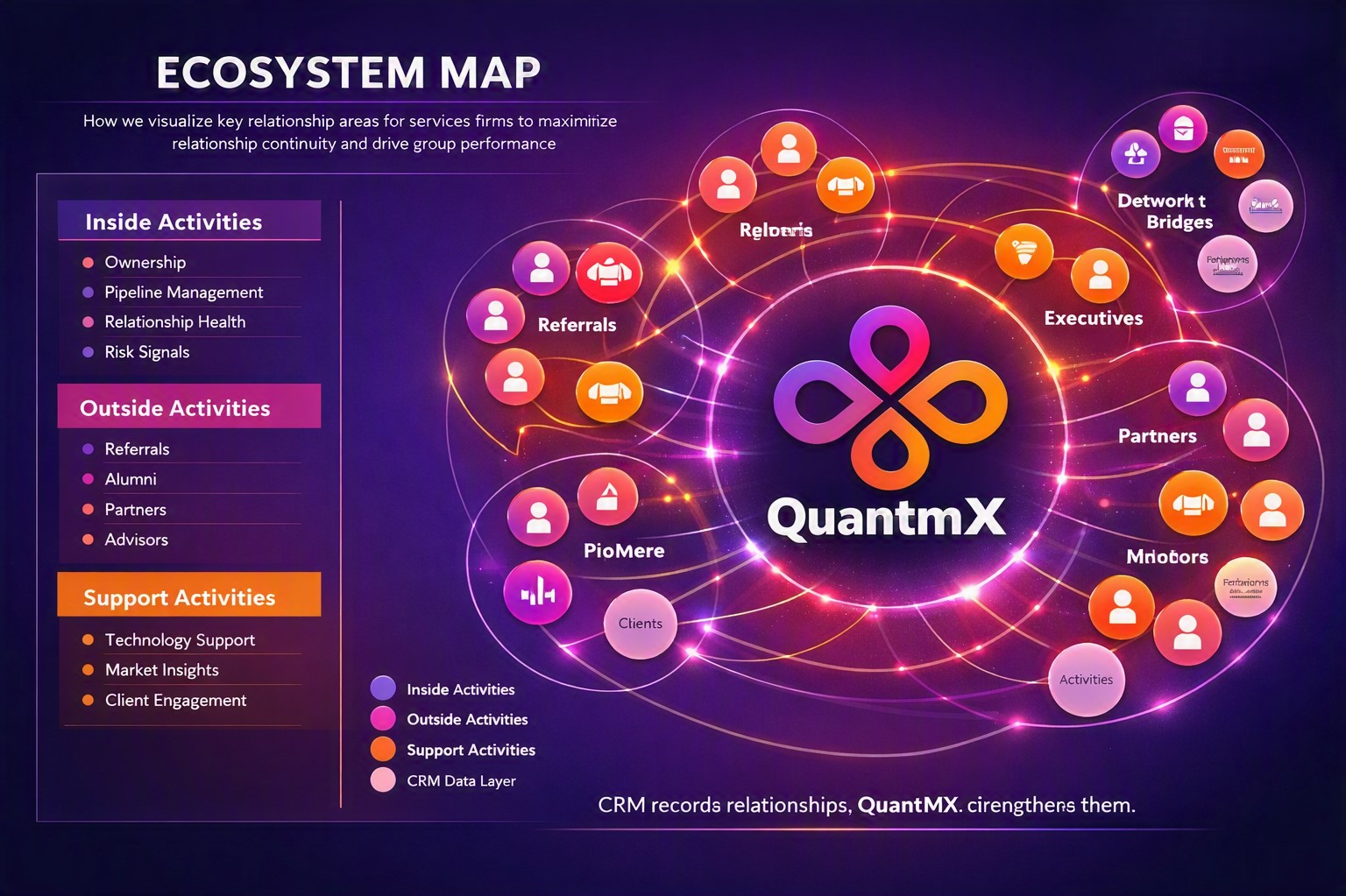
Most professional services firms don’t wake up one day and decide to leave their CRM. It happens gradually — a partner stops logging calls because “the system doesn’t capture what actually matters,” a referral source goes quiet and nobody notices until the pipeline dries up, an associate leaves and takes two years of relationship context with them because none of it lived anywhere but their inbox. One day someone finally says it out loud: professional services firms are outgrowing their CRM, and the tool that was supposed to protect the firm’s most valuable relationships has quietly become the place where those relationships go to be forgotten.
This isn’t a knock on CRM as a category. Salesforce, HubSpot, and their peers do exactly what they were built to do — manage a sales pipeline, track deal stages, and report on forecasted revenue. The problem is that professional services firms don’t run on pipelines. They run on relationships: referral sources who send work for years, alumni who become clients again, partners who introduce the next deal, advisors who vouch for the firm in rooms the firm will never see. A CRM records that those relationships exist. It was never built to actively grow them.
What “Outgrowing Your CRM” Actually Looks Like
Firms rarely notice they’ve outgrown their CRM until the symptoms pile up. A few patterns show up again and again:
- The CRM is full of contacts, but nobody can say who’s active. Thousands of records, no signal on which relationships are progressing and which have gone cold.
- Relationship knowledge lives in people’s heads, not the system. Ask a partner who their best referral source is this quarter, and they’ll answer from memory — not from a dashboard.
- Reporting shows pipeline health, not relationship health. Leadership can see what’s in the deal stage funnel but has no visibility into the Relationship Blind Spot sitting just outside it — the dormant alumni, quiet referral sources, and stalled partner introductions that never show up as a “deal.”
- Every partner departure is a mini crisis. When someone senior leaves, the firm discovers how much relationship equity walked out the door with them, because none of it was ever systematized.
None of these are CRM failures in the technical sense. The software works exactly as designed. They’re symptoms of asking a pipeline-tracking tool to do a job it was never built for.
Why CRM Was Never Built for Relationship-Led Growth
CRM stands for customer relationship management — but “management” in practice means recording: logging a call, updating a deal stage, noting the last touchpoint. That’s a passive model. It assumes someone already knows who matters and is doing the work of nurturing that relationship; the CRM just writes it down after the fact.
Professional services firms don’t grow that way. Growth comes from relationships that are actively progressed — a dormant referral source re-engaged, a former client brought back into the fold, a strategic partner moved from “occasional intro” to “consistent pipeline source.” A traditional CRM has no mechanism for that. It has no way to flag that a relationship is decaying, no way to score whether a contact is becoming more or less valuable over time, and no way to prompt anyone to act before the relationship goes cold.
This is the structural reason professional services firms are outgrowing their CRM: the tool was built for a world where relationships convert once and then get handed off to delivery. Professional services works the opposite way — the relationship is the business, long after the first engagement closes.
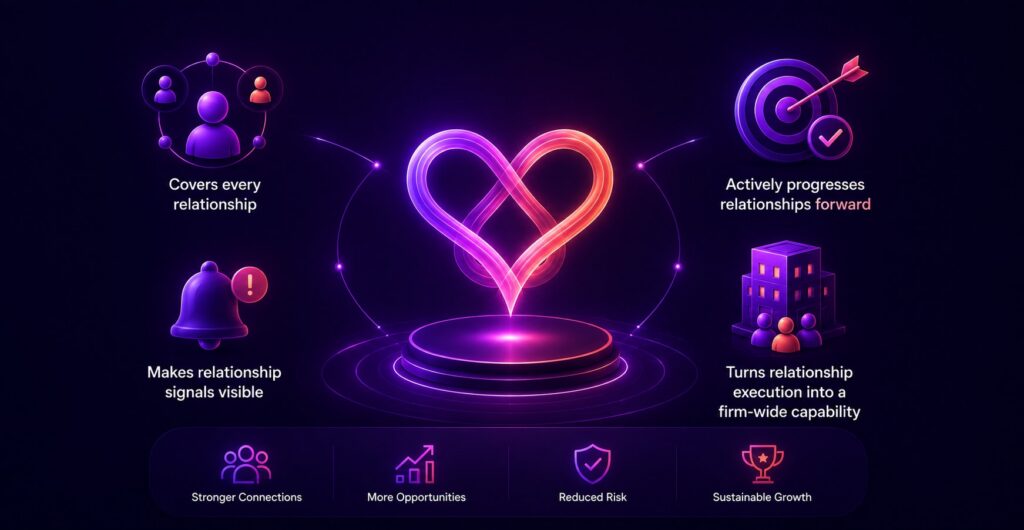
The Real Cost of Staying on a CRM Built for Pipeline, Not Relationships
Firms that stay too long on a CRM built for pipeline tracking tend to pay for it in three places.
Revenue Gap. Every firm has a Revenue Gap — the difference between what its existing relationships could produce and what they’re actually producing. A dormant alumni network, referral sources nobody’s spoken to in eight months, a partner’s rolodex that never made it into any system: all of it represents revenue the firm is entitled to and isn’t collecting, simply because nothing in the CRM tells anyone it’s there.
Scope Blindness. Most CRMs are scoped to “customers” — active clients, open deals. Everything outside that scope (alumni, advisors, investors, referral partners) either doesn’t get entered at all or gets entered and then ignored, because the system has no workflow built around it. That’s Scope Blindness: the firm can only manage what the software was scoped to see.
Progression Blindness. Even for the relationships that are in the CRM, there’s rarely any signal on whether they’re moving forward, standing still, or quietly decaying. A contact record updated eight months ago looks identical to one updated yesterday. Without a way to measure relationship progression, firms can’t tell the difference between a relationship that’s healthy and one that’s already gone cold — until it’s too late to do anything about it.
Together, these three gaps compound. A firm loses track of relationships it should be growing (Revenue Gap), stops seeing entire categories of relationships that matter (Scope Blindness), and can’t tell which of the relationships it does see are still alive (Progression Blindness). None of this shows up as a CRM bug. It shows up as slower growth, more partner-dependent business development, and revenue that should have renewed itself quietly disappearing instead.
Signs Your Firm Has Outgrown Its CRM
A firm is usually ready to move beyond CRM when several of the following are true at once:
- Business development still runs almost entirely on individual partners’ personal networks, not on a system the whole firm can see.
- Nobody can produce a current list of the firm’s active referral sources without asking around first.
- Alumni are tracked in a spreadsheet, an email list, or nowhere at all — not inside the system of record.
- The firm has no consistent way to know which client, partner, or referral relationships are trending toward disengagement.
- Onboarding a new partner means starting their relationship network from zero, because nothing transfers cleanly from the departing partner’s CRM records.
- Growth planning is based on pipeline forecasts alone, with no visibility into the relationship capital sitting outside the pipeline.
If most of these sound familiar, the CRM isn’t broken — it’s just being asked to do a job outside its scope.
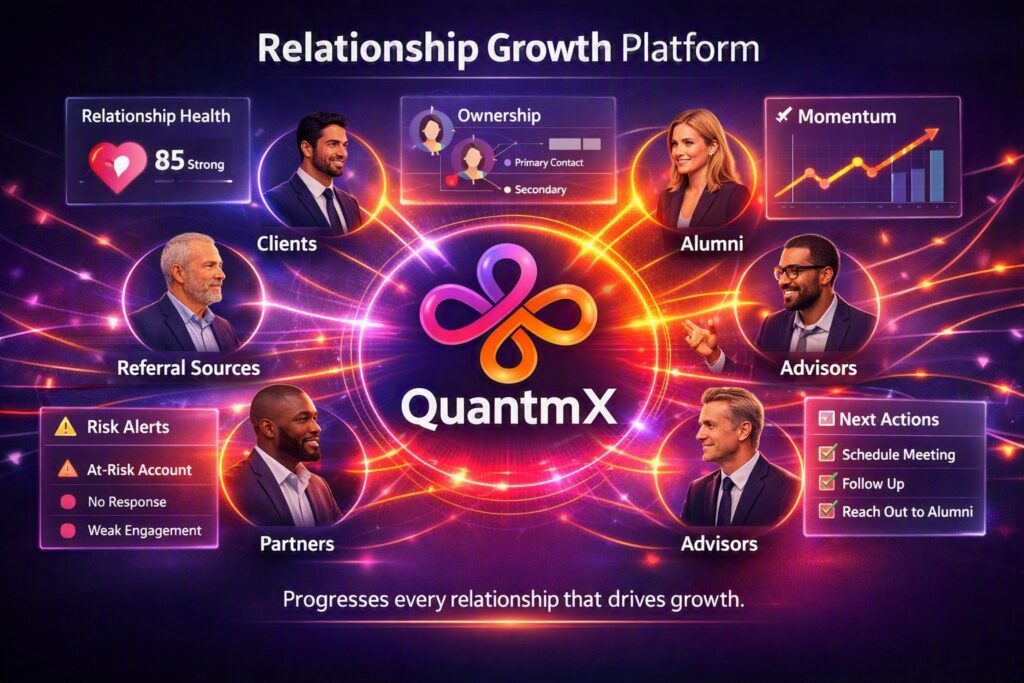
What Comes After CRM: The Relationship Growth Platform
The firms solving this problem aren’t replacing their CRM with a better CRM. They’re moving to a different category entirely: a Relationship Growth Platform.
Where a CRM records what already happened, a Relationship Growth Platform is built to actively progress every relationship that drives growth — clients, referral sources, alumni, partners, advisors, and investors — not just the accounts sitting in an open pipeline. It closes the Revenue Gap by surfacing which relationships are dormant and worth reactivating. It removes Scope Blindness by tracking every relationship type that matters to a services firm, not just active customers. And it addresses Progression Blindness directly, by scoring relationship health and flagging decay before a referral source or alumni contact goes quiet for good.
This is the shift behind the CRM vs. Relationship Growth Platform comparison firms are increasingly having internally: not “which vendor has better features,” but “does our system of record actually understand how our firm grows.” For a professional services firm, that answer determines whether relationship equity compounds over time or quietly leaks away one partner departure and one forgotten referral source at a time.
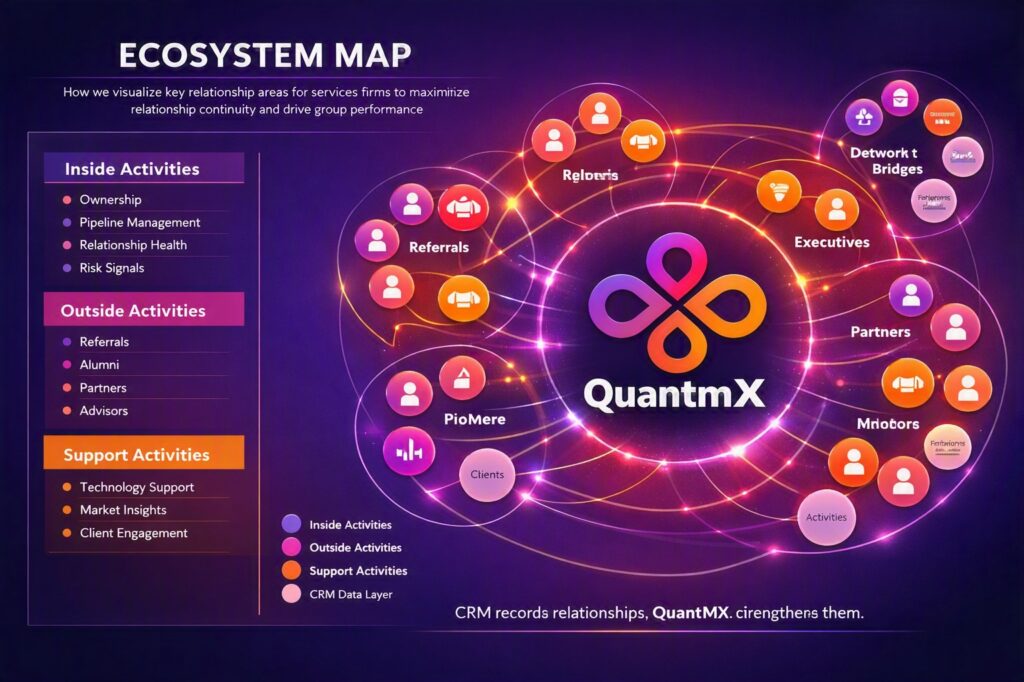
How to Know When It’s Time to Move
Moving off a CRM is rarely about the software itself — it’s about whether the firm’s growth model has outgrown what the software was designed to track. If the firm’s growth still depends on a handful of partners remembering who to call, and there’s no system-wide view of Total Relationship Value across clients, referral sources, alumni, and partners, that’s the clearest signal that the current CRM has reached its ceiling. The fix isn’t a CRM add-on or a better dashboard — it’s a platform built around relationships as the unit of growth, rather than deals as the unit of record.
Frequently Asked Questions
- What does it mean for a firm to “outgrow” its CRM?
It means the firm’s relationships — referral sources, alumni, partners, advisors — have grown more complex and more valuable than what a pipeline-tracking tool was ever designed to manage. The CRM still works technically; it just no longer reflects how the firm actually grows.
2. Is this a sign the firm needs a bigger or more expensive CRM?
Not necessarily. A more expensive CRM still records relationships rather than actively progressing them. The gap firms hit isn’t about CRM tier — it’s about category. A bigger CRM with more fields doesn’t fix Progression Blindness or Scope Blindness; it just gives the firm more places to log information nobody acts on.
3. How do I know if my firm has a Relationship Blind Spot?
Start by asking whether anyone can produce, without checking with a partner first, an up-to-date list of active referral sources, dormant alumni, and stalled partner introductions. If the honest answer is “not easily,” the firm likely has a Relationship Blind Spot the CRM isn’t surfacing.
4. What’s the difference between a CRM and a Relationship Growth Platform? A CRM records what happened in a relationship after the fact. A Relationship Growth Platform actively tracks relationship health, flags decay, and prompts action — treating every relationship type as something to be progressed, not just logged.
5. Does outgrowing a CRM mean the firm has to rip everything out at once?
No. Most firms transition gradually, layering relationship intelligence on top of existing workflows before fully migrating. The priority is closing the visibility gap first — knowing what relationships exist and how they’re trending — before deciding on a full platform switch.
6. What’s the biggest risk of staying on a CRM built for pipeline tracking? Revenue that should renew itself quietly disappearing — dormant referral sources, disengaged alumni, and stalled introductions that never show up as a lost deal because they were never tracked as an open opportunity in the first place.
7. Why do law firms outgrow their CRM faster than most industries?
Law firm growth depends heavily on referral networks between firms and individual attorney relationships that predate any given matter. A CRM tuned to matter management rarely tracks referral sources or alumni attorneys as first-class relationships, leaving firms blind to where new business actually originates.
8. How does this apply to accounting and advisory firms?
Accounting firms often carry large alumni networks — former staff who become clients, referral sources, or hire the firm again from a new company. Most CRMs built for engagement tracking have no structured way to manage that alumni layer, so it gets left out entirely.
9. Why is CRM limitation a bigger issue for consulting firms specifically? Consulting firms rely heavily on partner and advisor introductions that happen outside any formal sales process. A pipeline-based CRM only sees a relationship once it becomes a proposal, missing the months or years of relationship-building that led up to it.
10. What about firms with a strong referral-based growth model, like boutique advisory practices?
For referral-dependent firms, the CRM’s blind spot is direct: if referral sources aren’t tracked as an ongoing relationship category with health signals, the firm has no early warning when its best sources of new business start going quiet.
11. Do investor relations or fundraising-adjacent professional services firms face this problem too?
Yes — investor and advisor relationships in this context are long-term and low-frequency, which is exactly the profile a transaction-oriented CRM tends to underserve. Without progression tracking, these relationships can go a year without contact before anyone notices.
12. How does partner departure risk connect to CRM limitations in partnership-based firms?
In partnership models, a departing partner often takes relationship context that was never captured in the CRM to begin with — referral sources, informal introductions, and alumni ties that lived in personal notes rather than the system of record. Firms without a Relationship Growth Platform have no way to preserve that continuity when a partner leaves.