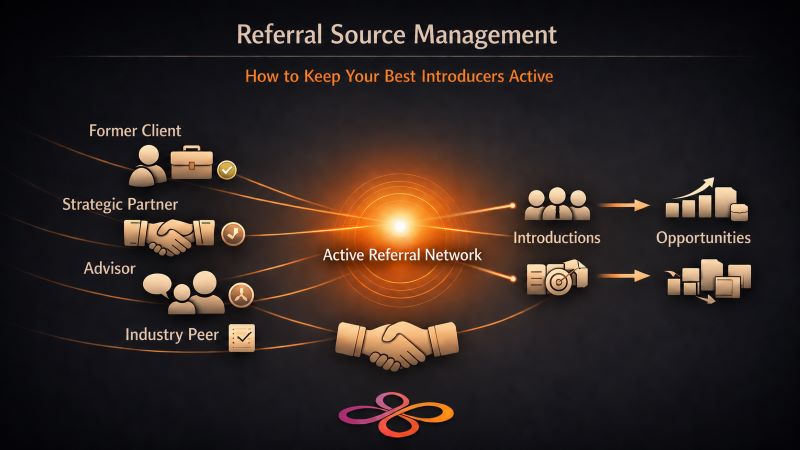
Referral source management is the process of identifying, tracking, nurturing, and measuring the people and organizations that consistently introduce new clients, opportunities, or relationships to your firm.
For professional services firms, referral sources can include:
- Former clients
- Current clients
- Industry peers
- Strategic partners
- Lawyers, accountants, bankers, and other advisors
- Consultants and complementary service providers
- Alumni
- Investors and executives
- Industry associations and professional networks
The challenge is that most firms know who their referral sources are, but very few systematically manage those relationships.
A referral source may introduce several clients in one year, then receive no meaningful contact from the firm for 12 months. By the time the firm realizes the relationship has gone cold, the referral opportunity may already have moved elsewhere.
That is why referral source management should be treated as a growth discipline, not simply a networking activity.
Professional services firms sell expertise, trust, and outcomes. That makes recommendations from people who already understand the firm’s capabilities particularly valuable.
Research from Hinge has found that generating more referrals is a major marketing priority for professional services firms, while its research into referral marketing also shows that firms can receive referrals from people and organizations they have not necessarily worked with directly.
Industry research also continues to highlight the importance of referrals in professional services. One 2026 analysis reports that more than half of consultants surveyed generate 60% or more of their business through referrals.
The implication is straightforward:
Your referral network is not simply a collection of contacts. It is a potential revenue channel.
But that channel only works when the relationships behind it remain active.
What Is Referral Source Management?
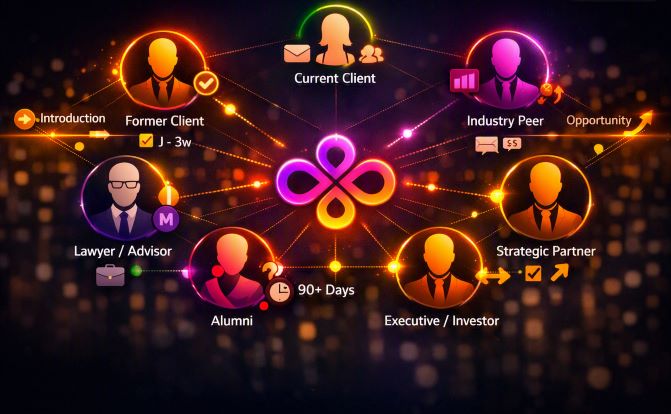
Referral source management is the structured process of managing the relationships that can generate introductions and new business for your firm.
A strong referral source management process answers five questions:
Who are our most valuable referral sources?
How strong is each relationship today?
When did we last have a meaningful interaction?
Who owns the relationship internally?
What should happen next?
This is different from simply maintaining a contact database.
A CRM might tell you:
John Smith — Partner, ABC Advisory — Last email: March 14.
Referral source management should tell you:
John Smith is a high-value referral source, relationship momentum has declined over the last six months, Sarah owns the relationship, and a strategic catch-up should happen this month.
That difference matters.
Recording a relationship is not the same as managing it.
Why Good Referral Sources Go Quiet
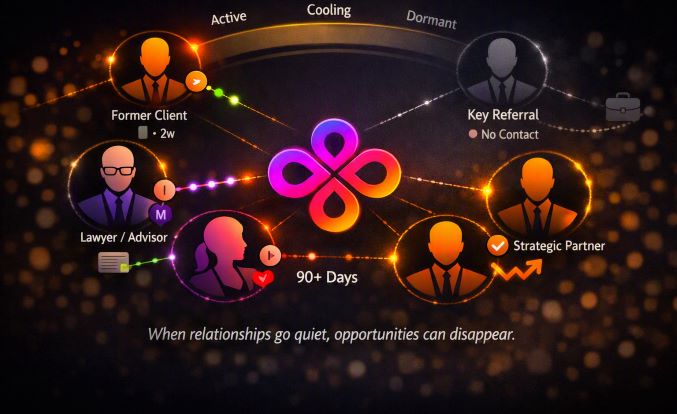
Referral relationships rarely disappear overnight.
They usually weaken gradually.
Common causes include:
- No one clearly owns the relationship
- The relationship depends entirely on one senior partner
- Follow-ups are inconsistent
- The firm contacts the source only when it wants a referral
- The source changes jobs or organizations
- The source’s priorities change
- The firm fails to provide useful value between referrals
- Previous introductions are not acknowledged properly
- There is no record of the relationship history
- Internal teams do not know who has the strongest connection
This creates what QuantmX describes as a Relationship Blind Spot: the firm can see its clients and pipeline, but not necessarily the broader network of relationships that can create future growth.
That broader network can include referral sources, alumni, strategic partners, dormant clients, and other influential relationships.
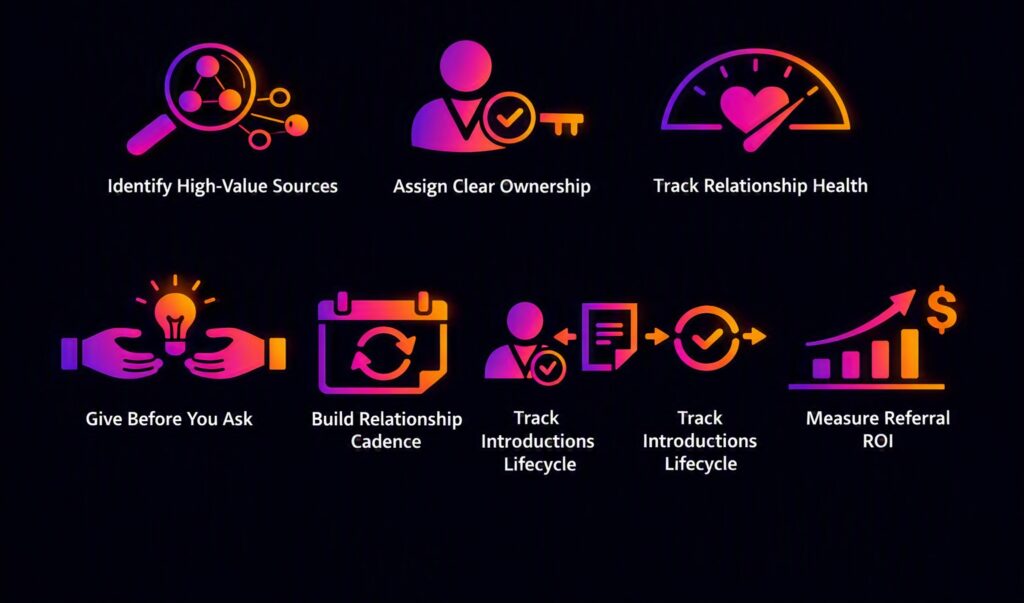
The 7 Principles of Effective Referral Source Management
1. Identify Your Highest-Value Referral Sources
Not every contact deserves the same level of attention.
Start by categorizing referral sources based on:
- Number of introductions
- Revenue generated from introductions
- Quality of referred opportunities
- Strategic fit
- Industry relevance
- Seniority and influence
- Relationship strength
- Likelihood of future introductions
- Access to your ideal clients
For example, a professional services firm may have 500 people in its broader network but only 30 people who consistently influence its target market.
Those 30 relationships deserve disproportionate attention.
A simple segmentation model
Tier 1 — Strategic referral sources
- Regular introductions
- High-value opportunities
- Strong relationship
- Strong alignment with your ideal client
Tier 2 — Emerging referral sources
- Some introductions
- Good market alignment
- Relationship has growth potential
Tier 3 — Network contacts
- Limited referral activity
- Potential future value
- Requires occasional nurturing
The objective is not to ignore Tier 3.
It is to ensure your highest-value relationships receive the attention they deserve.
2. Assign Clear Ownership
One of the biggest problems with referral relationships is shared responsibility.
When everyone owns a relationship, nobody necessarily owns the next action.
Every important referral source should have:
- One primary relationship owner
- A backup relationship owner where appropriate
- A record of previous interactions
- A clear next action
- A defined follow-up cadence
This is especially important as professional services firms grow.
A relationship that once lived inside one partner’s memory can become invisible when that partner becomes busy, changes roles, or leaves the firm.
Relationship ownership turns:
“Someone should probably call them.”
into:
“Sarah owns this relationship and the next action is a strategic conversation this month.”
That is a much more scalable model.
3. Track Relationship Health, Not Just Referral Counts
Counting referrals is useful.
It is not enough.
Consider two referral sources.
Referral Source A
- 5 referrals last year
- No interaction for 10 months
- One senior partner owns the relationship
- No recent mutual value
- Contact recently changed roles
Referral Source B
- 2 referrals last year
- Monthly meaningful interactions
- Three people at the firm know the source
- Strong strategic alignment
- Two potential introductions currently being discussed
Which relationship is healthier?
Referral count alone cannot answer that question.
A better referral source score can include:
- Recency
- Frequency
- Engagement
- Responsiveness
- Relationship depth
- Ownership
- Strategic value
- Referral history
- Current opportunity potential
This is consistent with the broader relationship-health framework used in relationship intelligence, where relationship strength can be assessed using signals such as recency, frequency, engagement, continuity, momentum, and strategic value.
4. Give Before You Ask
One of the easiest ways to damage a referral relationship is to contact someone only when you need an introduction.
Strong referral relationships are reciprocal.
You can create value by:
- Sharing relevant market intelligence
- Introducing the source to someone useful
- Sending a relevant research report
- Inviting them to an industry event
- Sharing a potential client or partner
- Offering expertise on a problem they are facing
- Congratulating them on a career move
- Connecting them with someone in your network
The objective is simple:
Become useful before you become needy.
A referral source should think:
“This firm understands my world and makes my network stronger.”
Not:
“They only call when they want business.”
5. Build a Referral Relationship Cadence
Good intentions do not create consistent relationship management.
A simple cadence can help.
High-value referral sources
Monthly
- Meaningful conversation
- Relevant insight or introduction
- Relationship health review
Quarterly
- Strategic conversation
- Review mutual opportunities
- Identify possible introductions
Annually
- Relationship review
- Assess value generated
- Revisit goals and priorities
Emerging referral sources
Quarterly
- Personal check-in
- Share something useful
- Identify opportunities to collaborate
The cadence should be personalized.
A senior partner who regularly exchanges strategic conversations with you does not need the same outreach pattern as a contact you barely know.
6. Track Introductions From Start to Finish
A referral is not complete when an introduction email arrives.
It has a lifecycle:
Referral source → Introduction → First conversation → Qualified opportunity → Proposal → Won/Lost → Follow-up with source
Every stage matters.
For each introduction, track:
- Who made the introduction
- Date of introduction
- Referred company
- Referred contact
- Opportunity value
- Relationship owner
- Current opportunity stage
- Next action
- Outcome
- Follow-up with the referral source
This creates an important feedback loop.
You can identify:
- Which sources generate the most opportunities
- Which sources generate the highest-value opportunities
- Which sources generate the best-fit clients
- Which introductions convert
- Where referrals are getting stuck
- Which sources have become inactive
That is much more valuable than simply counting introductions.
7. Measure Referral Source ROI
Referral relationships should ultimately connect to business outcomes.
Useful metrics include:
Referral volume
How many introductions did each source generate?
Referral conversion rate
What percentage of referred opportunities became clients?
Referral revenue
How much revenue came from each referral source?
Average referred-client value
How valuable are referred clients compared with other acquisition channels?
Time to conversion
How quickly do referred opportunities move through the pipeline?
Relationship activity
How frequently does the firm have meaningful interactions with the source?
Relationship health
Is the relationship strengthening, stable, or weakening?
Referral concentration
How dependent is the firm on a small number of referral sources?
That last metric is particularly important.
If 70% of referral-generated revenue comes from five people, the firm may have a relationship concentration risk.
What Data Should You Track About Referral Sources?
A practical referral source record should contain more than a name and email address.
At minimum, track:
| Data Point | Why It Matters |
| Referral source | Identifies the relationship |
| Company | Provides organizational context |
| Role | Shows influence and relevance |
| Relationship owner | Establishes accountability |
| Referral history | Shows past contribution |
| Referral revenue | Measures commercial value |
| Last meaningful interaction | Indicates relationship recency |
| Interaction frequency | Shows engagement |
| Relationship health | Identifies risk |
| Potential value | Shows future opportunity |
| Recent job change | Identifies new opportunities |
| Next action | Keeps the relationship moving |
This is where relationship intelligence becomes more useful than traditional contact management.
The goal is not to collect more data.
The goal is to turn relationship data into decisions.
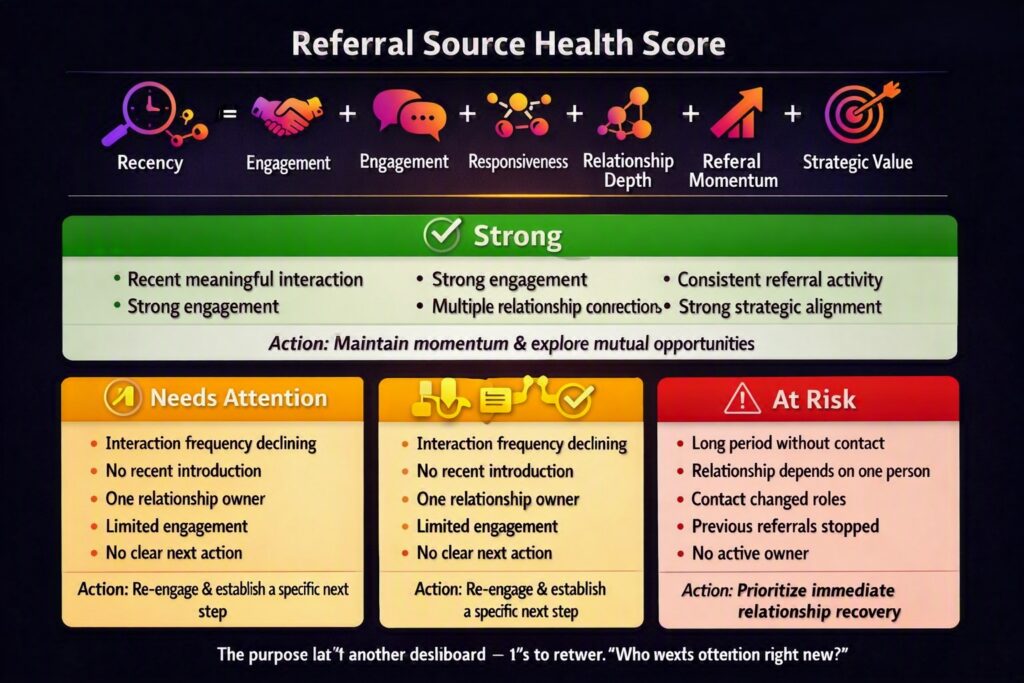
A Simple Referral Source Health Score
Firms can create a simple scoring framework to identify relationships that need attention.
For example:
Referral Source Health = Recency + Engagement + Responsiveness + Relationship Depth + Referral Momentum + Strategic Value
You could score each factor from 1–5.
Green: Strong
- Recent meaningful interaction
- Strong engagement
- Multiple relationship connections
- Clear owner
- Consistent referral activity
- Strong strategic alignment
Action: Maintain momentum and explore mutual opportunities.
Yellow: Needs Attention
- Interaction frequency declining
- No recent introduction
- One relationship owner
- Limited engagement
- No clear next action
Action: Re-engage and establish a specific next step.
Red: At Risk
- Long period without meaningful contact
- Relationship depends on one individual
- Contact changed roles
- Previous referrals have stopped
- No active owner
Action: Prioritize immediate relationship recovery.
The purpose of the score is not to create another dashboard.
It is to answer:
Who needs attention right now?
How AI and Relationship Intelligence Improve Referral Source Management
Traditional referral management depends heavily on people remembering who they should contact.
That does not scale.
AI and relationship intelligence can help firms identify patterns across a much larger relationship network.
For example, a relationship intelligence system can surface:
- Referral sources that have gone quiet
- Contacts who recently changed companies
- High-value relationships without clear ownership
- Referral sources with declining engagement
- Relationships concentrated around one partner
- Previous referral sources who may be worth reactivating
- Contacts connected to multiple high-value relationships
- Relationships with high potential but low current attention
This changes the workflow from:
“Who should I call?”
to:
“Which relationship deserves my attention most?”
That is a significant shift.
Why Referral Source Management Is Especially Important for Growing Firms
Smaller firms can often manage relationships through memory.
A founder knows:
- Who sends referrals
- Who needs a call
- Who recently changed jobs
- Who introduced the last major client
- Who might know the next ideal client
But as the firm grows, that knowledge becomes distributed.
The result can be:
- Relationship information trapped in individual inboxes
- Duplicate outreach
- Missed follow-ups
- Lost context
- Referral sources becoming inactive
- Senior partners becoming relationship bottlenecks
- Opportunities disappearing when employees leave
This is why referral source management becomes increasingly important as a professional services firm scales.
The challenge is not simply generating more relationships.
It is making the firm’s existing relationship capital visible and actionable.
The Cost of Ignoring Referral Relationships
The financial impact of relationship neglect can be significant.
Bain & Company has reported that increasing customer retention by 5% can increase profits by 25% to 95%, illustrating the broader economic importance of maintaining valuable relationships.
Referral relationships create another layer of value because a single strong relationship can influence multiple future opportunities.
Imagine a referral source generates:
- 3 introductions per year
- $75,000 average first-year revenue per client
- 40% conversion rate
That source represents:
3 × $75,000 × 40% = $90,000 in expected annual referral revenue.
Now imagine the relationship goes dormant.
The firm may not see a lost opportunity in its CRM because no deal ever entered the pipeline.
That is the problem.
The opportunity disappeared before it became pipeline.
A Practical Referral Source Management Framework
Professional services firms can implement a simple five-step process.
Step 1: Map
Identify all current and potential referral sources.
Include:
- Clients
- Former clients
- Alumni
- Partners
- Advisors
- Industry peers
- Complementary providers
- Influential executives
Step 2: Segment
Classify sources based on:
- Current value
- Future potential
- Relationship strength
- Strategic fit
- Referral history
Step 3: Assign
Give every priority relationship a clear owner.
Step 4: Activate
Create personalized actions based on relationship health.
Examples:
- Reconnect
- Share insight
- Make an introduction
- Schedule a strategic conversation
- Ask about their priorities
- Explore mutual opportunities
Step 5: Measure
Track:
- Introductions
- Opportunities
- Revenue
- Conversion
- Relationship health
- Engagement
- Next actions
This turns referral management into a repeatable operating process.
Referral Source Management vs. Traditional CRM
A CRM is essential for managing pipeline and customer records.
But referral source management addresses a broader question.
Traditional CRM
- Who is the contact?
- What company are they at?
- What opportunity exists?
- What stage is the deal in?
- What activity occurred?
Relationship intelligence
- Who influences our growth?
- Who introduces us to ideal clients?
- Which relationships are weakening?
- Which relationships have no owner?
- Where are we overly dependent on one partner?
- Which former relationships could become valuable again?
- What should happen next?
The two systems do not need to compete.
In fact, they work best together.
The CRM manages the known commercial process.
Relationship intelligence helps uncover and manage the relationship network that creates the commercial process.
How to Keep Your Best Introducers Active
If you have only a few hours each week for relationship development, start with your highest-value introducers.
Use this checklist:
- Review your top 20 referral sources.
- Identify which relationships have gone quiet.
- Check whether every priority source has an owner.
- Review their last meaningful interaction.
- Identify recent job or company changes.
- Look for opportunities to provide value.
- Schedule personalized conversations.
- Review past introductions and outcomes.
- Thank sources for introductions.
- Track the next action.
- Review referral-source health every quarter.
The most important point is this:
Do not wait until you need a referral to contact the person who could provide one.
The Future of Referral Growth Is Relationship-Led
Referral generation should not be treated as an occasional business-development activity.
For relationship-driven firms, it is an ongoing system.
The strongest firms will increasingly manage referral relationships using:
- Relationship intelligence
- Relationship health scoring
- Clear relationship ownership
- Automated interaction capture
- Referral attribution
- Relationship progression
- AI-assisted prioritization
- Data-driven follow-up
The goal is not to turn relationships into transactions.
It is to make sure valuable relationships receive the attention required to stay valuable.
Your best introducers already know your firm.
They already trust you.
They already have access to the people you want to meet.
The growth opportunity is often not finding more people.
It is managing the right relationships better.
Final Takeaway
Your best referral sources are already part of your network.
The question is whether your firm knows:
- Who they are
- How valuable they are
- How healthy the relationships are
- Who owns them
- When they last engaged
- What they could introduce next
- What your team should do next
That is the purpose of referral source management.
When firms combine relationship intelligence with clear ownership and consistent follow-up, referrals stop being something the firm simply hopes for.
They become a relationship-led growth channel that can be measured, prioritized, and systematically developed.
The best referral source is not necessarily the person who sent you the most business last year. It may be the person whose relationship is becoming valuable—and who your firm is currently failing to manage.
Explore how QuantmX can help you identify and progress the relationships that drive growth through the QuantmX Relationship Growth Platform.
Frequently Asked Questions About Referral Source Management
What is referral source management?
Referral source management is the process of identifying, tracking, nurturing, and measuring relationships with people or organizations that can introduce new clients and business opportunities to a firm.
Why is referral source management important?
Referral source management helps firms protect and grow valuable referral relationships. It ensures important referral sources have clear ownership, regular engagement, and a defined next step rather than becoming inactive or forgotten.
How do you manage referral sources effectively?
Effective referral source management involves:
- Identifying your highest-value referral sources
- Assigning relationship owners
- Tracking referral history and revenue
- Monitoring relationship health
- Maintaining consistent, personalized engagement
- Providing value before asking for introductions
- Tracking referrals from introduction through conversion
What data should you track about referral sources?
Firms should track the referral source’s company, role, relationship owner, referral history, revenue generated, last meaningful interaction, engagement level, relationship health, strategic value, and next action.
How often should you contact a referral source?
There is no single ideal frequency. High-value referral sources may benefit from monthly meaningful interactions, while emerging referral sources may need quarterly engagement. The goal should be relevant, valuable conversations rather than simply increasing the number of touchpoints.
How do you identify your best referral sources?
Look beyond the number of referrals. The best referral sources can be identified by combining:
- Referral volume
- Revenue generated
- Quality of referred opportunities
- Conversion rate
- Strategic fit
- Relationship strength
- Future potential
- Engagement and responsiveness
What are the signs that a referral relationship is becoming inactive?
Common warning signs include:
- Long gaps between meaningful interactions
- Fewer or no recent introductions
- Declining responsiveness
- No clear relationship owner
- Reduced engagement
- A recent job or company change
- No planned next action
Can AI help with referral source management?
Yes. AI and relationship intelligence can analyze relationship data to identify high-value referral sources, detect declining engagement, surface dormant relationships, identify relationship risks, and recommend which relationships deserve attention.
What is the difference between referral source management and referral marketing?
Referral marketing focuses primarily on generating referrals through campaigns, programs, and referral requests.
Referral source management focuses on the relationships behind those referrals—understanding who the sources are, how healthy the relationships are, who owns them, and how to develop them over time.
For professional services firms, both can work together.
How can professional services firms increase referrals?
Professional services firms can increase referrals by identifying their strongest referral relationships, consistently providing value, maintaining regular engagement, making ownership clear, and using relationship data to identify the right opportunities and people to approach.
What is the best way to keep referral sources engaged?
The best approach is to provide value consistently rather than contacting referral sources only when you need a referral.
Share useful insights, make relevant introductions, understand their priorities, and maintain genuine relationships between referral opportunities.