
Relationship ownership accountability is the practice of assigning a clear, named owner to every relationship that matters to a firm’s growth — clients, referral sources, partners, alumni, and advisors — so that someone is always responsible for its health, not just its history.
Most firms assume this already exists. It usually doesn’t.
Ask a managing partner who “owns” a mid-tier client relationship and you’ll often get two or three different answers from two or three different people. Ask who owns a referral source that hasn’t sent work in eight months, and the room goes quiet.
That gap — between assumed ownership and actual accountability — is where relationships quietly decay.
What happens when the owner is unavailable? What happens when the owner leaves? What happens when no one was ever formally assigned in the first place?
Why relationship ownership breaks down
Ownership isn’t usually lost on purpose. It erodes through normal business activity — the kind that happens in every firm, every quarter, without anyone intending harm:
- A partner who originated a relationship moves to a different practice group
- A client is “shared” across two or three people, so no one treats it as theirs
- An associate who managed day-to-day contact leaves the firm
- A relationship starts strong, goes quiet, and no one notices because it was never formally assigned
- Ownership lives in someone’s inbox or memory instead of a shared system
- A firm grows quickly and adds new relationships faster than it can formally assign them
- Two partners both believe the other is maintaining contact, and neither reaches out
- An owner is promoted into a role with less client-facing time, but the relationship isn’t reassigned
Individually, none of these look like a crisis. Together, they create Scope Blindness — the firm can see that a relationship exists, but not who is accountable for keeping it active. And Scope Blindness compounds. The longer a relationship goes unowned, the harder it becomes for anyone to pick it up, because the context that made it valuable — why it mattered, what was discussed last, what the next step should be — has started to fade along with it.
What relationship ownership accountability actually requires
A CRM will tell you who is listed as the “account owner” on a contact record. That is not the same as accountability.
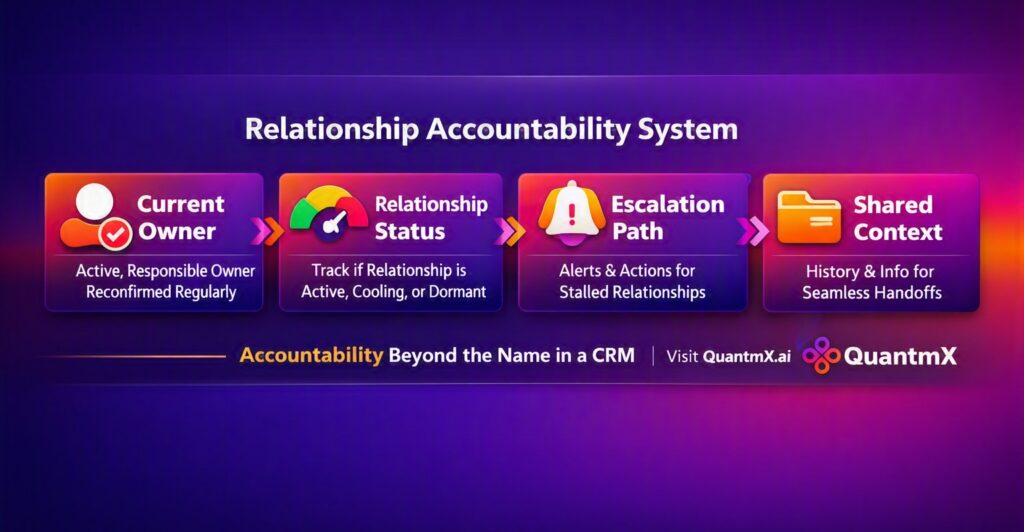
Real ownership accountability requires four things a static contact field can’t provide:
- A named, current owner — not whoever originally entered the contact, but whoever is responsible for it right now. This owner should be reconfirmed periodically, not set once and forgotten.
- Visibility into relationship health — is the relationship active, cooling, or dormant, and can anyone in the firm see that status without asking the owner directly
- A clear escalation path — what happens, and who is notified, when a relationship shows no progression for a defined period
- Shared context — enough history and background that ownership can transfer without the relationship losing momentum, including why the relationship matters and what the next meaningful step should be
Without all four, “ownership” is a label, not a system. A name in a field answers who is nominally responsible. It doesn’t answer whether that person is actually doing anything, whether anyone else could step in if needed, or whether the firm would even notice if the relationship went quiet tomorrow. That last question is usually the one that matters most, because it’s the one firms only ask after something has already gone wrong.
CRM ownership vs. relationship ownership accountability
| What a CRM field shows | What accountability requires |
| Assigned account owner | Confirmed, current owner |
| Static contact record | Live relationship health status |
| Manual reassignment | Structured handover with context |
| Last logged activity | Whether the relationship is progressing |
| One name on one record | Ownership visible across the whole firm |
A CRM answers “who is listed on this account.” Relationship ownership accountability answers “who is responsible for what happens to this relationship next.” Those are different questions, and firms that only answer the first one are exposed to the second.
What ownership accountability looks like in practice
1. Every relationship has one accountable owner — even shared ones
Shared relationships still need a single point of accountability. Multiple people can be involved; only one should be answerable for whether the relationship is progressing.
- Ownership is visible to the whole firm, not just the owner
If a client’s owner is unavailable, someone else should be able to see the relationship’s status, history, and next step without hunting through inboxes.
- Dormant relationships trigger a review, not silence
When a relationship stops progressing, the system should surface it — instead of waiting for someone to notice a client hasn’t been contacted in months.
- Ownership transfers formally, not by accident
When a partner leaves, changes roles, or gets overloaded, relationships should be reassigned deliberately, with context intact — not left to whoever happens to answer the next email.
- Accountability is measured, not assumed
Firms that track ownership as a metric — not just a field — can see where relationships are under-owned, over-concentrated, or falling through the cracks.
Why this connects to Total Relationship Value
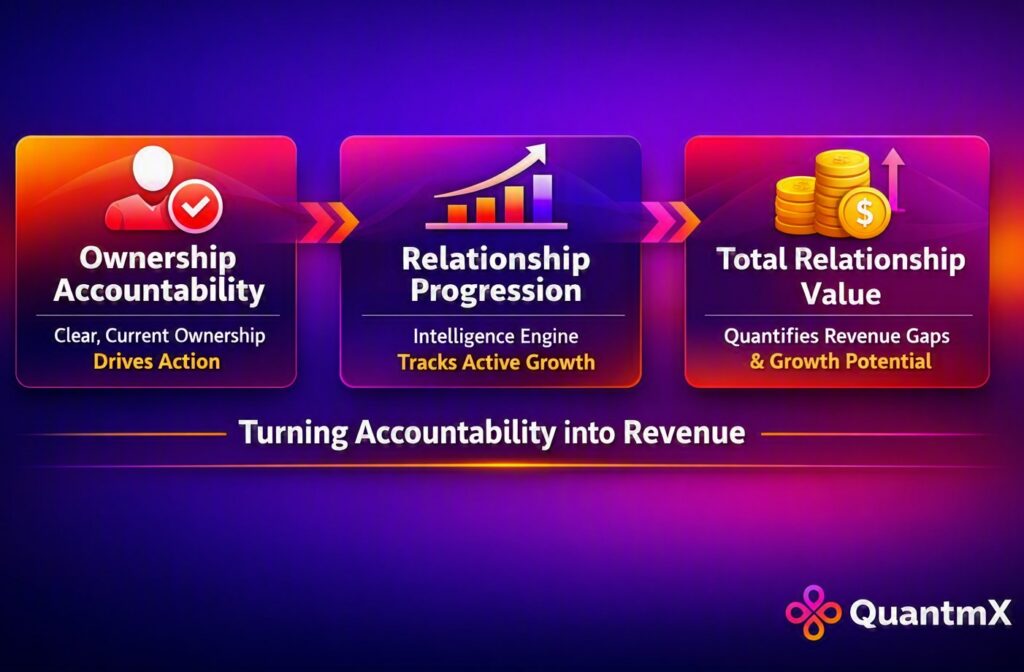
Ownership accountability isn’t an administrative exercise. It’s directly tied to revenue.
A relationship with no clear owner is a relationship with no one actively working to grow it. Over time, unowned relationships stop progressing, drift into dormancy, and become part of a firm’s Revenue Gap — the value sitting in relationships the firm has already earned but no longer actively manages.
This is where a Relationship Intelligence Engine does something a CRM can’t: it doesn’t just store who owns a relationship, it tracks whether that ownership is actually producing progression — and flags it the moment it isn’t.
How to build relationship ownership accountability into a firm
Firms don’t need to overhaul everything at once. Ownership accountability tends to hold up when it’s built in stages:
- Start with a relationship inventory
Before assigning accountability, a firm needs a complete list of the relationships that matter — not just active clients, but referral sources, alumni, strategic partners, and advisors. Many firms are surprised by how much of their relationship network was never formally captured anywhere.
- Assign a single accountable owner to each one
Every relationship on the list gets one name attached to it, even if several people are involved day to day. That person is the one who answers for whether the relationship is progressing.
- Define what “at risk” looks like
Set a clear standard for what counts as a relationship going quiet — for example, no meaningful contact in 60 or 90 days — so that dormancy is flagged automatically rather than discovered by accident.
- Build a formal handover process
When ownership needs to change — a promotion, a departure, a reorganization — the transfer should include context, not just a reassigned name. The next owner should be able to pick up the relationship without starting from zero.
- Make ownership visible, not private
Ownership that only the owner can see isn’t accountability, it’s just a personal to-do list. The firm as a whole should be able to check on any relationship’s status at any time.

Key Takeaway
Relationship ownership accountability means every relationship that matters to growth has a named, current owner whose job is measured by whether the relationship is progressing — not just whether it’s on file.
A CRM can tell you who a relationship is assigned to. It can’t tell you whether that ownership is working. Firms that close this gap stop losing relationships to silence, turnover, and assumption — and start treating ownership as something they manage, not something they hope is happening.
Explore QuantmX — Relationship Growth Platform
Frequently Asked Questions
What is relationship ownership accountability?
Relationship ownership accountability is the practice of assigning a clear, named person to be responsible for a business relationship’s health and progression — not just recording their name as a contact owner. It ensures someone is answerable for whether a relationship is active, growing, or at risk.
Who should own a client relationship in a professional services firm?
Ownership should go to whoever is best positioned to maintain and grow the relationship day to day — often a partner or account lead — but it must be formally assigned and visible firmwide, not assumed based on who originally brought the client in.
What happens when a relationship has no clear owner?
Unowned relationships tend to drift. No one proactively checks in, follow-ups slip, and the relationship can go dormant without anyone noticing until a client leaves, a referral source goes quiet, or a competitor steps in.
How is relationship ownership different from account ownership in a CRM? Account ownership in a CRM is usually a static field showing who a contact is assigned to. Relationship ownership accountability adds a live layer on top: is that owner actively progressing the relationship, and does the whole firm have visibility into its current health.
How often should relationship ownership be reviewed?
Ownership should be reviewed whenever a relationship goes quiet, whenever staffing changes (a partner leaves, changes roles, or takes on more accounts), and on a regular cadence — such as quarterly — to catch relationships that have quietly become under-owned.
Can relationship ownership be shared across a team?
Yes, but shared ownership still needs one accountable name. Multiple people can be involved in a relationship, but accountability for whether it’s progressing should sit with a single person to avoid the “I thought someone else was handling it” problem.
How does relationship ownership accountability work in law firms?
In law firms, ownership is often informally tied to whichever partner originated the matter. This creates risk when that partner is overloaded or leaves, since referral sources and client relationships can be tightly bound to one individual rather than the practice group.
How does relationship ownership accountability apply to accounting and advisory firms?
Accounting firms often manage relationships across audit, tax, and advisory teams simultaneously, which can blur ownership. Clear accountability prevents a client from being “everyone’s responsibility and no one’s job,” especially during busy season when follow-up naturally slips.
How does relationship ownership accountability work in management consulting firms?
Consulting relationships frequently transition between the partner who sold the engagement and the team that delivers it. Without formal ownership handover, client relationships can weaken the moment delivery ends and no one is clearly responsible for staying in touch.
How does relationship ownership accountability apply to wealth management and financial advisory firms?
In wealth management, client trust is highly personal, which makes ownership concentration especially risky. Firms need a clear plan for reassigning ownership if an advisor leaves or retires, so client relationships don’t leave with them.
How does relationship ownership accountability work in insurance brokerages? Insurance brokers manage large books of renewal-based relationships where ownership gaps show up as missed renewals or lapsed policies. Clear accountability ensures every account has an active owner tracking renewal timing, not just a name on a policy file.
How does relationship ownership accountability apply to marketing and creative agencies?
Agencies often assign account managers who rotate across projects, which can leave long-term client relationships without a consistent owner. Formal ownership accountability keeps a single person responsible for the relationship even as project teams change.