
Most professional services firms track revenue the same way: pipeline value, closed-won deals, renewal rates. What almost none of them track is the revenue sitting inside relationships they already have — the referral source who stopped sending work, the alumnus who moved into a buying role, the partner introduction that never got a second call. That revenue doesn’t show up as churn. It never shows up as anything. It just quietly stops happening, and nobody notices because nothing was ever built to notice it. This is relationship revenue loss for professional services firms: the Relationship Blind Spot in dollar terms, and it’s a real cost most firms are carrying without a line item to show for it.
The CRM Was Never Built to See This
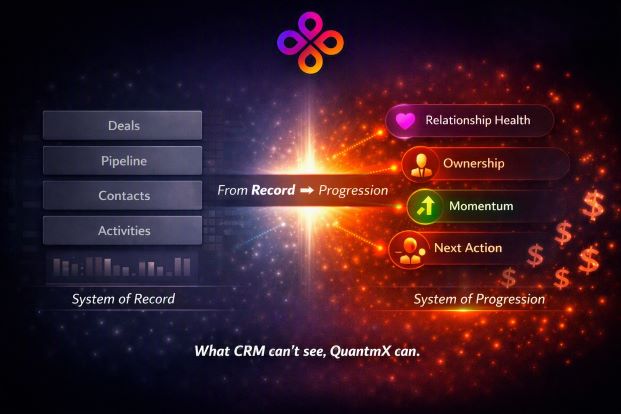
A CRM is a system of record for the pipeline you’re actively selling. It logs deals, tracks stages, and reminds a rep to follow up before a deal goes cold. That’s useful — but it was designed around a narrow definition of “relationship”: one that starts when a prospect enters the funnel and ends when they either buy or get marked lost.
Everything outside that funnel is invisible to it. Alumni. Advisors. Referral sources. Former clients who are still warm. Partners who introduced a deal eighteen months ago and were never followed up with. None of that lives in the CRM, because none of it was ever supposed to be a “customer” in the CRM’s eyes.
So firms end up managing their most valuable relationship capital in the tools that are worst suited to it — inboxes, spreadsheets, sticky notes, and the memory of whichever partner originally built the relationship. When that partner gets busy, or leaves, the relationship goes quiet. Nobody decided to lose it. It just fell into the gap between systems.
What the Blind Spot Actually Costs
The math is easier to see than most firms expect, because it isn’t really new revenue you’d have to go earn — it’s revenue you’ve already earned the right to and are simply not collecting.
- Referral sources that go quiet without anyone noticing. A single introducer can account for a meaningful share of inbound work; when that channel slows and nobody flags it, the firm doesn’t just lose one deal, it loses a pattern of future deals.
- Alumni who move into decision-making roles at other companies. A former client who becomes a VP of Procurement somewhere else is a warm door — if the firm still knows who they are and what they need.
- Partner and advisor relationships that stall after the first or second conversation, because no one owned the follow-through.
- Dormant clients who would restart work with the right nudge, but are instead filed away as “inactive” and never revisited.
None of these are hypothetical. Firms that rely on referrals as a primary growth channel are effectively running a large, unmeasured revenue line through relationships that live outside any system of record — which is also why the underlying economics favor firms that protect what they already have. Harvard Business Review has reported that winning a new customer typically costs five to twenty-five times more than keeping an existing one, depending on the industry. For a professional services firm, “existing” doesn’t just mean active clients — it means the full relationship ecosystem: alumni, referral sources, partners, and advisors who already trust the firm and would re-engage with the right prompt.
And the problem isn’t confined to a few firms with weak processes. The Hinge Research Institute has found that attracting and developing new business is the challenge professional services firms report most often — notable given how much of that “new business” is, in practice, revenue that used to exist inside a relationship the firm already had.
Why This Stays Invisible
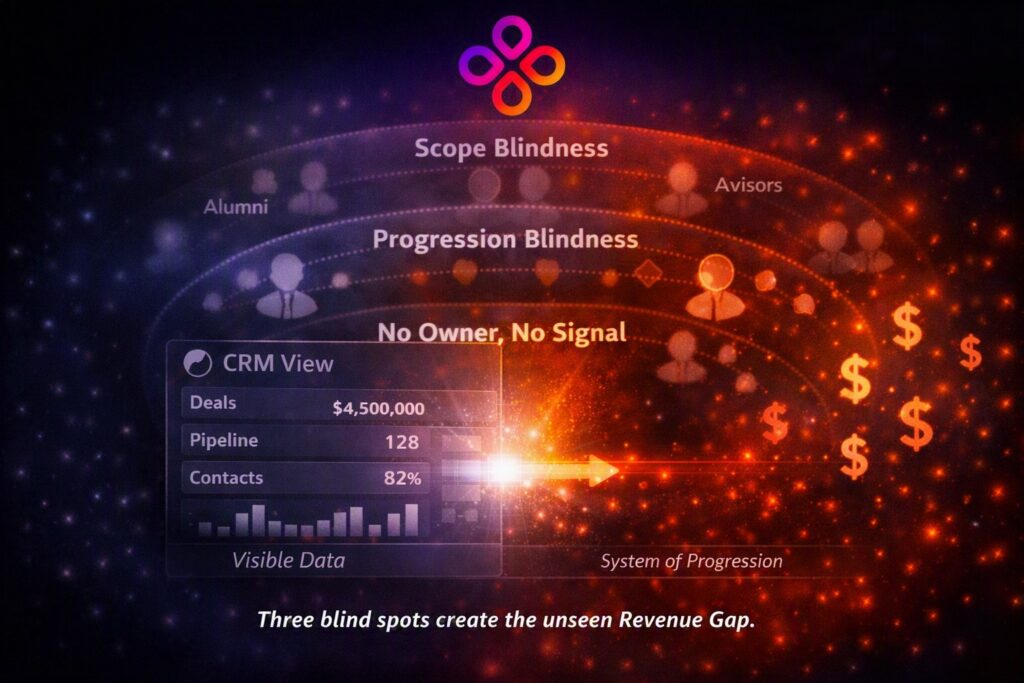
The reason this revenue loss doesn’t show up on a dashboard is structural, not accidental. Three things are usually happening at once:
- Scope Blindness — the firm is only tracking the relationships inside its CRM or pipeline, so anything outside that scope (alumni, advisors, referral sources) is simply never measured in the first place.
- Progression Blindness — even relationships that are being tracked are being recorded, not progressed. Someone logs that a call happened, but nothing surfaces that the relationship has gone quiet or needs a next step.
- No owner, no signal. When a relationship doesn’t have a clearly assigned owner, no one is accountable for noticing it’s stalled — so it drifts until it’s cold, and by then re-engaging costs far more than maintaining would have.
Put together, these three gaps form what firms are sitting on without knowing it: a Revenue Gap — the portion of a firm’s Total Relationship Value that exists but isn’t being actively realized, because the relationships behind it were never inside a system built to progress them.
Getting a Real Number
Most firms can put a rough number on this faster than they expect, because the inputs are already known — they’re just scattered. Estimating the size of the gap usually means walking through a short set of questions:
- How many active referral sources sent work in the last 12 months, versus the 12 months before that?
- How many former clients have had zero contact in the past year, and what was their average annual value when active?
- How many partner or advisor introductions in the last year never had a documented follow-up?
- What’s the average value of a client relationship that originated through an internal referral or alumni connection?
Multiplying the count of stalled or invisible relationships by their historical average value gives a directional figure — usually the first time a firm has ever seen it written down. It’s rarely small.
Closing the Gap Requires a Different System, Not More Effort
The instinct at most firms is to ask people to “do a better job” of staying in touch — more check-ins, more reminders, more discipline. That doesn’t fix a structural problem. The relationships were never inside a system that could see them in the first place, so no amount of individual effort scales to cover the gap.
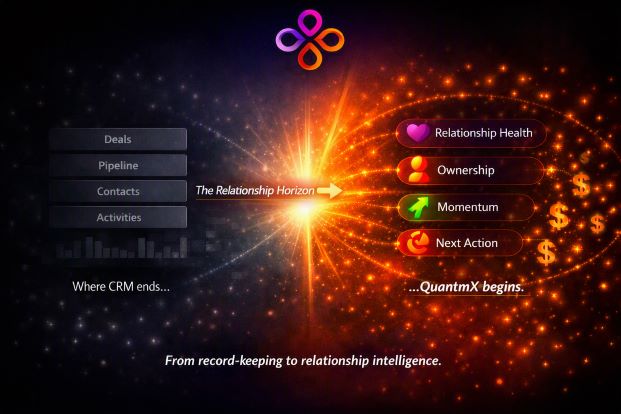
Closing it requires something built for the full scope of relationships a firm depends on, not just the ones already in the pipeline — a Relationship Intelligence Engine that captures every relationship, assigns ownership, and surfaces the ones losing momentum before they go cold. That’s the shift from relationship recording to active relationship progression: from a system that tells you what happened to one that tells you what needs to happen next.
Firms that make that shift stop discovering their Revenue Gap by accident — a stalled deal here, a departed alumnus there — and start closing it on purpose.
See what the Relationship Blind Spot is costing your firm →
Frequently Asked Questions
How much revenue do firms lose from bad relationships?
It varies by firm size and how referral-dependent the business is, but the pattern is consistent: firms that don’t actively track alumni, referral sources, and partner relationships typically underestimate the revenue tied to those relationships by a wide margin, because none of it appears in standard pipeline reporting.
Why do professional services firms lose revenue from existing relationships specifically?
Because CRMs and pipeline tools are built to track active deals, not the full relationship ecosystem. Alumni, advisors, dormant clients, and referral sources fall outside that scope, so they go unmanaged until someone happens to remember them.
What is a Relationship Revenue Gap?
It’s the portion of a firm’s Total Relationship Value that exists in relationships the firm already has, but isn’t being realized because those relationships aren’t being actively tracked or progressed. Calculate an estimate of your own gap here →
How can a firm start measuring this?
Start by counting relationships that have gone quiet in categories the CRM doesn’t cover — referral sources, alumni, and stalled partner introductions — and estimating their historical value. That gives a directional number even before adopting a new system.
Does relationship revenue loss look different for law firms versus consulting firms?
The mechanics are the same, but the relationships carrying the most exposure differ. Law firms tend to lose the most to dormant client relationships and referring attorneys who quietly stop sending work, since so much origination runs through personal trust rather than marketing. Consulting firms lose more through partner and alliance introductions that stall after the first meeting, since a large share of new engagements originates from other firms’ referrals rather than direct outreach. In both cases, the revenue was already earned in relationship terms — it’s just sitting outside any system that tracks it.
How can accounting firms measure relationship revenue loss from alumni and referral partners?
Accounting firms typically have two under-tracked sources: alumni who move into finance or executive roles at other companies, and referral partnerships with attorneys, bankers, and wealth managers. Start by pulling a list of staff and clients who left in the past three to five years and checking how many are now in a position to refer or re-engage. Then look at referral partners by volume sent per year — a drop-off with no follow-up is the clearest sign relationship revenue loss is happening quietly inside a channel the firm assumes is still healthy.
What’s the difference between customer churn and relationship revenue loss?
Churn is a client who was active and formally left — it shows up in a report because someone cancelled or didn’t renew. Relationship revenue loss is quieter: it’s the referral that never got a follow-up, the alumnus nobody re-engaged, the partner introduction that stalled. No one cancelled anything, so it never triggers a churn alert. That’s exactly what makes it larger and harder to catch than churn in most professional services firms — it’s a gap in visibility, not a decision either side made.
How does relationship revenue loss show up for architecture and engineering (AEC) firms?
AEC firms lose the most through repeat-client relationships and subcontractor or partner-firm networks. A developer or property owner who worked with the firm on one project is a strong candidate for the next one, but that connection typically lives with whichever project lead managed it — if that person moves to another project or leaves, so does the relationship. Referral relationships with general contractors and other specialty firms follow the same pattern: steady for years, then quiet, with no one tracking why.
How does relationship revenue loss affect financial advisory practices?
For advisory practices, relationship revenue loss concentrates in two places: centers of influence (CPAs, attorneys, and other professionals who refer clients) who go quiet, and former clients who left for a life event — a move, a job change, an inheritance — rather than dissatisfaction. Both groups are usually still reachable, but without a system tracking last contact and referral volume by source, advisors typically only notice the drop-off well after it’s already cost them a year or two of introductions.
Can relationship revenue loss be prevented, or only measured after it happens?
It can be prevented, but only if the firm can see a relationship losing momentum before it goes cold — which is exactly what most firms can’t do today, since nothing outside the CRM is being monitored for signals. Once ownership and decay detection are in place for the full relationship ecosystem, the same referral sources and alumni that used to go quiet unnoticed instead surface as a next action for someone to take.
How often should a firm audit its relationship revenue gap?
An initial audit is worth doing once, as a baseline — most firms are surprised by the number. After that, it shouldn’t be a periodic audit at all; a firm that’s actively tracking its full relationship ecosystem sees decay and disengagement continuously, the same way a pipeline dashboard shows deal movement in real time, rather than waiting for a quarterly review to notice a channel has gone quiet.