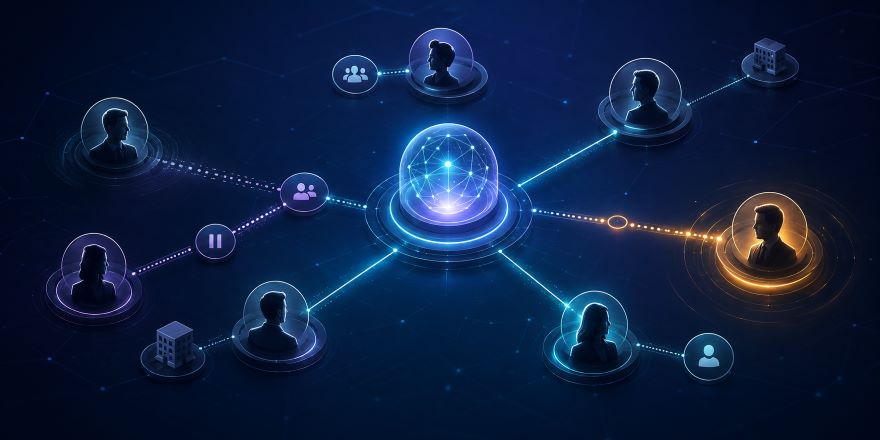
A senior partner leaves.
On paper, the firm still has the clients, the CRM, the contact database, the emails, and the business development team.
But then something uncomfortable becomes clear:
A significant part of the firm’s most valuable relationship network left with them.
The partner may have taken years of trust, introductions, context, referral relationships, informal conversations, and institutional knowledge that were never truly owned by the firm.
That is the real senior partner departure relationship risk.
For professional services firms, this can be one of the most underestimated forms of key person risk. The problem is not simply that a senior person has left.
The problem is that the relationships that generated growth may have been dependent on that person rather than embedded in the business.
And that raises a bigger question:
What happens to the firm’s relationships when the person who owns them walks out the door?
The hidden risk behind a senior partner departure
Professional services firms are built differently from many transactional businesses.
- Their value is often tied to trust.
- Clients trust partners.
- Referral sources trust partners.
- Other professionals trust partners.
- Alumni stay connected to partners.
- Potential clients may take a meeting because a particular partner called them.
- Investors, advisors, industry contacts, and former clients may all respond because of an established personal relationship.
Over time, this creates enormous relationship value. But it can also create a structural weakness.
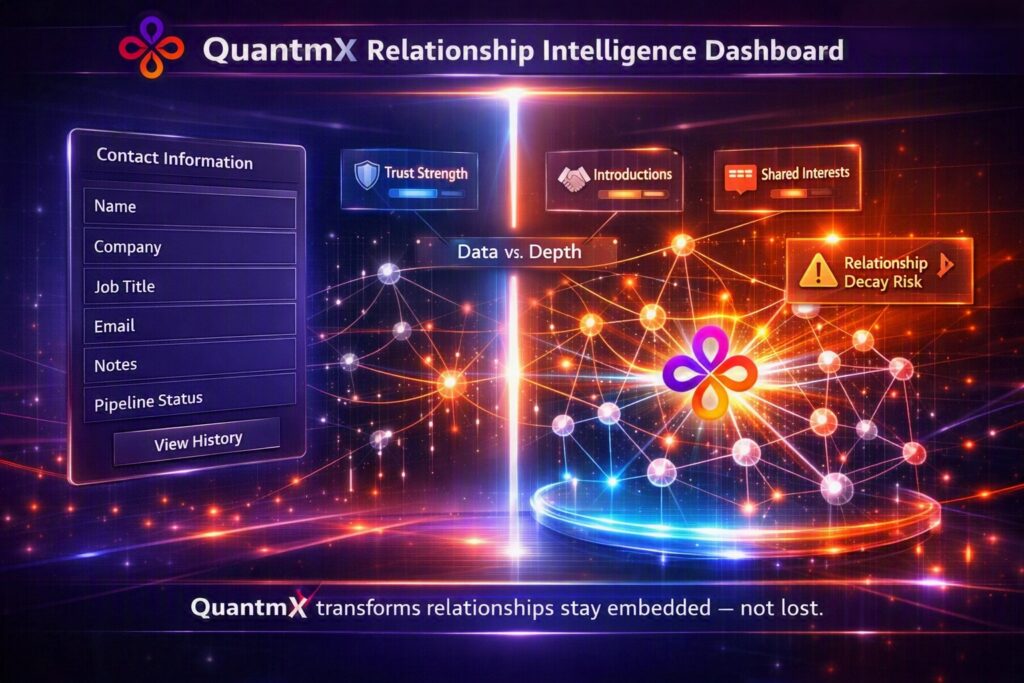
The relationship belongs to the person — not the firm.
That distinction matters.
A firm’s CRM may show:
- The contact’s name
- Company
- Job title
- Email address
- Previous interactions
- Opportunity history
- Notes
- Current pipeline status
But that information does not necessarily capture:
- Why the relationship matters
- Who introduced whom
- The strength of the personal trust
- What the person cares about
- Which other relationships connect them to the firm
- When the relationship needs attention
- What the next meaningful interaction should be
- Whether another partner could successfully take over
- Whether the relationship is already beginning to decay
This is where relationship continuity becomes a business issue rather than simply a people issue.
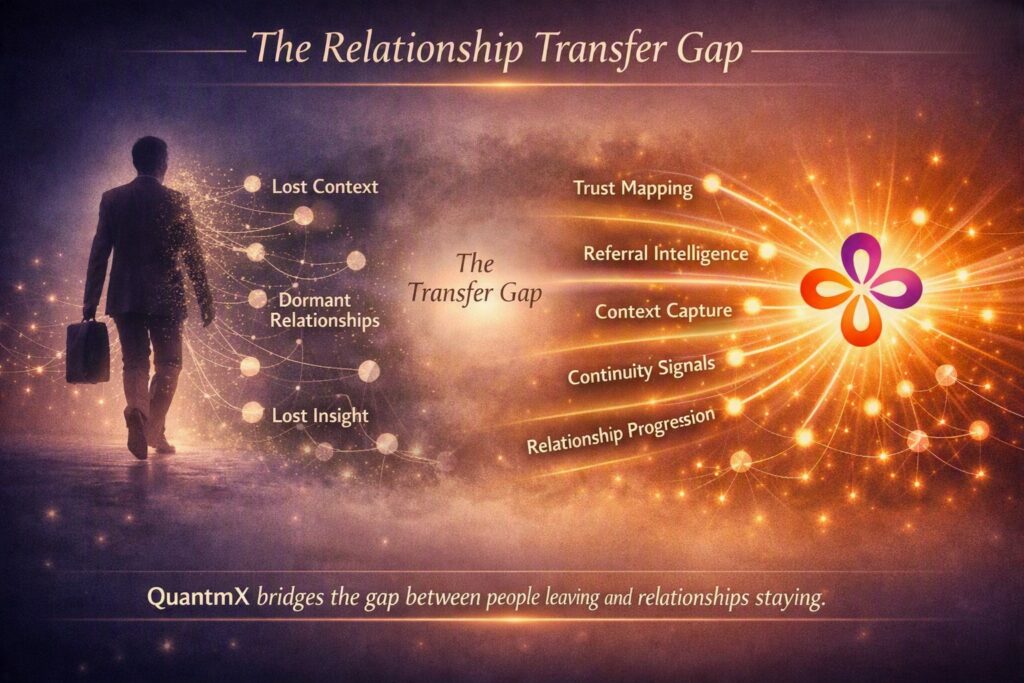
What happens when a partner leaves and takes relationships?
The immediate impact is rarely visible.
There may not be a dramatic revenue drop on day one.
Instead, the firm can experience a gradual weakening of its relationship network.
1. Client relationships become vulnerable
A client may have worked primarily with one partner for years.
When that partner leaves, the client technically remains in the firm’s database.
But technically being in the database does not mean the relationship is secure.
The client may follow the partner.
Or they may stay temporarily while becoming less engaged.
Or they may simply become more receptive to another firm.
The risk is particularly high when the firm has not deliberately built relationships between the client and multiple people internally.
2. Referral relationships can disappear
Referral sources are another major risk.
A senior partner may have built a network of accountants, lawyers, bankers, investors, executives, consultants, and other professionals over decades.
Those people may associate the relationship with the individual rather than the firm’s brand.
When the partner leaves, the introductions can leave too.
The firm may only realize this months later when referral volume declines.
3. Institutional knowledge walks out
Some relationship knowledge is difficult to capture in a CRM.
A partner might know:
- Who should receive a call before a formal introduction
- Which executive is considering a move
- Which former client is likely to return
- Which relationship has gone quiet
- Which introduction would be valuable
- Which conversation should happen privately
- Which relationships require nurturing before an opportunity appears
This is key person dependency risk in professional services.
The firm does not simply lose an employee.
It can lose the context surrounding hundreds of relationships.
4. Business development becomes slower
When relationships are concentrated around a few senior people, business development becomes dependent on their availability.
If that person is:
- Busy
- Retiring
- Moving firms
- Taking a leave
- Changing roles
- Selling their practice
- Or simply disengaging
the relationship network can stop moving.
The firm’s pipeline may still look healthy.
But the network underneath the pipeline may already be weakening.
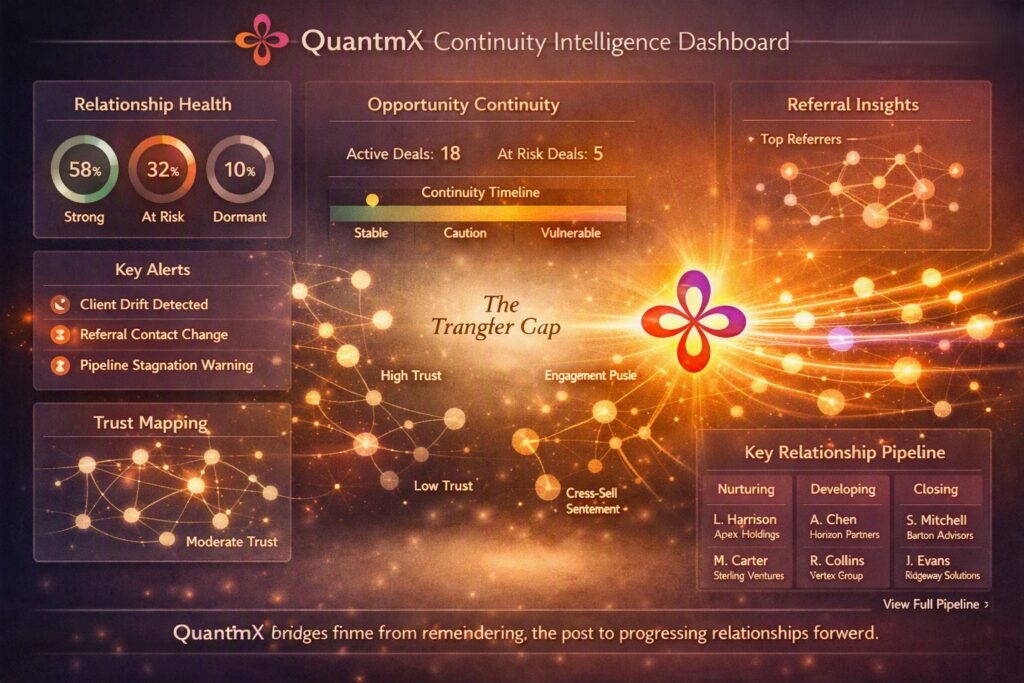
A CRM cannot solve the entire problem
This is an important distinction.
CRM is not enough.
That does not mean CRM is useless.
CRM remains valuable for what it was designed to do: managing customer information, opportunities, pipeline activity, and the history associated with those relationships.
The problem occurs when a firm expects its CRM to manage the entire relationship network that drives growth.
A CRM can tell you:
“This person is a client.”
But the larger business question is:
“How resilient is our relationship with this person if the partner who introduced them leaves?”
Those are different questions.
A CRM is primarily a system of record.
Relationship continuity requires something closer to a system of progression.
The difference is significant.
| CRM can record | Relationship continuity requires |
| Contact information | Relationship context |
| Client history | Relationship ownership |
| Opportunity status | Relationship health |
| Activities | Momentum |
| Past interactions | What should happen next |
| Account information | Network connections |
| Pipeline | Broader relationship value |
This is why the next generation of relationship management is moving beyond simply storing contact data.
QuantmX describes this distinction through its Relationship Growth Platform: a system designed to manage the broader network of relationships that contribute to growth and actively move those relationships forward.
The real problem is relationship concentration
Consider a professional services firm with 10 senior partners.
Suppose one partner has personally developed:
- 35 major client relationships
- 20 referral sources
- 15 former clients
- 25 alumni relationships
- 10 strategic partners
- 30 other high-value industry relationships
That is 135 relationships connected heavily to one individual.
If the partner leaves, the firm may technically retain records for all 135 people.
But the records are not the relationships.
The risk is not:
“Do we have their email address?”
The risk is:
“Can the firm continue the relationship without the person who created it?”
That is a much more difficult question.
How firms can reduce partner departure relationship loss
The answer is not to prevent every senior partner from becoming highly trusted.
That would defeat the purpose of relationship-led professional services.
The objective is to turn individual relationship strength into institutional relationship strength.
There are several practical steps firms can take.
1. Map the relationship network
Start by identifying the relationships that actually matter.
Do not limit the exercise to current clients.
Include:
- Clients
- Former clients
- Referral sources
- Strategic partners
- Alumni
- Advisors
- Investors
- Prospects
- Industry relationships
The goal is to understand the firm’s complete relationship surface.
2. Identify relationship concentration
Ask:
Which relationships depend almost entirely on one partner?
Look for situations where:
- One partner is the only internal connection
- No other employee has meaningful contact
- The relationship exists primarily through personal communication
- Important context exists only in someone’s memory
- The firm has no defined succession plan for the relationship
These are relationship concentration risks.
3. Establish relationship ownership
A relationship should not simply belong to “the partnership.”
Someone should be accountable for maintaining it.
Clear ownership makes continuity possible.
It also prevents the classic problem:
“I thought someone else was looking after them.”
4. Build multiple relationship connections
The strongest client relationships should not depend on one person.
Where appropriate, clients and strategic relationships should have meaningful connections across the firm.
For example:
- Partner → Client
- Managing Director → Client
- Subject-matter expert → Client
- Business development → Client
This creates relationship resilience.
5. Capture context, not just contact data
The firm should know more than someone’s phone number.
It should understand:
- Why the relationship matters
- Relationship strength
- Relevant history
- Important connections
- Recent activity
- Potential opportunities
- Risks
- Next steps
That makes a partner transition significantly easier to manage.
Relationship continuity should be measured before a departure
One mistake firms make is waiting until someone announces their departure.
By then, it may already be too late.
Relationship continuity should be part of ongoing business relationship management.
A firm should periodically ask:
● Which relationships are highly valuable?
● Which relationships are dependent on one person?
● Which relationships have no secondary owner?
● Which relationships have stopped progressing?
● Which clients have limited connections beyond one partner?
● Which referral sources have become inactive?
● Which former clients have moved into new roles?
● Which relationships require attention now?
These questions shift the conversation from relationship preservation after a crisis to relationship resilience before the crisis.
The bigger opportunity: turning relationship intelligence into a firm asset
The best firms do not try to eliminate personal relationships.
They make those relationships stronger and more transferable.
That requires a different mindset.
The relationship should remain personal.
But the intelligence around the relationship should not remain trapped inside one person’s head.
This is where technology can help.
A modern relationship platform can help firms:
- Bring relationship information into one shared environment
- Identify relationships that matter most
- Detect relationship gaps and concentration
- Establish clear ownership
- Monitor relationship momentum
- Surface relationships that need attention
- Identify what should happen next
- Reduce dependency on individual memory
That is a different objective from simply maintaining a database.
It is about making the firm’s relationship network visible, actionable, and resilient.
Why this matters beyond partner departures
It would be easy to treat this as a succession problem.
It is bigger than that.
The same relationship concentration appears when:
- A rainmaker retires
- A managing partner changes firms
- A key employee leaves
- A founder steps back
- A business development leader resigns
- A partner becomes too busy to maintain their network
- A senior executive moves into another role
In every case, the underlying question is the same:
Does the relationship belong to the business, or does the business merely have access to the relationship through one person?
That distinction can determine whether growth is repeatable.
From key person risk to relationship resilience
A strong professional services firm should be able to answer:
“If one of our most connected partners left tomorrow, which relationships would be at risk?”
And then:
“What are we doing about those relationships today?”
If the answer requires opening spreadsheets, searching email, asking partners what they remember, or waiting for someone to manually update the CRM, the firm has a relationship continuity problem.
The goal is not to replace the human relationship.
The goal is to make the relationship stronger than the individual’s memory.
That is the shift from relationship dependency to relationship resilience.
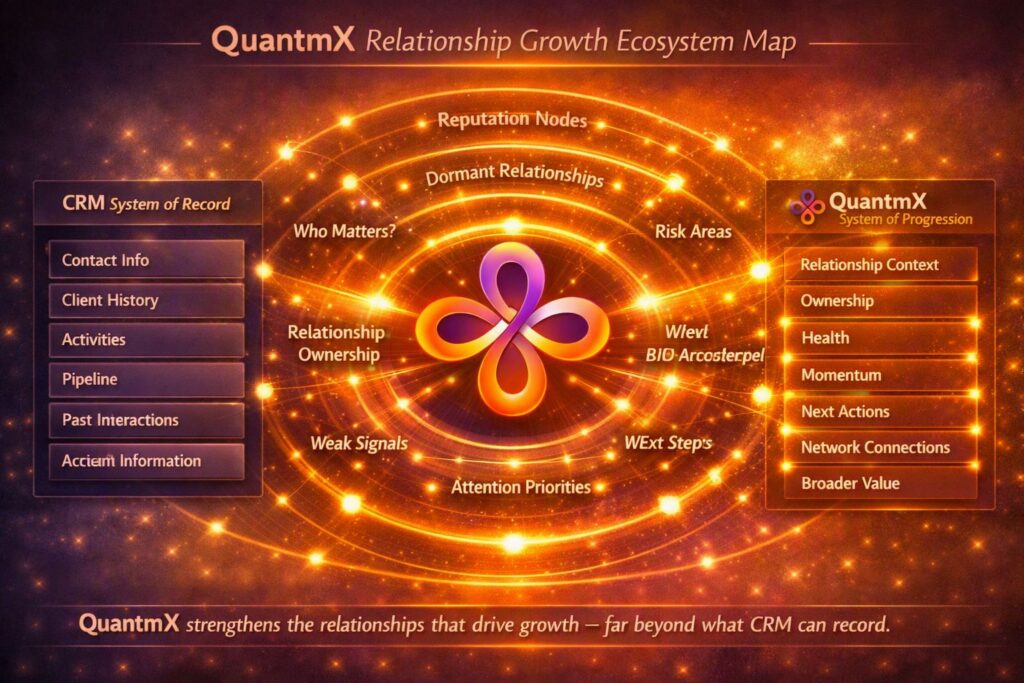
CRM records relationships. Relationship growth strengthens them.
The lesson from a senior partner departure is not that firms should stop using CRM.
It is that CRM alone cannot manage every relationship a professional services firm depends on.
A CRM can provide an important foundation.
But firms that rely heavily on referrals, reputation, alumni, partnerships, senior relationships, and long sales cycles need visibility beyond the customer pipeline.
They need to know:
- Who matters?
- Who owns the relationship?
- Where is relationship risk concentrated?
- Which relationships are weakening?
- Which relationships need attention?
- What should happen next?
That is where a Relationship Growth Platform can extend the value of CRM.
QuantmX is built around this broader approach: helping businesses manage the relationships that drive growth, identify relationship risk, establish ownership, and keep important relationships moving forward.
Explore QuantmX — Relationship Growth Platform
The objective is simple:
Don’t let your firm’s most valuable relationships leave with the person who built them.
Build relationship continuity before you need it.
Key Takeaway
A senior partner should be able to leave without taking the firm’s relationship capital with them.
The strongest firms don’t wait for a departure to discover where their relationship risk sits.
They identify dependency early, strengthen relationship continuity, distribute relationship knowledge, and make the broader network visible and actionable.
Because the real asset is not the contact list.
It is the trust, context, ownership, and momentum behind every important relationship.
Frequently Asked Questions
What is senior partner departure relationship risk?
Senior partner departure relationship risk is the risk that a firm’s valuable client, referral, partner, alumni, or other business relationships weaken or leave when a senior partner exits. The risk is highest when important relationships depend primarily on one person’s trust, memory, and personal network.
What happens when a partner leaves and takes relationships?
When a partner leaves and takes relationships, a firm can lose client continuity, referral opportunities, institutional knowledge, and access to valuable networks. The impact may not appear immediately and can emerge gradually through declining engagement, referrals, or client retention.
What is key person dependency risk in professional services?
Key person dependency risk occurs when critical business relationships, knowledge, revenue, or opportunities depend heavily on one individual. In professional services, this often happens when senior partners personally own major client and referral relationships.
Can a CRM prevent partner departure and relationship loss?
A CRM can help preserve important contact and account information, but CRM alone may not prevent relationship loss. Relationship continuity requires additional visibility into relationship ownership, health, concentration, context, and what actions should happen next.
How can professional services firms improve relationship continuity?
Firms can improve relationship continuity by mapping their full relationship network, identifying relationships concentrated around individual partners, assigning clear ownership, building multiple internal connections, capturing relationship context, and continuously monitoring relationship health and progression.
How does QuantmX help strengthen relationships?
QuantmX approaches relationship management beyond the traditional CRM model. Its Relationship Growth Platform is designed to bring broader growth-critical relationships into one system, identify relationship risk, establish ownership, and actively progress relationships rather than simply recording interactions.
What are the signs that a firm has relationship concentration risk?
Common signs include a major client having only one meaningful internal relationship, referral sources communicating exclusively with one partner, important relationship knowledge being stored in personal email or memory, and limited visibility into who could maintain the relationship if that partner left.
How should firms prepare for a senior partner transition?
Firms should identify critical relationships before the transition, document relationship context, establish secondary relationship owners, introduce other senior team members to key contacts, and create a clear plan for maintaining relationship momentum after the partner’s departure.
How can firms identify relationships at risk before a partner leaves?
Firms can look for relationships with single-person ownership, declining engagement, long periods without meaningful interaction, limited internal connections, or high commercial value concentrated around one individual. Monitoring these indicators allows firms to address relationship risk before a transition occurs.
What is the difference between relationship management and relationship growth?
Relationship management focuses on maintaining information and interactions associated with a relationship. Relationship growth goes further by identifying opportunities, strengthening connections, assigning ownership, monitoring momentum, and determining what action should happen next.
Why is relationship intelligence important for professional services firms?
Relationship intelligence helps firms understand the people, connections, context, ownership, and opportunities behind their business relationships. It can reduce key person dependency, improve relationship continuity, and help firms turn individual relationship knowledge into a more durable organizational asset.