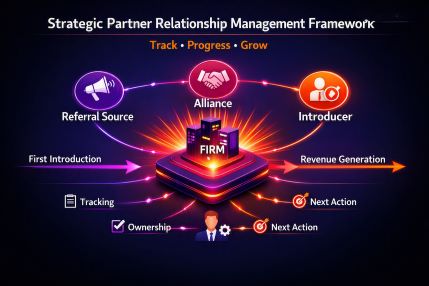
Strategic partner relationship management is the discipline that decides whether a referral source, alliance, or introducer keeps generating revenue for your firm or quietly goes cold. Most professional services firms have no formal system for strategic partner relationship management, which means partner value is tracked in someone’s memory instead of a shared record. This guide breaks down what strategic partner relationship management actually requires, where it typically breaks down, and how to build a system that keeps every partner relationship progressing instead of stalling after the first few calls. It’s written for firm leaders, business development teams, and anyone responsible for turning a promising first introduction into a durable, revenue-generating relationship.
Why Strategic Partner Relationship Management Is a Growth Priority for Professional Services Firms
Partner and alliance relationships are one of the highest-leverage, lowest-cost growth channels available to a professional services firm, yet most firms manage them informally. Strategic partner relationship management matters because the alternative — tracking partner touchpoints in inboxes and personal notes — collapses the moment a partner-facing employee leaves or simply gets busy.
The scale of the opportunity, and the risk of ignoring it, shows up clearly in the data:
- Professional services firms retain an average of 84% of their clients year over year, among the highest of any sector — a benchmark strategic partner relationships help sustain by keeping referral pipelines active.
- Existing relationships generate roughly 67% more spend over their lifetime than new ones, and a “green-health” relationship converts on new opportunities at 60–70%, compared with 5–20% for a cold prospect.
- Improving retention by just 5% can lift profits by 25–95%, according to Bain & Company research — a multiplier that applies directly to partner-sourced revenue.
- Despite that upside, 60% to 70% of strategic alliances fail, most often from unrealistic expectations, unclear objectives, or a lack of ongoing communication.
- The gap between the two halves of that picture — high potential value, high failure rate — is exactly what a deliberate strategic partner relationship management process is meant to close.
The Core Stages of Strategic Partner Relationship Management
Strategic partner relationship management is not a single activity; it’s a sequence of stages a partner relationship should move through, each with its own signals and its own risk of stalling out:
- Introduction — the first meeting, referral, or handshake that establishes the relationship exists.
- Qualification — confirming the partner has real reach, relevant clients, or genuine influence worth investing in.
- Activation — the partner sends a first introduction, referral, or joint opportunity.
- Progression — the relationship produces repeat activity, not a single isolated win.
- Institutionalization — the relationship survives staff turnover because it’s owned by the firm, not one person.
Firms that only track the first two stages — who they met and whether the partner seemed promising — are the ones most likely to see deals die quietly after the second or third call. Strategic partner relationship management earns its value in the later stages, where most informal systems stop paying attention.
Building a Strategic Partner Relationship Management System That Works
A working strategic partner relationship management system doesn’t require enterprise software on day one, but it does require structure that survives beyond any one person’s memory. At minimum, it should include:
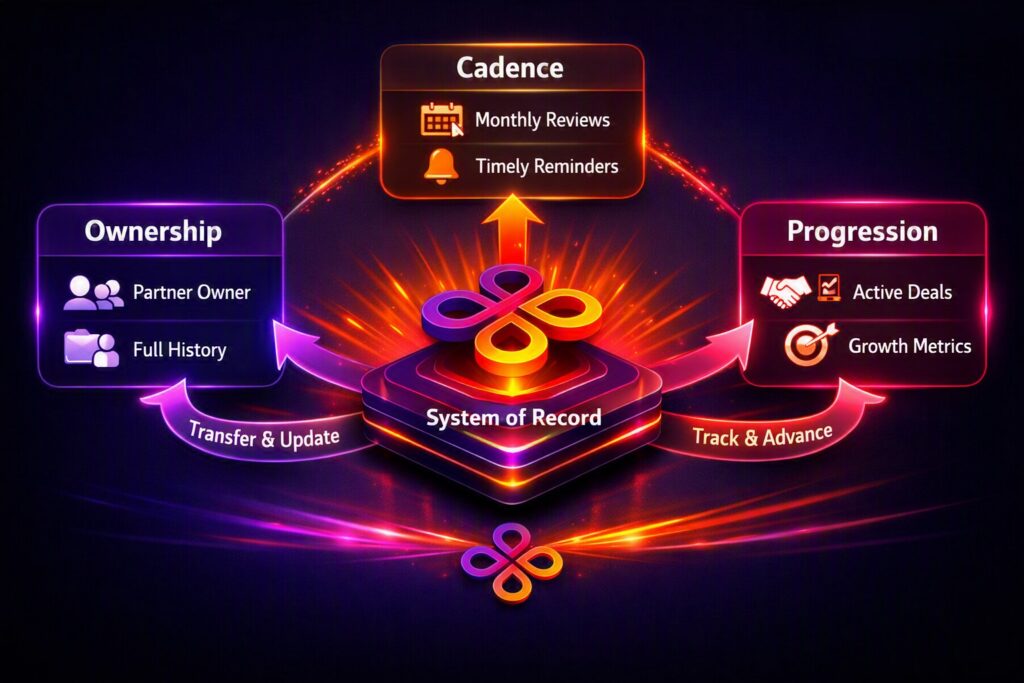
- A single system of record for every partner relationship — who owns it, last contact date, and next planned action.
- Defined progression criteria for moving a partner from introduction to active, so “we met once” isn’t confused with “this is generating work.”
- A cadence, not a whim — a set review rhythm (monthly for top partners, quarterly for the rest) rather than contact triggered only when someone remembers.
- Ownership that transfers — when the person managing a partner relationship changes roles, the relationship and its history transfer with a full record, not a verbal handoff.
- A shared view across the firm so partners aren’t re-introduced to three different people who don’t know the others have a relationship with them.
This is where the difference between spreadsheets and a purpose-built relationship system shows up. Spreadsheets can hold contact information, but they can’t flag a partner relationship that’s gone quiet, can’t distinguish a dormant introducer from an active one, and can’t preserve context automatically when ownership changes. Strategic partner relationship management depends on visibility into what’s happening between check-ins, not just a record of what happened at the last one.
Strategic Partner Relationship Management in Practice: What Progression Actually Looks Like
It helps to see what a healthy, progressing partner relationship looks like next to a stalled one, because the difference is rarely dramatic — it’s a handful of missed steps compounding over months.
A partner relationship under active strategic partner relationship management tends to follow a visible pattern:
- The first meeting is logged with next steps and a named owner, not just a note that the meeting happened.
- A second touchpoint is scheduled before the first one ends, so momentum doesn’t depend on someone remembering to follow up weeks later.
- Every introduction or referral the partner sends is recorded against their profile, so their real value to the firm is visible, not estimated.
- If 60–90 days pass with no activity, the relationship is flagged automatically rather than discovered by accident during a quarterly review.
- When the relationship owner changes roles, the next owner can see the full history in minutes, not by asking around the office.
Without that structure, the same relationship typically follows a quieter, more familiar path: a strong first call, a vague plan to “stay in touch,” a slow drop-off in contact frequency, and eventually a partner who assumes the firm lost interest — when in reality, no one was ever assigned to keep the relationship moving. Strategic partner relationship management exists specifically to close that gap between intention and follow-through.
Common Breakdowns in Strategic Partner Relationship Management (and How to Fix Them)
Most failures in strategic partner relationship management trace back to a handful of repeatable patterns rather than one dramatic mistake:
- No follow-through after the first call. A promising introduction gets a warm first meeting and then nothing — no second touchpoint scheduled, no next step assigned.
- Unclear ownership. Multiple people at the firm think someone else is managing the relationship, so no one is.
- No visibility into partner activity. Referrals or introductions happen, but nobody tracks them centrally, so the firm underestimates how valuable a partner actually is.
- Relationship knowledge trapped in one person’s head. When that person leaves or changes roles, the relationship’s history — and often the relationship itself — goes with them.
- Mismatched expectations. The firm and the partner never agreed on what success looks like, which the Harvard Business Review research on alliance failure identifies as one of the most common root causes.
Each of these is fixable with process, not more headcount: assign explicit ownership, define what “active” looks like, and put review cadence on a calendar rather than leaving it to memory. Firms that address these systematically are the ones that convert partner relationships into a compounding channel instead of a one-off referral.
Metrics That Prove Strategic Partner Relationship Management Is Working
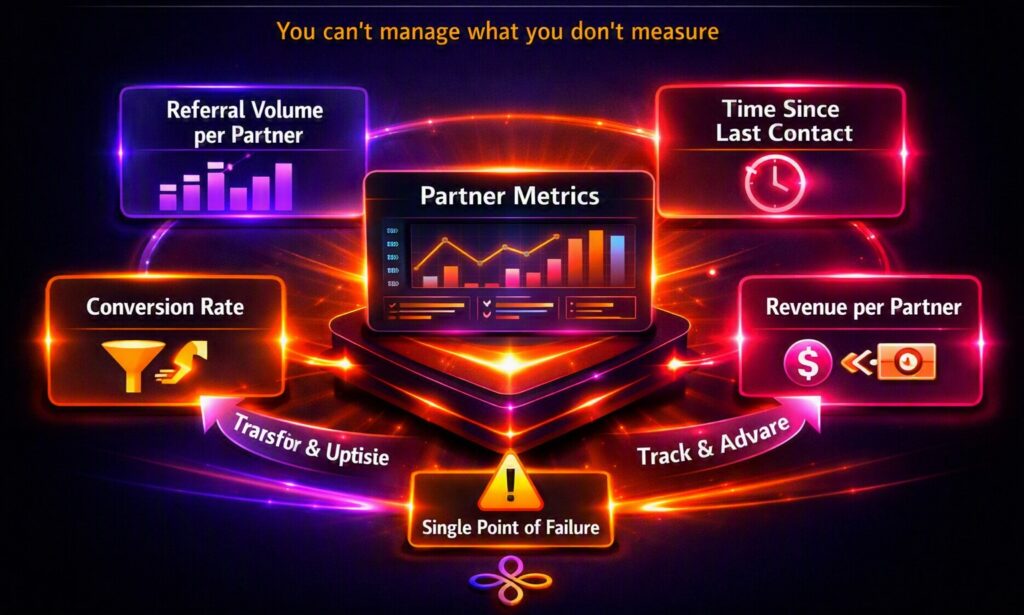
You can’t manage what you don’t measure, and strategic partner relationship management is no exception. Firms that get real value from partner relationships typically track:
- Referral or introduction volume per partner, tracked over time, not just at renewal.
- Time since last meaningful contact, flagged automatically once it crosses a set threshold.
- Conversion rate from partner introduction to active engagement, compared against other lead sources.
- Revenue attributable to each partner relationship, not just the number of introductions made.
- Number of relationships with a single point of failure — partners known to only one person at the firm.
Tracking these consistently turns strategic partner relationship management from a soft, relationship-driven habit into a measurable growth channel the firm can actually forecast and defend in a planning conversation.
The Takeaway
Partner and alliance relationships are too valuable, and too easy to lose track of, to manage from memory or a spreadsheet built for contacts, not relationships. Every breakdown covered here — the stalled follow-up, the unclear owner, the relationship that leaves with the person who managed it — is a symptom of the same Relationship Blind Spot: value the firm has already earned but can no longer see. A traditional CRM logs that a meeting happened. It doesn’t tell you a partner relationship has gone quiet, doesn’t flag which introductions are turning into revenue, and doesn’t preserve context when ownership changes hands.
That’s the gap QuantmX’s Relationship Intelligence Engine is built to close — surfacing which partner relationships are progressing, which have stalled, and where revenue is sitting unmanaged, so strategic partner relationship management becomes a system the whole firm can see rather than a habit that lives with one person.
See it on your own partner relationships. Book a demo of QuantmX and find out how much Total Relationship Value is currently invisible to your firm.
Frequently Asked Questions About Strategic Partner Relationship Management
What is strategic partner relationship management?
Strategic partner relationship management is the ongoing process of tracking, nurturing, and progressing relationships with referral sources, alliance partners, and introducers so they continue generating value over time, rather than fading after an initial introduction.
How is strategic partner relationship management different from a CRM?
A traditional CRM is built to log contacts and deals. Strategic partner relationship management is built around relationship health and progression — whether a partner relationship is warming up, stalling, or going cold — which most CRMs weren’t designed to surface.
Who should own strategic partner relationship management inside a firm?
Ownership works best when it’s assigned explicitly to a person or team, with a documented handoff process, rather than left informally with whoever happened to make the first introduction.
How often should partner relationships be reviewed?
Top-tier partner relationships typically warrant a monthly review; lower-priority relationships can be reviewed quarterly. The specific cadence matters less than having one that’s actually followed.
What tools support strategic partner relationship management?
Effective tools go beyond contact storage to flag dormant relationships, track progression stages, and preserve relationship history when ownership changes — capabilities most general-purpose CRMs and spreadsheets lack.
What’s the biggest mistake firms make in strategic partner relationship management?
Treating the first meeting as the finish line. Most partner value is created — or lost — in what happens after the introduction, not during it.
How does strategic partner relationship management work specifically for law firms?
Law firms often rely on informal referral networks among partners, yet fewer than 40% of law firm partners know their firm’s client retention rate, let alone their referral-partner activity — strategic partner relationship management gives firms a way to close that visibility gap.
How does strategic partner relationship management help consulting firms track referral sources?
Consulting firms typically generate a meaningful share of new engagements through informal introductions. Strategic partner relationship management creates a shared record of which referral sources are active, so consultants aren’t relying on individual memory to know who’s worth re-engaging.
What role does strategic partner relationship management play in accounting firm alumni networks?
Former employees and alumni often become referral sources or even clients later in their careers. Strategic partner relationship management keeps that network organized and active instead of letting it lapse once someone leaves the firm.
How does strategic partner relationship management prevent revenue loss when a partner leaves the firm?
When partner relationships live in one person’s inbox, that knowledge leaves with them. Strategic partner relationship management institutionalizes the relationship and its history so the firm — not just the individual — retains the connection.
Can strategic partner relationship management help professional services firms grow without adding business development staff?
Yes — because reactivating a dormant partner relationship is typically far cheaper than acquiring a new one, strategic partner relationship management often produces growth from relationships a firm has already invested in building.
How does strategic partner relationship management support cross-selling in multi-practice firms?
By making partner and client relationships visible across practice areas, strategic partner relationship management helps one team recognize when a relationship it doesn’t directly manage could support work in another part of the firm — turning a relationship owned by one practice into a growth channel for several.