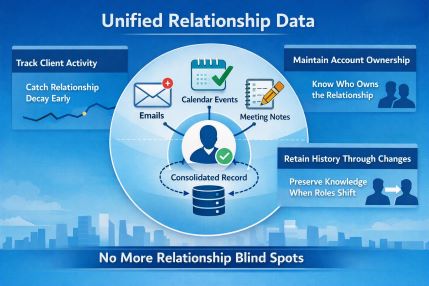
To unify relationship data means combining every email, calendar event, and meeting note tied to a business relationship into a single, continuously updated record, rather than leaving that history scattered across separate inboxes, calendars, and files. Firms that unify relationship data can detect relationship decay early, maintain clear account ownership, and preserve relationship history as people change roles. Manual consolidation does not scale; automated capture across email, calendar, and meetings does.
Professional services firms already have the relationship data they need to grow—it’s just scattered across inboxes, calendars, and meeting notes. This is the Relationship Blind Spot, QuantmX’s term for untracked relationships. Firms that fail to unify relationship data miss decaying clients, cold referrals, and stalled introductions. This guide shows how to fix it.
Why Firms Struggle to Unify Relationship Data
Professional services firms run on relationships that move constantly across three channels: email, calendar, and meetings. A single client relationship might involve dozens of email threads, a recurring check-in on the calendar, and quarterly meeting notes scattered across someone’s laptop. Each of these channels captures a piece of the relationship, but none of them captures the whole picture.
A few forces make it especially hard to unify relationship data inside a typical firm:
- Ownership is unclear. No single person or system is responsible for pulling email, calendar, and meeting activity into one record.
- Tools were built for transactions, not relationships. Traditional CRM systems were designed to log deals, not to track the ongoing, multi-channel texture of a real relationship — a gap we cover in why professional services firms are outgrowing their CRM.
- Manual entry does not scale. Even disciplined teams cannot manually copy every email, call, and meeting into a shared system without losing context or falling behind.
- Institutional memory lives in individuals. When the only unified view of a relationship exists in one partner’s head, the firm has not actually unified relationship data — it has just centralized the risk.
The result is predictable. Reps and partners spend enormous amounts of time on administrative upkeep instead of the relationship itself. According to Salesforce’s State of Sales research, the average rep spends roughly 60% of the workweek on tasks other than selling — including data entry, internal meetings, and CRM administration — which works out to about 24 hours a week. Forrester’s Activity Study puts admin and data entry alone at close to 20% of a typical week, time spent updating systems that still don’t talk to each other.
What It Really Means to Unify Relationship Data
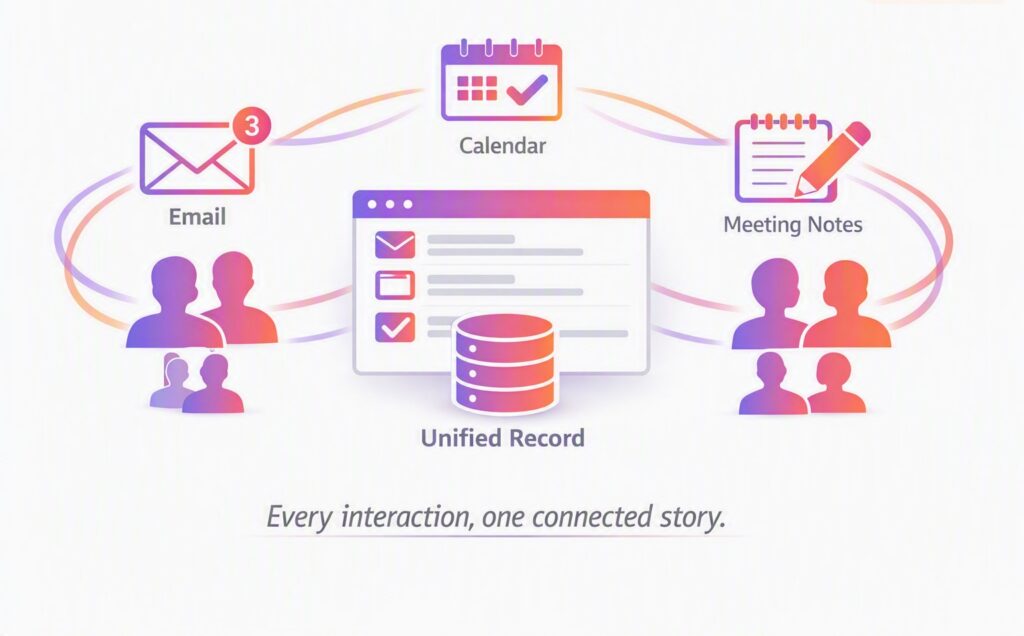
To unify relationship data across email, calendar, and meetings means building one continuous, chronological record of every interaction tied to a relationship — regardless of which channel it happened in. It is not a dashboard that links out to three different tools. It is a single source of truth that captures:
- Every email exchanged with a contact, automatically logged without manual forwarding
- Every calendar event, including who attended, how often it recurs, and how long it has been since the last one
- Every meeting note, decision, and follow-up commitment, tied back to the relationship it came from
When a firm can unify relationship data this way, the question changes. Instead of asking “what happened with this client?” and digging through three inboxes to find out, the team can simply look at one record and know. That shift — from reconstructing history to seeing it instantly — is the foundation of what we describe in what active relationship progression means and why recording isn’t enough.
Where Firms Need to Unify Relationship Data From
Before a firm can unify relationship data, it helps to be honest about where that data currently sits. In most professional services firms, the picture looks like this:
- Email holds the richest detail — proposals, objections, informal commitments — but it is siloed to whoever received the message.
- Calendars show cadence and frequency, which is one of the earliest signals of relationship health, but calendar data rarely gets connected to what was actually discussed.
- Meeting notes capture decisions and next steps, but they typically live in personal notebooks, shared drives, or nowhere at all.
- Spreadsheets and static CRM fields attempt to summarize all of the above, but by the time someone updates them, the information is already stale.
Each of these sources is a fragment. None of them, on its own, tells the full story of a relationship. Firms that try to unify relationship data by asking people to manually consolidate these fragments almost always fail, because the volume of activity outpaces anyone’s capacity to track it by hand.
This is especially true for the relationships that sit outside the pipeline entirely. A dormant client, a strategic partner, or a referral source rarely gets the same disciplined tracking as an active deal, simply because no one is measured on keeping their record current. Over time, the firm ends up with two classes of relationships: the ones inside the CRM that get partial attention, and the ones scattered across inboxes and calendars that get none. Both groups need the same thing — a single place where their email, calendar, and meeting history live together — but most firms only build that discipline for the relationships already generating a deal in progress.
How to Unify Relationship Data: A Practical Framework
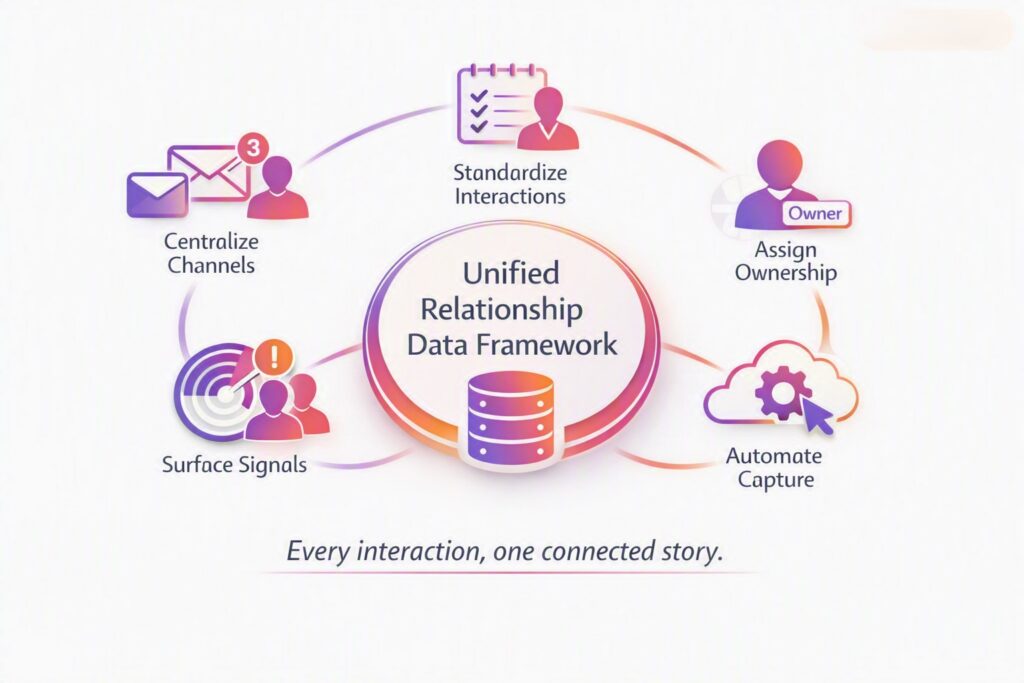
Firms that successfully unify relationship data tend to follow a similar sequence, whether they are doing it manually or through a platform built for it.
- Centralize the channels first. Connect email, calendar, and meeting tools into a single system rather than treating them as three separate records to check individually.
- Standardize what counts as an interaction. Define what gets captured — a reply, a meeting, a missed call — so the unified relationship data record is consistent across every relationship, not just the ones someone happened to track closely.
- Assign ownership to every relationship. Unified data without an owner just becomes a more complete version of the same blind spot. Every relationship needs someone accountable for what happens next, a discipline we outline in how relationship ownership accountability works in practice.
- Automate the capture, not just the storage. The goal is not a bigger archive. It is a system that pulls in email, calendar, and meeting activity automatically, so nothing depends on someone remembering to log it.
- Surface signals, not just history. Once you unify relationship data, the real value comes from what the system does with it — flagging a client who has gone quiet for two weeks, or a referral source whose meeting cadence has slipped, a pattern explored in our guide to relationship decay detection.
What Changes When You Unify Relationship Data
The impact of unifying relationship data shows up quickly once email, calendar, and meeting activity live in one place:
- Continuity survives personnel changes. When a partner leaves or a team member moves on, the relationship history stays with the firm instead of walking out the door — a risk we cover directly in how to manage alumni relationships systematically.
- Decay becomes visible before it becomes revenue loss. A relationship that has gone quiet across email and calendar activity is a signal, not a surprise, once the data is unified.
- Follow-through stops depending on memory. A meeting note that used to sit in someone’s personal file becomes part of a record the whole team can act on.
- Reporting becomes accurate instead of reconstructed. Instead of guessing at “what happened with Acme this quarter,” the answer is already assembled.
Firms that unify relationship data are not just organizing information more neatly. They are closing the exact gap described in QuantmX’s own Relationship Revenue Gap calculator — the annual revenue lost because growth-critical relationships sit outside any system that tracks them.
There is also a compounding effect that shows up over time. Every additional quarter a firm spends without a unified record is another quarter of email threads, calendar events, and meeting notes that eventually have to be reconstructed — or, more often, are simply lost. The firms that unify relationship data early do not just save time going forward; they preserve history that would otherwise be gone the moment a partner changes roles, a team reorganizes, or a client goes quiet for a few months before coming back.
Common Mistakes Firms Make Trying to Unify Relationship Data
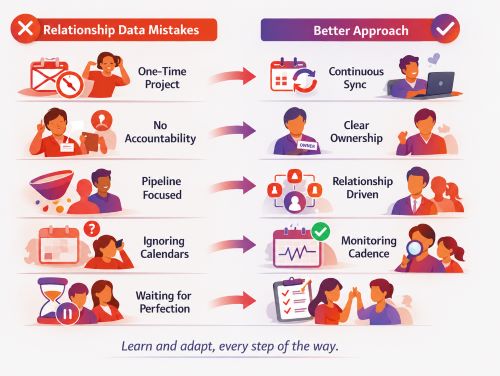
Not every attempt to unify relationship data succeeds. A few patterns show up repeatedly:
- Treating it as a one-time project. Data unification is not a spreadsheet cleanup exercise. New emails, meetings, and calendar events happen every day, so the system has to keep unifying relationship data continuously, not just once at setup.
- Unifying storage without unifying accountability. A single record with no owner just becomes a well-organized version of the same blind spot.
- Choosing a tool built for pipeline, not relationships. Many platforms can unify relationship data for active deals but drop everything else — alumni, referral sources, advisors — the moment a deal closes or stalls, a limitation we explore in what comes after CRM.
- Underestimating how much lives in calendars. Teams often focus on email and meeting notes and forget that calendar cadence is one of the fastest signals of relationship health.
- Waiting for a perfect rollout. Firms sometimes delay unifying relationship data until every team is aligned on process, when the more effective approach is to connect the channels first and refine ownership and workflow as the data starts flowing in.
Avoiding these mistakes matters more than most firms expect, because a half-unified system can feel like progress while still leaving the same relationships exposed. A partial view of email without calendar context, or meeting notes that never get tied back to the relationship record, recreates the same blind spot in a slightly tidier format.
Unify Relationship Data Once, and Let It Work for Every Relationship
The firms that grow fastest are not the ones with the most relationships. They are the ones that can actually see the relationships they already have — across every email, every calendar entry, and every meeting, in one place. When you unify relationship data, you are not just cleaning up a system. You are removing the single biggest reason growth-critical relationships fall through the cracks: nobody could see the whole picture in time to act.
QuantmX was built to unify relationship data automatically, capturing every interaction across email, calendar, and meetings into one continuous record, then surfacing what needs attention before it becomes a lost relationship. If your firm is still piecing together relationship history from three different inboxes and a shared drive, it’s worth seeing what that gap is actually costing you.
Calculate your Relationship Revenue Gap in 90 seconds →
Frequently Asked Questions
What does it mean for a professional services firm to unify relationship data?
For a professional services firm, unifying relationship data means combining every email, calendar event, and meeting note tied to a client, partner, alumnus, or referral source into one continuously updated record — instead of leaving that history split across individual inboxes, personal calendars, and one-off meeting notes.
Why is unifying relationship data harder for professional services firms than for product companies?
Professional services firms run on a wider set of relationships than a typical sales pipeline — clients, referral sources, alumni, advisors, and partners — and most of that activity happens informally, over email and in meetings, rather than inside a structured deal record. Without a way to unify relationship data across those channels, the firm’s most valuable relationships end up living outside any system at all.
Do law firms need to unify relationship data differently than consulting or accounting firms?
The underlying need is the same across law, accounting, and consulting firms: relationship history scattered across email, calendars, and meeting notes. Law firms tend to feel the gap most around referral sources and former clients who could send business again, which is why we cover it directly in how law firms can systematize business development relationships.
How does unifying relationship data help professional services firms retain clients?
When email, calendar, and meeting activity are unified, a drop in contact frequency becomes visible immediately instead of surfacing only after a client has already gone quiet for months. That earlier visibility is what allows a firm to intervene before a relationship decays into churn, a pattern covered in relationship decay detection.
What professional services relationships benefit most from unifying data?
Relationships that sit outside the active pipeline benefit the most — alumni, dormant clients, referral sources, and strategic partners — because these are the relationships professional services firms are least likely to track consistently once a deal isn’t in motion.
Can a CRM alone unify relationship data for a professional services firm?
Most CRMs were built to log transactions and pipeline stages, not to automatically capture the full email, calendar, and meeting history behind every relationship. Professional services firms that rely on CRM fields alone typically end up with a system that unifies data for active deals but drops everything else, a gap explored in why professional services firms are outgrowing their CRM.
How long does it take a professional services firm to unify relationship data?
Centralizing the channels — connecting email, calendar, and meeting tools into one system — can happen quickly, often within days. Building consistent ownership and workflow habits around that unified record takes longer and is best treated as an ongoing discipline rather than a one-time project.
Does unifying relationship data replace the need for relationship owners at a professional services firm?
No. Unified data without an assigned owner just becomes a more complete version of the same blind spot. Professional services firms still need every relationship assigned to someone accountable for the next action, a requirement covered in how relationship ownership accountability works in practice.
What happens to relationship data when a partner leaves a professional services firm?
Without a unified record, a partner’s relationship history typically leaves with them — client context, referral relationships, and informal commitments that existed only in their inbox and calendar. Firms that unify relationship data keep that history with the firm instead, a risk covered in how to manage alumni relationships systematically.
How much revenue do professional services firms lose by not unifying relationship data?
The exact figure varies by firm size and relationship base, but it shows up as the Relationship Revenue Gap — the annual revenue lost because alumni, partners, referral sources, and dormant clients sit outside any tracked system. Firms can estimate their own gap using the Relationship Revenue Gap calculator.
Is unifying relationship data a manual process or an automated one for professional services firms?
Manual consolidation does not scale for professional services firms, given the volume of email, calendar, and meeting activity across a full client and referral network. The firms that succeed automate the capture — connecting the channels directly rather than asking people to log activity by hand.