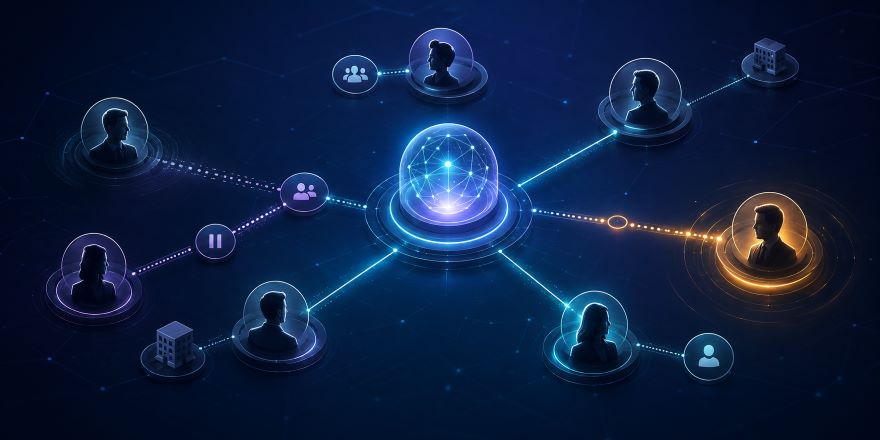
Ask ten partners at a professional services firm to name their most valuable relationships, and you’ll get ten different, incomplete answers — because that information lives in someone’s memory, not in any system. Relationship Intelligence is the discipline built to close that gap: turning a firm’s entire relationship network into something that can actually be seen, measured, and acted on, instead of something that only exists in the heads of the people who built it.
Relationship Intelligence is the practice of capturing, analyzing, and acting on relationship data — interactions, signals, ownership, and history — across a firm’s full network of clients, partners, alumni, and referral sources, so that no growth-critical relationship depends on a single person’s memory.
This guide covers what Relationship Intelligence actually means, why it matters more now than it did five years ago, and how it fits together with the other disciplines — health scoring, decay detection, ownership accountability, and automation — that professional services firms are already building around it.
What Is Relationship Intelligence?
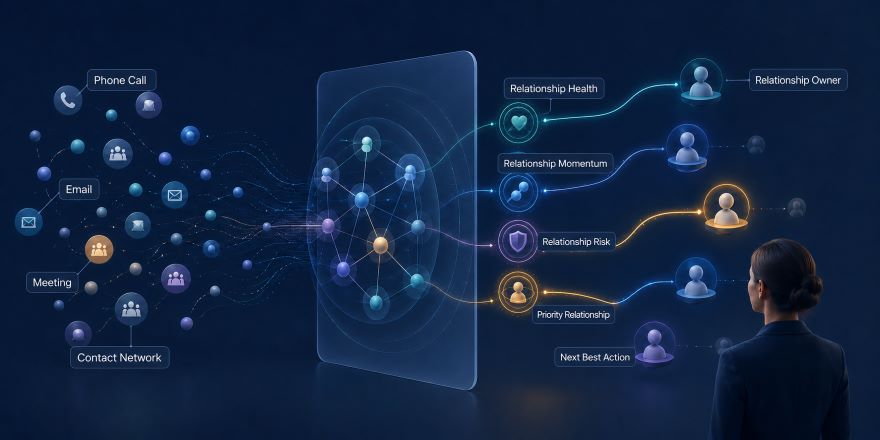
Relationship Intelligence is the layer that sits between raw contact data and an actual decision. A spreadsheet of contacts is data. A CRM pipeline stage is data. This layer is what turns that raw information into an answer to the question every partner eventually asks: which relationships need attention right now, and why?
In practice, this means:
- Capturingevery interaction — calls, emails, meetings — across a firm’s full relationship network, not just active client deals
- Analyzingthat history to surface health, momentum, and risk, rather than just storing it
- Assigningclear ownership so every relationship has a named person accountable for it
- Surfacingthe next best action automatically, instead of waiting for someone to remember to check in
Why Relationship Intelligence Matters for Professional Services Firms Right Now
The case for Relationship Intelligence isn’t theoretical. According to Hinge Marketing’s 2026 High Growth Study, leads from referrals and direct human outreach account for nearly two-thirds of all new business at professional services firms — meaning most new revenue already depends on relationships a CRM was never built to track.
At the same time, the infrastructure most firms rely on is falling behind that reality. Cherry Bekaert’s 2026 industry survey found that 72% of professional services finance and operations leaders cite data integration as their single biggest pain point, and broader research on information silos found that 83% of companies report silos existing internally, with 97% saying those silos actively hurt performance. When two-thirds of growth depends on relationships and the underlying data about those relationships is fragmented across inboxes and calendars, this discipline stops being a nice-to-have and becomes the thing standing between a firm and the revenue it’s already entitled to.
Relationship Intelligence vs. Traditional CRM: What’s Actually Different
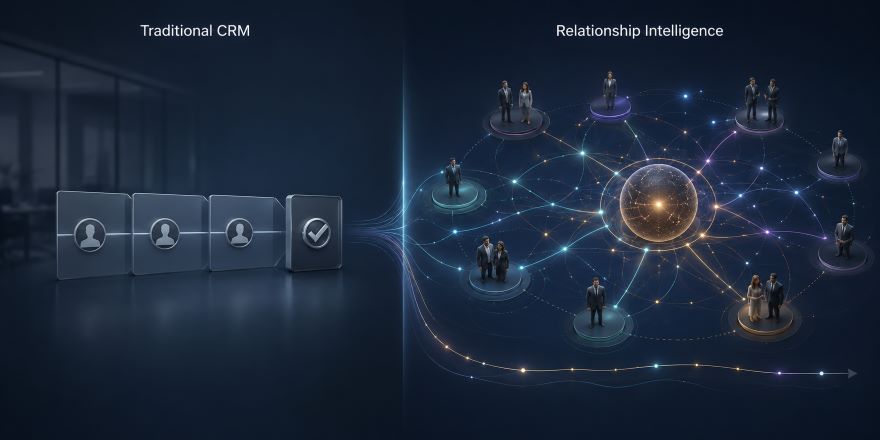
Most professional services firms already own a CRM. Very few have this layer in place, and the difference explains why.
- A CRM tracks contacts inside an active pipeline. This approach tracks the full relationship network — alumni, partners, referral sources, and advisors — long after (or before) they enter any pipeline.
- A CRM is passive: it records what a person types into it. This approach is active: it surfaces signals and next steps without waiting to be asked.
- Time horizon.A CRM’s usefulness typically ends when a deal closes or stalls. It keeps watching a relationship for years, because value in professional services rarely comes from a single transaction.
- Unit of measurement.A CRM measures deals and pipeline stages. This discipline measures Total Relationship Value — the combined worth of every growth-critical relationship a firm holds, not just the ones currently being sold to.
The Core Components of Relationship Intelligence
This system is built from a handful of interlocking disciplines, each of which typically starts as its own practice before firms connect them into one system:
- Unified data capture— pulling interactions from email, calendar, and meetings into a single relationship record, rather than leaving history scattered across individual inboxes
- Health scoring— quantifying how strong or at-risk a relationship currently is, based on recency, frequency, and sentiment of contact
- Decay detection— flagging relationships that are cooling before they go fully cold, rather than discovering the loss after it’s already happened
- Ownership accountability— assigning a named owner to every relationship, so responsibility never depends on who happens to remember
- Automated next steps— surfacing or triggering the right action once a signal fires, so follow-through doesn’t rely on someone checking a dashboard
How Relationship Intelligence Works Inside the Relationship Intelligence Engine
At QuantmX, these components come together inside what’s called the Relationship Intelligence Engine — the layer that turns relationship data into actual momentum. It captures interactions automatically, assigns ownership, surfaces relationships that are losing momentum, and suggests what should happen next, so no growth-critical relationship is left to memory or chance.
This is where the concept stops being abstract and becomes something a firm actually runs on:
- Interactions get captured the moment they happen, the same principle covered in how to unify relationship data across email, calendar, and meetings
- Relationships that are cooling get flagged automatically, a pattern explored in relationship decay detection
- Every relationship gets a named owner, the discipline behind how relationship ownership accountability works in practice
- Low-judgment actions fire on their own, while high-judgment outreach stays with a person — the boundary drawn in automated relationship management
What Relationship Intelligence Looks Like in Practice
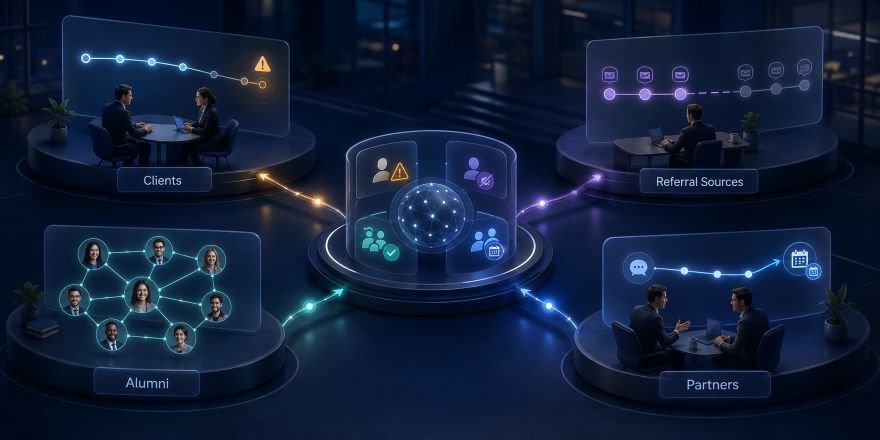
This shows up differently depending on the type of relationship a firm is managing, but the underlying pattern stays consistent:
- With clients, it means knowing which accounts are quietly cooling before renewal season arrives, not after.
- With referral sources, it means noticing when a normally active introducer has gone quiet for a month, rather than months later when the pipeline visibly shrinks.
- With alumni, it means treating former clients and former employees as a live relationship channel rather than a dead contact list.
- With partners, it means making sure a promising conversation, like the ones explored in strategic partner relationship management, doesn’t stall simply because nobody scheduled the next call.
The Cost of Operating Without Relationship Intelligence
Firms without this discipline don’t usually notice the cost directly — they notice the symptoms:
- Senior partners become single points of failure, holding relationship context that exists nowhere else
- Referral pipelines shrink quietlybecause nobody notices when an introducer goes cold
- Alumni networks go untappedeven though they represent some of the lowest-friction growth a firm has access to
- Total Relationship Value stays invisible, because a firm can only measure the revenue sitting inside its pipeline, not the revenue sitting in relationships outside it
This is the exact condition QuantmX calls the Relationship Blind Spot: growth-critical relationships that are outside the system, or inside it but never actively progressed. Both situations quietly cost revenue, and this discipline is built specifically to close that gap.
How to Start Building Relationship Intelligence at Your Firm
Firms don’t need to build every component at once. The rollout that tends to work best follows a sequence:
- Start with unified capture.Get interaction data out of individual inboxes and into one shared relationship record before automating anything.
- Add health scoring next.Once data is unified, scoring relationships by strength and risk becomes possible rather than guesswork.
- Layer in decay detection.Use the health data to flag relationships that are cooling before they go cold.
- Assign ownership formally.Every relationship surfaced by the system needs a named person responsible for the next move.
- Automate the low-judgment layer last.Reminders, task creation, and ownership routing are safe to automate once the underlying data and accountability are already solid.
The Bottom Line
Relationship Intelligence turns a firm’s relationship network from something that exists only in individual memory into something the entire firm can actually see, measure, and act on. Done well, it means senior partners stop being the only ones who know which relationships matter, referral sources stop going quiet unnoticed, and Total Relationship Value becomes a number a firm can actually calculate instead of a rough guess. The firms adopting this now aren’t doing it because CRM software got worse. They’re doing it because the relationships that drive most of their growth were never inside a CRM to begin with.
See how much of your firm’s Total Relationship Value is currently invisible. Calculate your Revenue Gap in 90 seconds →
Frequently Asked Questions
What is Relationship Intelligence in simple terms?
It’s the practice of turning a firm’s relationships — with clients, partners, alumni, and referral sources — into data that can be tracked, scored, and acted on, instead of information that only exists in individual memory.
How is this different from a CRM?
A CRM is generally scoped to active deals and records what’s manually entered. This approach covers the full relationship network, including contacts outside any pipeline, and actively surfaces signals rather than waiting to be checked.
Do law firms need this, or is it just for consulting firms?
Any professional services firm where growth depends on referrals, alumni, or long-term client relationships benefits — law firms are actually among the most exposed, since referral relationships are often the single biggest driver of new business.
What is a relationship health score, and how does it relate to Relationship Intelligence?
A relationship health score quantifies how strong or at-risk a relationship currently is, based on factors like contact recency and frequency. It’s one of the core measurement components inside this broader system.
Can this help with alumni relationship management specifically?
Yes — alumni relationships are one of the clearest use cases, since former clients and former employees are easy to lose track of without a system actively monitoring role changes and re-engagement opportunities.
How does this reduce a firm’s Revenue Gap?
By making relationships outside the traditional pipeline — partners, alumni, referral sources — visible and actively tracked, so they can be counted as part of a firm’s Total Relationship Value instead of quietly disappearing from view.
Is this the same as relationship marketing?
No. Relationship marketing typically refers to broad engagement strategies aimed at audiences. This discipline is about tracking and acting on individual, named relationships at the contact level.
What data does a system like this typically use?
Email, calendar, and meeting history are the most common sources, unified into a single record per contact so a firm can see the full history of a relationship in one place.
How does automation fit in?
Automation handles the repeatable parts — flagging signals, assigning ownership, creating reminder tasks — while judgment calls like outreach strategy and sensitive conversations stay with a person.
Is Relationship Intelligence worth adopting for smaller professional services firms?
Often more so than for larger ones — smaller firms have fewer people available to manually track every relationship, so the cost of one slipping through unnoticed is proportionally higher.
Who should be responsible for this inside a firm?
Ideally, every relationship has one named owner, with a partner or business development lead responsible for the overall system — shared responsibility across a group tends to function the same as no responsibility at all.
What’s the first step to adopting Relationship Intelligence at a firm with no formal system today?
Start by unifying interaction data across email, calendar, and meetings into a single record per relationship. Every other component — health scoring, decay detection, ownership, automation — depends on that foundation being in place first.