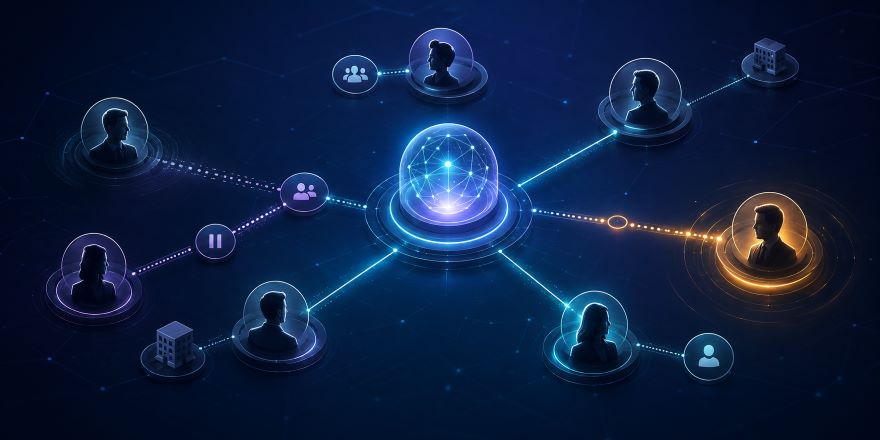
Ask a managing partner how the firm’s doing, and they’ll point to the pipeline. Ask how many relationships outside that pipeline are quietly cooling, and most won’t know — not because the data doesn’t exist, but because no system is built to show it. That gap is the Relationship Blind Spot — the reason most professional services firms are managing a partial revenue picture without realizing it. It isn’t a reporting error; it’s where growth-critical relationships sit unseen, uncounted, and unacted on. This guide breaks down why it forms and what closing it looks like.
What Is the Relationship Blind Spot, and Why Does It Hide Revenue?
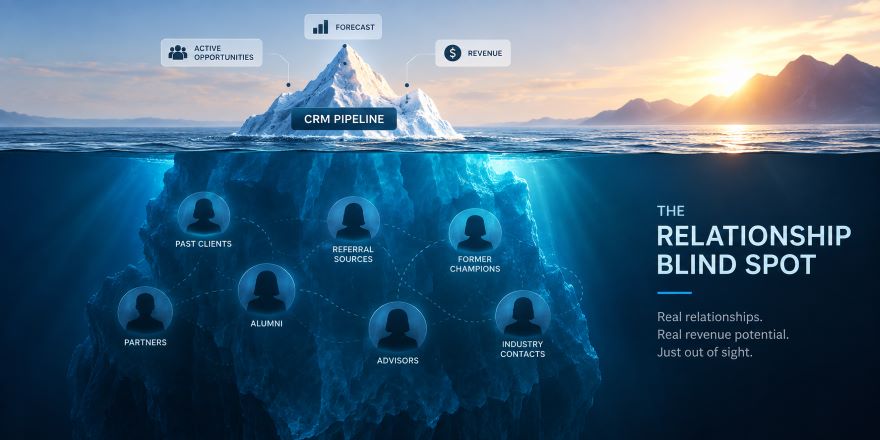
The Relationship Blind Spot is the collection of growth-critical relationships — partners, alumni, referral sources, advisors, even past clients — that exist outside a firm’s active pipeline and therefore outside its financial visibility. A CRM can only report on what’s inside it. If a relationship never formally entered the pipeline, or entered and then stalled without anyone noticing, that relationship’s value is effectively invisible to every dashboard the firm relies on.
This is what makes it so easy to underestimate. Firms don’t see a red flag when a referral source goes quiet or a former client’s champion changes jobs. They simply see nothing at all — the absence of a signal, not the presence of a warning.
The Data Behind the Relationship Blind Spot
The scale of this problem isn’t anecdotal. One study of consulting firms found that 44% of businesses failed to meet their revenue targets due to internal blind spots like poor forecasting and misaligned capacity, and the same research found 86% of leaders believed they had better visibility into their business than they actually did — a gap between confidence and reality that sits at the center of the Relationship Blind Spot problem.
The underlying cause tracks closely to how fragmented firm data typically is. Research on information silos found that 83% of companies report silos existing internally, with 97% saying those silos actively hurt performance. And the revenue actually at stake is substantial: Hinge Marketing’s 2026 High Growth Study found that referrals and direct human outreach account for nearly two-thirds of all new business at professional services firms — meaning the relationships most exposed to this blind spot are also the ones driving most of the growth.
Where the Relationship Blind Spot Comes From
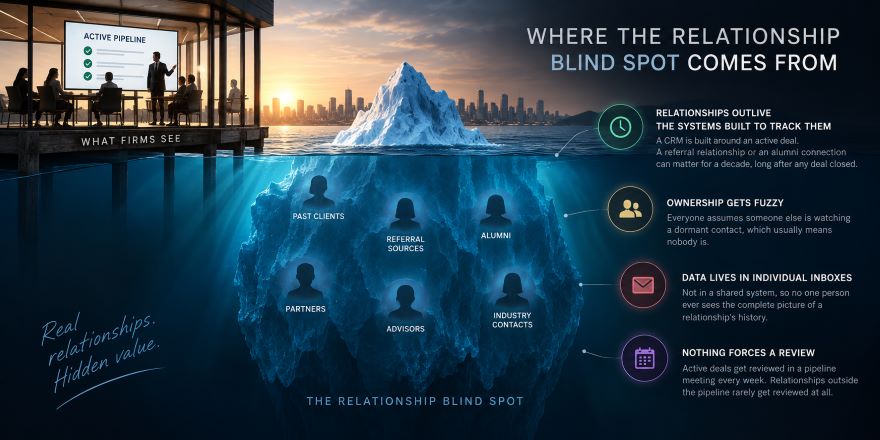
It doesn’t form because firms are careless. It forms because of how professional services relationships actually work:
- Relationships outlive the systems built to track them.A CRM is built around an active deal. A referral relationship or an alumni connection can matter for a decade, long after any deal closed.
- Ownership gets fuzzy the moment a relationship leaves the pipeline.Everyone assumes someone else is watching a dormant contact, which usually means nobody is.
- Data lives in individual inboxes, not in a shared system, so no one person ever sees the complete picture of a relationship’s history.
- Nothing forces a review.Active deals get reviewed in a pipeline meeting every week. Relationships outside the pipeline rarely get reviewed at all.
The Two Faces of the Relationship Blind Spot: Scope and Progression
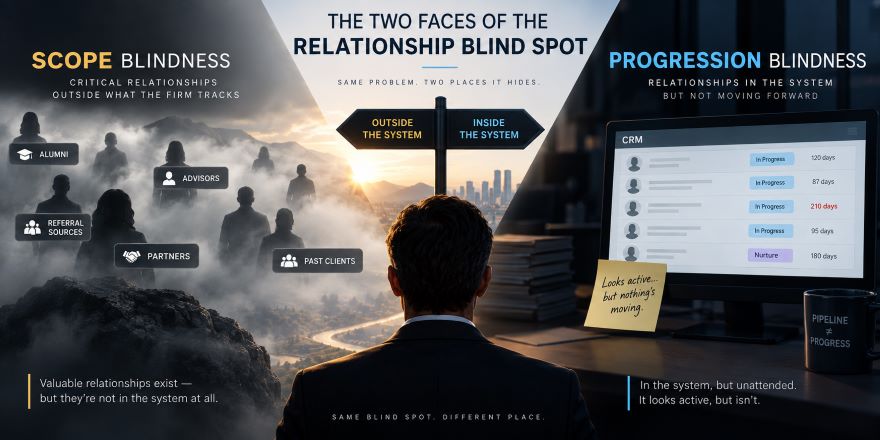
This problem typically shows up in one of two distinct forms:
- Scope Blindness— when a relationship category is entirely outside what a firm tracks at all. Alumni, advisors, and referral sources are the most common victims of Scope Blindness, since most systems were never built with them in mind.
- Progression Blindness— when a relationship is technically inside the system, but nobody is actively moving it forward. A contact sits in a CRM with a stale “in progress” tag for months, which creates the appearance of activity without any real momentum behind it.
Firms often assume that having a CRM means they’ve solved this problem. In reality, a CRM without active review and ownership just relocates the blind spot from “outside the system” to “inside the system, unattended” — which is Progression Blindness in practice.
What a Relationship Blind Spot Actually Costs a Firm
The cost rarely shows up as a single number on a P&L. It shows up as a pattern of quiet, compounding losses:
- Referral pipelines shrinkwithout anyone noticing until new introductions have already slowed to a trickle
- Partner conversations stall after the second call, exactly the pattern explored in strategic partner relationship management, because nobody owned what happened next
- Alumni networks go untappedeven though they represent some of the lowest-friction growth a firm has access to
- Senior partners become single points of failure, holding relationship context that exists nowhere else in the firm
None of these losses are dramatic in isolation. Together, they represent Total Relationship Value that a firm is entitled to but never realizes, simply because it never enters anyone’s field of view.
How to See Past Your Firm’s Relationship Blind Spot
Closing this gap doesn’t require replacing every system a firm already uses. It requires a specific sequence of changes:
- Unify interaction history first.Email, calendar, and meeting data need to live in one place before any signal can be reliably detected — the foundation covered in how to unify relationship data across email, calendar, and meetings.
- Assign a named owner to every relationship, not just active deals, so accountability doesn’t disappear the moment a contact leaves the pipeline — the discipline behind how relationship ownership accountability works in practice.
- Watch for decay signals actively, rather than discovering a cooling relationship only after it’s already gone cold, as covered in relationship decay detection.
- Automate the low-judgment layer, so reminders and next-step routing happen without depending on memory — the boundary explored in automated relationship management.
- Review relationships outside the pipeline on a fixed cadence, the same way active deals get reviewed weekly.
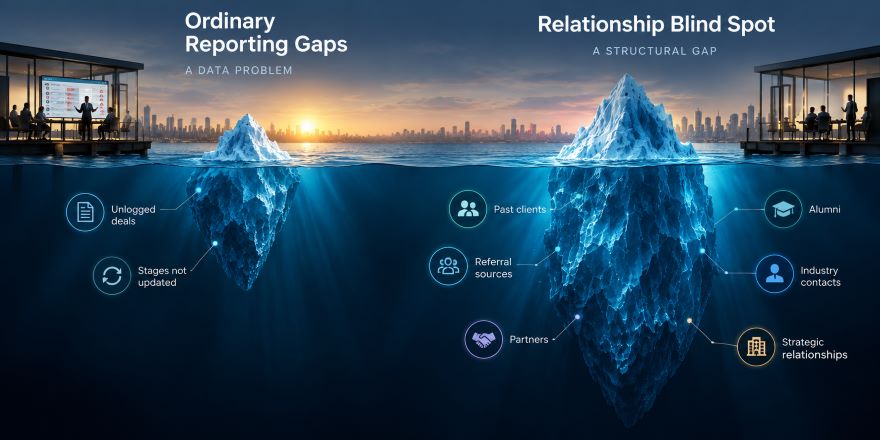
Relationship Blind Spot vs. Ordinary Reporting Gaps: What’s Different
Not every visibility problem qualifies as one, and the distinction matters for how a firm should respond:
- An ordinary reporting gapis usually a data-entry problem — a deal that wasn’t logged, a stage that wasn’t updated. It’s fixable with better CRM discipline.
- A Relationship Blind Spotis structural — the relationship was never designed to be tracked by the system in the first place, so no amount of better data entry into the existing CRM will surface it.
- An ordinary reporting gapcosts accuracy. A Relationship Blind Spot costs revenue the firm doesn’t know it’s owed, because Total Relationship Value sitting outside the pipeline never gets counted at all.
How the Relationship Blind Spot Connects to Total Relationship Value
The Relationship Blind Spot and Total Relationship Value are two sides of the same measurement problem. Total Relationship Value is what a firm’s relationships are actually worth — direct revenue, pipeline potential, and network value combined. The Relationship Blind Spot is the portion of that value a firm currently can’t see. Closing the gap between the two is, in practical terms, what QuantmX’s Revenue Gap calculation measures: the dollar difference between a firm’s realized relationship value and what it’s actually sitting on.
The Bottom Line
The Relationship Blind Spot isn’t a talent problem or a work-quality problem — it’s a visibility problem, and it exists in nearly every professional services firm to some degree, simply because most systems were built to track deals, not relationships. Firms that close it stop discovering lost referral sources after the pipeline has already shrunk, stop losing partner conversations to silence after the second call, and start seeing Total Relationship Value as a number they can actually calculate instead of a rough guess. The firms ahead of this aren’t working harder. They’re simply looking at a fuller picture than everyone else.
See exactly what your firm’s Relationship Blind Spot is costing you. Calculate your Revenue Gap in 90 seconds →
Frequently Asked Questions
What is the Relationship Blind Spot?
It’s the collection of growth-critical relationships — partners, alumni, referral sources, advisors — that sit outside a firm’s active pipeline and therefore outside its financial visibility, so their value never gets tracked or counted.
How is this different from a normal CRM reporting problem?
A reporting problem is usually fixable with better data entry into an existing system. This is structural — the relationship was never designed to be tracked by that system in the first place, so no amount of better entry solves it.
Which professional services firms are most exposed to this?
Any firm where growth depends heavily on referrals, alumni, or long-standing partner relationships is highly exposed — law firms and consulting firms especially, since referral-driven revenue is often the largest and least-tracked part of their pipeline.
What are Scope Blindness and Progression Blindness?
They’re the two forms this takes. Scope Blindness is when an entire relationship category — like alumni or referral sources — is outside the system. Progression Blindness is when a relationship is inside the system but nobody is actively moving it forward.
Can a firm have this even if it already uses a CRM?
Yes — a CRM only shows what’s actively tracked inside it. Relationships that never entered the pipeline, or stalled without anyone noticing, remain invisible regardless of how good the CRM itself is.
How does this affect referral source management specifically?
A referral source can stop sending introductions for months before anyone notices, since there’s rarely a system actively watching for a drop-off in referral activity the way there is for an active deal stage.
Does this affect alumni relationships too?
Yes, often more than any other category — former clients and former employees are the textbook example of Scope Blindness, since almost no CRM was ever built to track them in the first place.
How much revenue does this typically cost a firm?
It varies by firm size and relationship volume, but the pattern is consistent: firms that actively manage only a fraction of their relationships are sitting on a meaningful and calculable Revenue Gap between what they’re capturing and what they’re entitled to.
What’s the first sign a firm has this problem?
A common early sign is a senior partner who can list several client and referral relationships from memory that nobody else in the firm knows exist in any system.
How is this different from Total Relationship Value?
Total Relationship Value is what a firm’s full relationship network is actually worth. The Relationship Blind Spot is the portion of that value the firm currently can’t see or act on.
Can automation fix this problem on its own?
Automation helps close the gap by flagging signals and assigning ownership automatically, but it works alongside unified data and human judgment — it doesn’t replace either one.
What’s the first step to closing a Relationship Blind Spot?
Start by unifying interaction data — email, calendar, and meetings — into a single record per relationship. Every other fix, from ownership to decay detection, depends on that foundation being in place first.