
What Are Relationship Signals and Why Do They Matter?
A client stops replying as quickly as they used to. A referral source hasn’t sent an introduction in two months. A former colleague who left the firm just got promoted somewhere new. None of these events show up on an invoice, and none of them trigger an alert in a typical CRM — but each one is a relationship signal, and firms that can’t see them are making decisions with a piece of the picture missing.
Relationship signals are the early, often quiet indicators that a relationship is strengthening, cooling, or ready for a next step. They rarely announce themselves. They show up as a gap in communication, a change in tone, a job move, or a pattern in how often someone reaches out — and they matter because they’re usually the first evidence a firm gets that something is changing, long before it shows up in revenue.
This guide covers what these signals actually are, why professional services firms miss most of them. .
What Are Relationship Signals?
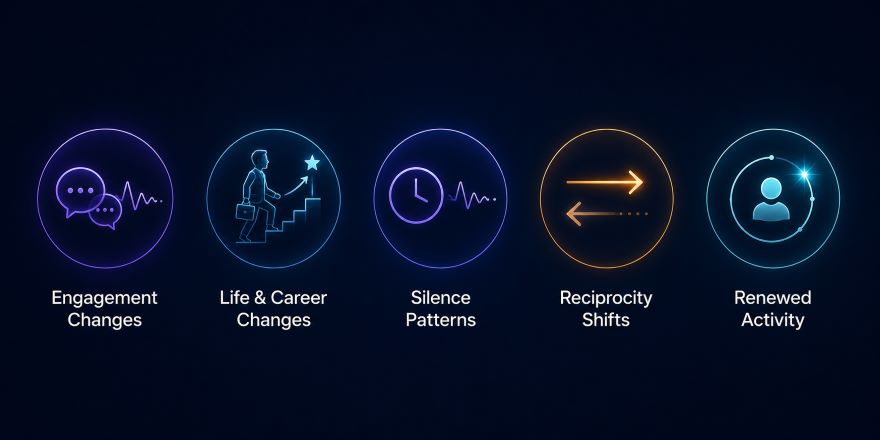
Relationship signals are observable changes in how a client, partner, alumnus, or referral source is engaging with a firm — changes that indicate something about the health or trajectory of that relationship, even when nobody has said so directly. They include:
- Engagement changes— slower email replies, fewer meetings scheduled, shorter calls than usual
- Life and career changes— a champion changing jobs, a client getting promoted, a referral source joining a new firm
- Silence patterns— a contact who used to reach out monthly and hasn’t in ninety days
- Reciprocity shifts— a referral source who used to send introductions regularly and has quietly stopped
- Renewed activity— a dormant contact suddenly opening emails again or reaching out after a long gap
None of these signals alone proves much. Together, and tracked over time, they tell a firm far more about a relationship’s real state than a static CRM record ever could.
Why Relationship Signals Matter for Professional Services Firms
The cost of missing signals isn’t hypothetical — it’s well documented in adjacent research on B2B buyer behavior. According to sales intelligence research compiled by Databar, 87% of buying signals go unnoticed or ignored, and the average sales team takes 42 hours to respond to an inquiry, compared to under five minutes for top performers. If that gap exists for straightforward buying signals inside an active deal, it’s even wider for relationship signals happening quietly outside any pipeline — alumni drifting, referral sources going cold, partners losing momentum after a promising call.
For professional services firms specifically, this matters more than it does almost anywhere else, because so much revenue comes from relationships rather than transactions. A missed buying signal costs one deal. A missed relationship signal — a referral source going quiet, a champion leaving without anyone noticing — can cost years of downstream revenue that never gets attributed to the moment it was actually lost.
The Different Types of Relationship Signals Firms Should Track
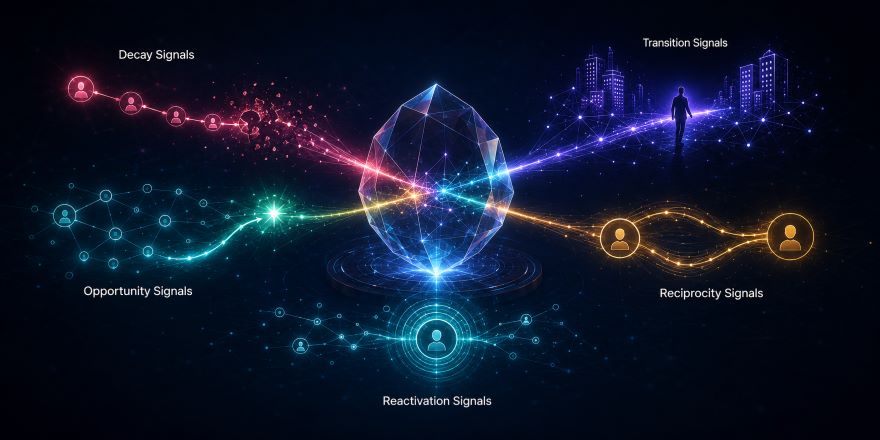
Not all of these carry the same weight, and firms that track them well typically organize them into a few categories:
- Decay signals— indicators that a relationship is cooling, such as declining reply rates or longer gaps between touchpoints
- Opportunity signals— indicators that a relationship is ready for more, such as a client asking a question outside their current scope of work
- Transition signals— a job change, a promotion, a firm move, or a retirement that changes who holds the relationship
- Reciprocity signals— a shift in how much value is flowing in each direction, particularly relevant for referral and partner relationships
- Reactivation signals— a dormant contact re-engaging, which often represents a narrow but real window to reconnect before they go quiet again
Why Relationship Signals Get Missed So Often
The uncomfortable truth is that most professional services firms have the underlying data needed to catch these — it’s just scattered. Email, calendar, and meeting history typically live in separate systems, or in individual inboxes that nobody but the relationship owner can see. A partner who’s cooling on a firm might mention it to three different people across three different channels, and none of those people ever compare notes.
- Data lives in silos.Email, meetings, and notes are rarely unified into one relationship record, so no single signal has enough context to stand out.
- Nobody’s actively watching.Signals only get noticed when someone happens to be paying attention, rather than by a system designed to surface them.
- Ownership is unclear.A signal that fires with no named owner tends to get seen by everyone and acted on by no one.
- The signal expires before anyone reacts.A promising reactivation window or a subtle warning sign often has a short shelf life, and manual detection is almost always too slow to catch it.
How Relationship Signals Turn Into Health Scores and Decay Alerts
These are the raw input. Health scores and decay alerts are what a firm builds once those signals are actually being captured and interpreted:
- A relationship health score is essentially an aggregation of multiple signals — recency of contact, frequency of touchpoints, and sentiment — rolled into a single number that indicates how strong or at-risk a relationship currently is
- Decay detection is what happens when negative signals accumulate past a threshold, the same pattern covered in relationship decay detection
- Ownership accountability ensures every signal that fires actually reaches a person responsible for acting on it, rather than disappearing into a dashboard nobody checks — the discipline behind how relationship ownership accountability works in practice
Without signals being captured consistently in the first place, none of this works — which is why unifying data across email, calendar, and meetings, as covered in how to unify relationship data across email, calendar, and meetings, is the foundation everything else depends on.
What to Do When a Relationship Signal Fires
Detecting a relationship signal is only useful if something happens next. The right response depends on what kind of signal fired:
- A decay signalshould trigger a check-in — a call or a direct message, not an automated email that reads as generic.
- A transition signal, like a champion changing jobs, should trigger outreach to both the new role and whoever now holds that relationship internally, since a job change often opens a new opportunity as much as it closes an old one.
- An opportunity signalshould route to whoever owns the relationship, with enough context to have an informed conversation rather than a cold pitch.
- A reactivation signalshould be treated with urgency, since the window to reconnect with a dormant contact who’s suddenly engaged again tends to be narrow.
The common thread across all four is that a signal should always land with a named person, not just a report — a principle explored further in automated relationship management, where the detection can run automatically but the actual response stays human.
Relationship Signals vs. Buying Signals: What’s the Difference
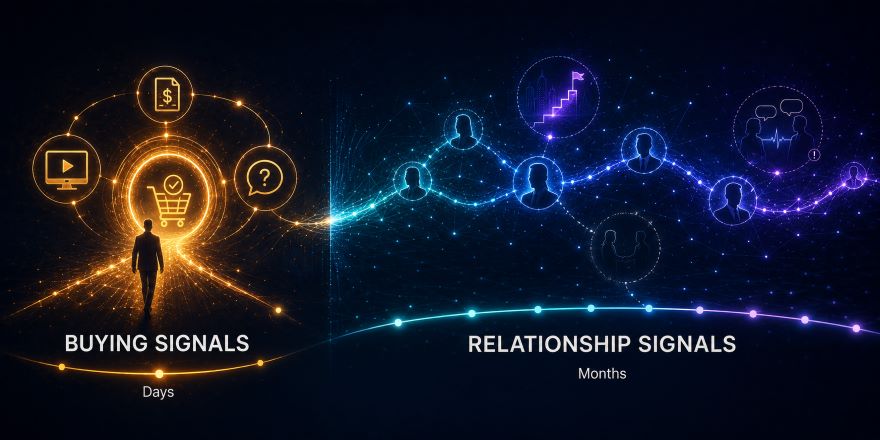
These overlap with buying signals but aren’t the same thing, and the distinction matters for how a firm should act on each:
- Buying signalsindicate a prospect is close to a purchase decision — a pricing page visit, a demo request, a specific product question.
- Relationship signalsindicate the state of an ongoing relationship, whether or not a transaction is anywhere in sight — a referral source going quiet, an alumnus getting promoted, a partner conversation stalling after the second call, as explored in strategic partner relationship management.
- Buying signalstypically expire in days. Relationship signals often unfold over months, which is exactly why they’re easy to miss without a system actively tracking them over time.
How to Start Tracking Relationship Signals at Your Firm
Firms building this capability for the first time generally see better results with a sequenced rollout rather than trying to catch everything at once:
- Unify the data first.Signals can’t be detected reliably if interaction history is scattered across individual inboxes.
- Define which signals matter most for each relationship type.A decay signal for a client looks different from a decay signal for a referral source.
- Assign ownership to every signal category, not just to active deals, so a fired signal always has someone responsible for the next step.
- Set a review cadence.Weekly is typical for active client relationships; monthly is often enough for alumni and dormant referral sources.
- Start with the highest-cost signal type first, usually decay signals on active client relationships, before expanding to partners and alumni.
The Bottom Line on Relationship Signals
Relationship signals are the earliest, most honest information a firm has about the true state of its relationships — long before any of it shows up in a renewal decision, a lost referral, or a quiet exit. Firms that build a system to capture and act on them stop discovering relationship problems after the damage is done, and start catching the quiet moments — a slower reply, a missed introduction, a job change — while there’s still time to do something about it. The firms getting the most value from this aren’t necessarily better at reading people. They’re simply the ones who stopped relying on memory to catch signals a system could be watching for them.
Find out how many relationship signals might already be going unnoticed at your firm. Calculate your Revenue Gap in 90 seconds →
Frequently Asked Questions
What is a relationship signal?
It’s an observable change in how a client, partner, alumnus, or referral source is engaging — a slower reply, a job change, a lapse in introductions — that indicates something about the health or direction of that relationship.
How is a relationship signal different from a buying signal?
A buying signal indicates readiness for a specific purchase decision and tends to expire quickly. A relationship signal reflects the ongoing state of a relationship and can unfold over weeks or months, whether or not a transaction is involved.
Which of these matter most for law firms?
Referral source silence and champion job changes tend to matter most, since so much new business at law firms flows through referral relationships that can quietly stop generating introductions without anyone noticing.
Can these help with alumni relationship management?
Yes — a job change or promotion is one of the clearest examples, and it’s exactly the kind of event that’s easy to miss for alumni relationships that aren’t actively being tracked.
How many does it typically take before action should be taken?
There’s no fixed number, but a single signal is often enough to warrant a check-in, while multiple signals accumulating in the same direction — several missed touchpoints plus a slower reply pattern — should trigger a more direct conversation.
Do these apply to referral sources, or only to clients?
They apply to any relationship type, and referral sources are actually one of the most important places to track them, since a referral source going quiet is one of the easiest signals to miss until the pipeline visibly shrinks.
What’s the risk of ignoring them?
Relationships quietly decay without anyone noticing until the cost is already visible — a lost renewal, a referral source who’s stopped introducing new business, or an alumnus who reconnects with a competitor instead.
How does automation help with tracking these?
Automation can flag when a signal fires — a gap in contact, a job change, a drop in reply rate — so a person doesn’t have to remember to check manually, while the actual response still comes from a person.
Is tracking this only useful for large firms with big client rosters?
Smaller firms often benefit more, since they have fewer people available to manually track every relationship and a proportionally higher cost when a single signal goes unnoticed.
How do these connect to a relationship health score?
A health score is typically built by aggregating multiple signals — recency, frequency, and sentiment of contact — into a single number that reflects how strong or at-risk a relationship currently is.
Who should be responsible for acting on them inside a firm?
Every signal should route to a named owner for that relationship. A signal seen by everyone and owned by no one is functionally the same as a signal nobody saw at all.
What’s the first step to building relationship signal tracking at a firm that doesn’t have it today?
Start by unifying interaction data — email, calendar, and meetings — into a single record per relationship. Signals can’t be reliably detected until the underlying data they depend on is in one place.